
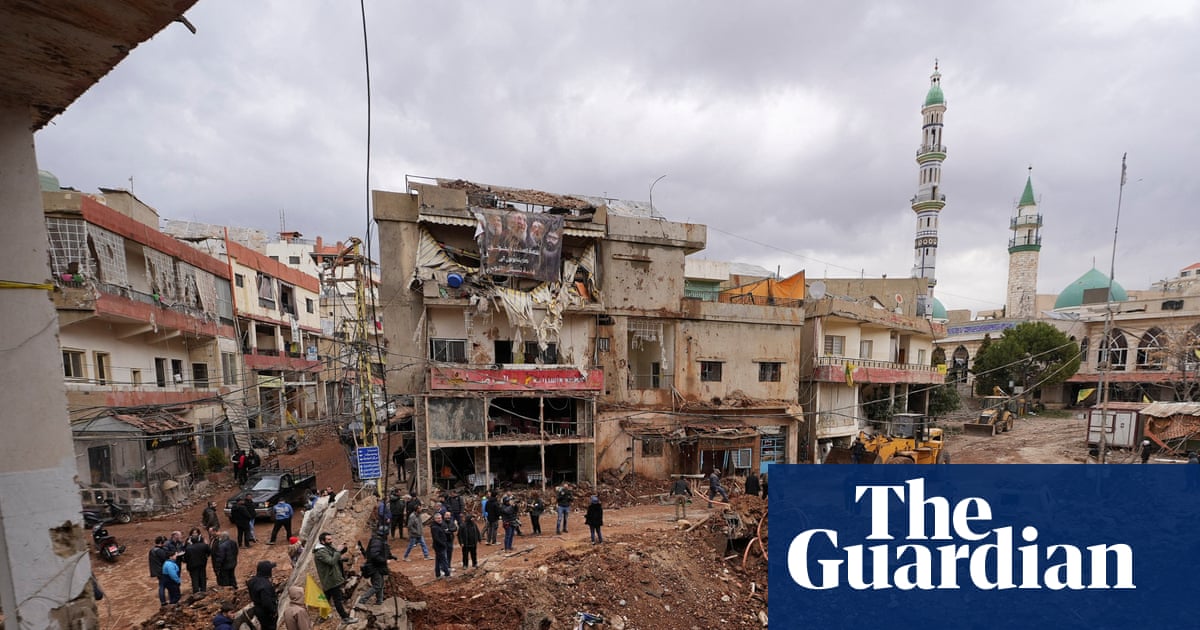
BEIRUT – An Israeli airstrike in the south Lebanese town of Al-Nimiriya killed eight members of the Hamdan family after an evening iftar during Ramadan, part of a military campaign that, since 2 March, has left 773 people dead in Lebanon, including more than 100 children, and driven whole communities from their homes, according to local accounts and officials cited on the ground.
The strike that collapsed the Hamdan family’s two‑storey house wiped out three generations: grandparents Ahmad and Najib, their children, including Batoul Hamdan, and grandchildren Fatima, seven months, and Jihad, three. Neighbours described no prior warning and a blast force that scattered family belongings across the rubble.
The offensive has expanded across multiple regions, reaching deep into Beirut as well as the Bekaa and the south. It has also prompted a sweeping displacement order by the Israeli military for civilians up to 25 miles from the frontier to move north before additional strikes on Hezbollah targets, in a move that Lebanese officials say risks reshaping demographic and political realities in the country’s south for years to come.
Families erased and a town emptied
Batoul Hamdan had moved back to her childhood town of Al‑Nimiriya seeking respite from bombardment in Arab Salim. The family had just finished breaking the day’s fast when the bomb hit. A neighbour and town police officer, Qassem Ayoub, said: “There was no warning before the strike. My own two kids started to cry, I picked them up and started to run away from the explosion when it happened,” adding, “Why were they targeted? I don’t know, ask the Israelis.”
Later, the site held only twisted rebar and concrete. Fragments of family life – a school certificate, cutlery, worn purses – were blown into the open by the blast, as relatives and rescue workers picked through the rubble for bodies and any possessions that could still be salvaged.
Local officials say Al‑Nimiriya, like many frontline communities, has seen most of its residents depart in recent days. Municipal services have largely ground to a halt, and those who remain describe relying on informal networks for food, fuel and medicine as formal relief struggles to reach repeatedly targeted areas.
Casualty clusters in the Bekaa and the south
Forty‑one people were killed by Israeli airstrikes in the Bekaa valley town of Nabi Chit in just five hours. Eighteen people died in a single night in Sir el‑Gharbiyeh on 8 March.
The scale has stunned residents who say they are struggling to keep pace with the mounting death toll and the geographic spread of the strikes. Civil defence teams and local hospitals report that casualty “clusters” – dozens killed or wounded within hours in a single town – are stretching already thin emergency capacity far beyond what was seen in earlier flare‑ups along the border.
Nabatieh: from bustling hub to ghost town
In Nabatieh, a community of about 90,000 people that serves as an administrative centre for much of south Lebanon, repeated airstrikes have emptied streets and shuttered most businesses. “There’s probably only about 150 families left here, the rest have left,” said Ali Hariri, a lawyer and first responder who helps run the Beit al‑Talaba aid organisation. Driving a battered red ambulance with colleague Abbas Fahad, Hariri pointed to a crater where a four‑storey apartment building had stood, saying four people were killed there.
Hariri voiced fear about a possible ground incursion: “We’re worried about tanks coming in of course. They’re talking about invasion. Maybe the Israelis will come all the way to Nabatieh, who knows? I mean, they came to Beirut in 1982.” He said medical facilities were damaged when a building behind the aid centre was levelled, but added, “We won’t leave though – our organisation is meant to help people, so we have to stay.”
As the sound of a warplane grew, he said, “You should leave now, the drone is gone and the jets are coming. That means they found a target to hit,” and jumped back into the ambulance.
Displacement order as rocket fire intensifies
An hour after Hariri’s warning, the Israeli military issued a displacement order covering a wide swathe of south Lebanon, including Nabatieh. People living up to 25 miles from the border were told to move north ahead of strikes on Hezbollah targets. Highways soon clogged with cars heading away from the south, as families weighed the risks of staying in their homes against the uncertainty of becoming displaced.
Analysts said the order was issued to help Israel fight Hezbollah, with which it has been clashing on the ground in the south over the past week. The military has progressively carved off the south from the rest of the country and bombed a bridge over the Litani River, causing it to collapse and effectively cutting one of the main routes between Beirut and the border districts.
Human rights groups said the displacement order was illegal and amounted to forced displacement, arguing that it runs counter to the protections for civilians set out in the Fourth Geneva Convention and customary international humanitarian law governing occupations and armed conflict. Lebanese officials say the directive also undermines the already fragile arrangements put in place after the 2006 war under United Nations Security Council Resolution 1701, which established a buffer zone in south Lebanon and expanded the mandate of UN peacekeepers along the frontier.
The order followed what was described as Hezbollah’s largest volley of rockets into Israel, which injured two people. Israeli officials say the strikes are aimed at degrading Hezbollah’s military infrastructure, while residents and local authorities say homes and civilian infrastructure have borne the brunt of the bombing.
Beirut hit as families flee
In Beirut’s Ramlet al‑Baida neighbourhood, Riyadh al‑Lattah, 57, said he had evacuated his home in the southern suburbs in line with the displacement order, even leaving windows and doors open to lessen the blast risk. A sidewalk about 15 metres in front of him then exploded in the early hours, he said. A second drone strike moments later killed the man he saw writhing on the ground and 11 others.
“This war is harder, because at least last time they’d tell you before they hit. Now it’s just random,” al‑Lattah said, seated beside the family’s tent by the corniche, where sand was still stained with blood. “But I guess I’ll stay here, my house is still under evacuation order.”
Diplomats in Beirut say the strikes in Ramlet al‑Baida and other parts of the capital underscore how quickly the fighting has spilled beyond the immediate border zone, complicating efforts by foreign governments to keep the confrontation contained and to protect their own nationals living or working in the city.
How the fighting escalated – and its scale
Accounts from residents and local officials describe a conflict that began when Hezbollah fired rockets at Israel on 2 March, prompting an Israeli campaign across Lebanon that has already pushed beyond the scope of the 13‑month Israel‑Hezbollah war of 2023-24. Strikes have reached deep into Beirut and displaced about 1 million people from large areas of the country, according to local authorities and aid organisations.
Key figures and timeline:
– Since 2 March: 773 people killed in Lebanon, including more than 100 children.
– Displacement: about 1 million people pushed from their homes.
– Geographic scope: strikes in the Bekaa valley, the south (including Nabatieh), and deep inside Beirut.
– Nabi Chit: 41 people killed in five hours.
– Sir el‑Gharbiyeh: 18 people killed on 8 March.
– Cross‑border fire: Hezbollah’s largest rocket volley into Israel injured two people.
Relative to population, the death toll in Lebanon is equivalent to more than 9,236 people killed in the UK in 11 days, or about 45,600 in the United States – figures intended to give international readers a sense of the intensity of the strikes in a country of roughly 5.5 million people.
‘No place to go’
Al‑Nimiriya’s mayor, Ali Farhat, said Batoul Hamdan had resisted sleeping on the street. He shared a screenshot of what he said were messages she sent a friend shortly before she died.
“I called many numbers but there is no place to go, I don’t want to be on the streets,” one text read. “I’d rather stay and die in my house.”
For many residents of south Lebanon, the choice has been reduced to staying put in homes that may be targeted, sheltering in overcrowded schools and public buildings, or travelling north with little clarity on how long they will be away or who will support them. Local officials say the absence of a nationwide emergency resettlement plan has left municipalities improvising, even as the airstrikes continue.
The Israeli military said people living up to 25 miles from the border with Israel had to move northwards before strikes it would conduct on Hezbollah targets. Lebanese authorities have called for an immediate halt to the attacks and for renewed international efforts to reinforce the ceasefire arrangements and territorial provisions laid out in UN Security Council Resolution 1701, warning that the longer the displacement continues, the harder it will be to reverse.
Worth a look
