
NEW YORK –
Hilton Honors has reopened its targeted status-match channel for 2026, offering an instant upgrade to Hilton Gold for a 90‑day trial and a short, accelerated path to retain or elevate that status by completing a reduced number of paid nights within the trial window. Successful applicants who complete six paid nights during the 90‑day period will have Gold extended through 31 March 2028; completing 12 paid nights will upgrade the member to Hilton Diamond with the same March 31, 2028 expiry. The programme requires applicants to submit proof of competing‑chain elite status and a recent stay as part of the registration process. Award nights do not count toward the night requirements, and stays completed before the status match approval are excluded. The operator will evaluate submissions and return a decision within five to seven business days.
GlobalHeadlinez reporting of the offer’s mechanics and timelines is based on the programme documentation provided with the 2026 status‑match launch. The 90‑day trial, the six‑ and 12‑night retention/upgrade thresholds, the exclusion of award nights, and the requirement that qualifying nights occur after approval are elements stated in the programme materials. The published eligibility language contains a inconsistency between the FAQ-restricting matches to members at base or Silver tiers-and the terms and conditions, which only explicitly exclude current Diamond members. That discrepancy matters for both consumers and corporate travel managers, because it shapes how aggressively travellers can plan around the offer.
How the offer maps to Hilton’s loyalty strategy
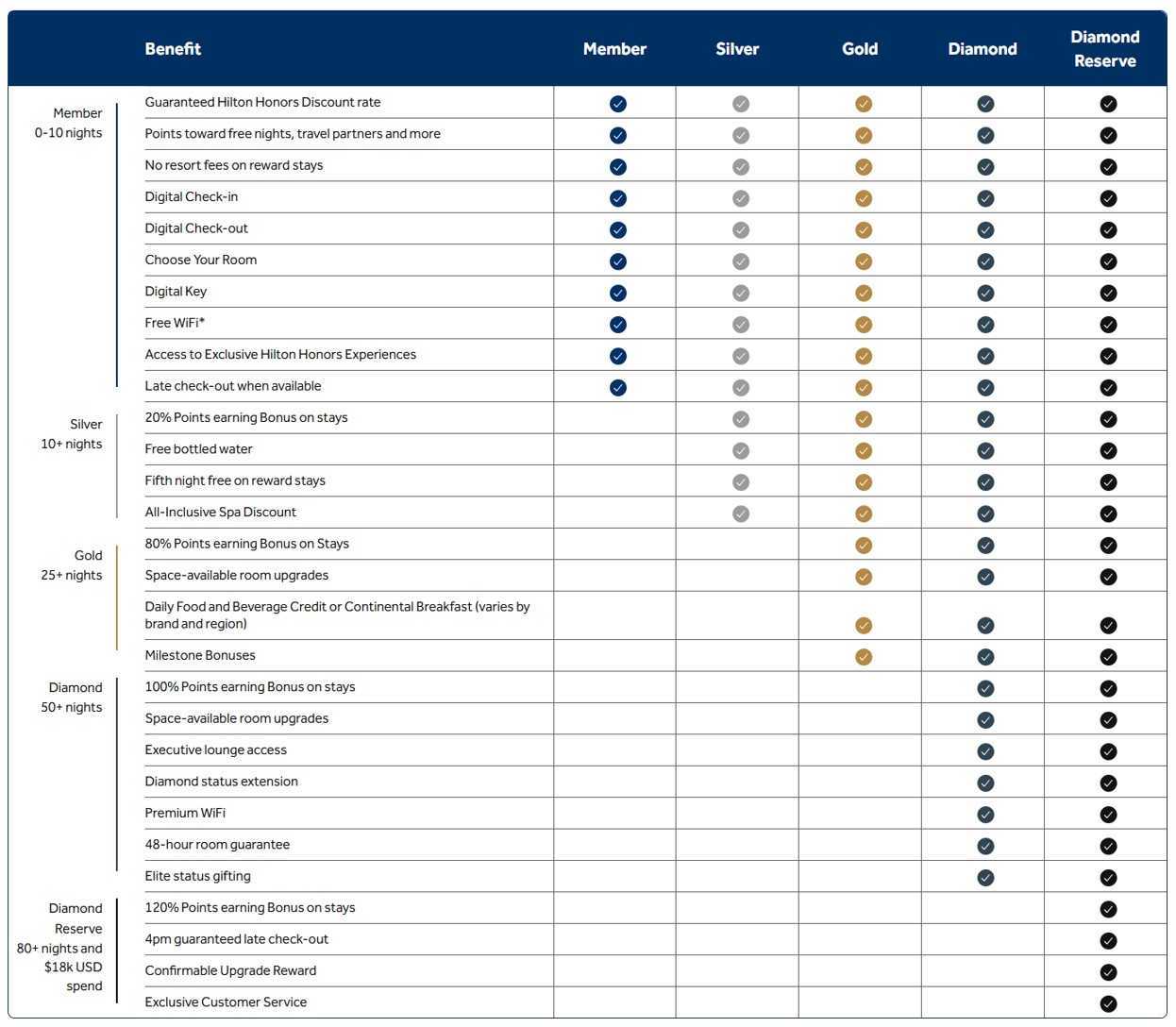
The status‑match programme is part of a broader reconfiguration of Hilton Honors that took effect for 2026. Hilton compressed conventional qualification thresholds for Gold and Diamond and introduced a new top tier, Diamond Reserve, which requires both a large night total and a minimum annual eligible spend. The Diamond Reserve tier is a premium, spend‑weighted status tier that requires 80 nights and US$18,000 of eligible spend to achieve, and the wider 2026 changes shorten the nights or spend paths to the lower elite tiers. These programme changes formalise a two‑track customer segmentation that rewards both frequency and direct spending at the hotel, and they align with how large travel and hospitality companies increasingly segment customers for revenue management and risk oversight.
Hilton is a publicly listed lodging company (NYSE: HLT) with global corporate headquarters in McLean, Virginia. The company operates an owner‑, franchise‑ and management‑led network model and has placed loyalty membership and top‑tier benefits at the centre of its commercial strategy for revenue and market‑share growth. Hilton’s investor relations materials and regulatory filings document membership scale and the company’s strategic emphasis on network growth and higher‑value customer segments, within disclosure standards overseen in the United States by the Securities and Exchange Commission. Those filings also frame loyalty liabilities-unredeemed points and elite benefits-as a balance‑sheet item scrutinised by both regulators and investors.
Commercial and operational implications
For Hilton the programme is a targeted customer‑acquisition and retention initiative executed at low marginal cost: a controlled, time‑limited upgrade that privileges breakfast, space‑available upgrades and late checkout-benefits that increase paid‑stay conversion for higher‑value inventory and can lift ancillary spend. For loyalty economics, the critical levers are (1) converting matched members to paid stays within 90 days, and (2) ensuring incremental spend per stay above break‑even for the incremental benefit cost (food, lounge access, upgrade inventory). Those levers are operationalised through sales channels, distribution availability and front‑of‑house upgrade policy enforcement, and monitored by revenue management teams that balance short‑term occupancy with long‑term brand positioning.
Competing global chains have pursued similar short‑term inducements; the industry practice of temporary status elevation is used to accelerate trial behaviour among customers who already hold status elsewhere. Where those trial offers succeed in generating incremental paid nights they typically reduce marketing acquisition costs and support higher RevPAR through room upsell and ancillary spending. For institutional buyers-such as corporations, travel management companies and large conference organisers-these promotions can alter preferred‑supplier negotiations at the margin by shifting traveller preference within otherwise fixed policy frameworks.
Eligibility, proof and edge cases
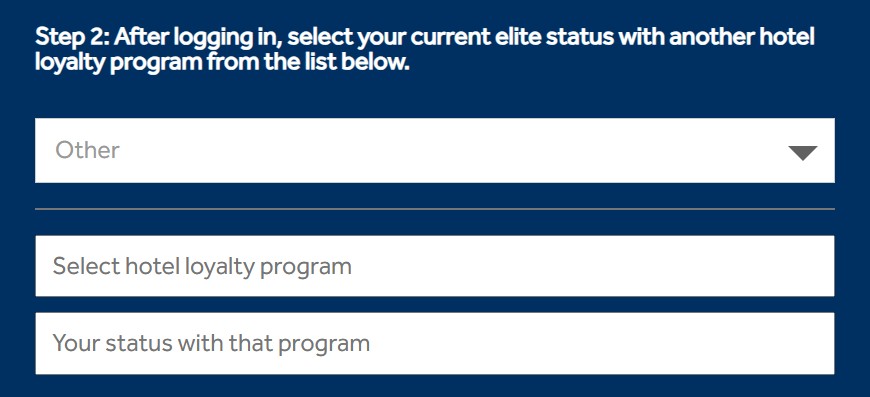
The programme requires two items at application: proof of current elite tier with a competing hotel chain and proof of a recent paid stay with that chain. The programme materials do not rigidly define “recent stay” in the public registration text; past iterations specified one stay within the previous 24 months, but current applicants should treat that interval as unspecified in the registration prompt and supply the most recent eligible stay documentation available. The materials also include an “Other” option for loyalty programmes not listed in the status dropdown, with manual input of programme name and tier. Anecdotal market data and community reporting suggest manual entries have produced mixed outcomes, underscoring that the match remains discretionary rather than entitlement‑based. The operator’s terms reiterate that only paid nights completed after the status‑match approval count toward retention or upgrade thresholds.
Hilton’s published FAQ language indicates the match is intended for members at base or Silver tiers, while the terms and conditions only explicitly bar current Diamond members; applicants should therefore read both documents and, when in doubt, allow time for the programme office to adjudicate prior to travel. (The operator’s stated processing window for applications is five to seven business days.) The programme also excludes award nights from the mini‑qualification pathway. For travellers whose employers reimburse travel under strict policy or compliance controls, these nuances-what counts as a qualifying night and when-can affect both trip timing and budget forecasting.
Competitive workaround and partner dynamics
The registration interface lists a set of participating loyalty programmes eligible for direct dropdown selection. In practice, the presence of an “Other” entry allows applicants to attempt matches from programmes outside the listed set, but historical match conversion from certain regionally concentrated chains has been limited. Market participants have flagged Best Western’s comparatively permissive status‑match policy as a potential indirect route: applicants can secure Best Western status with a minimal proof threshold and then use that status to seek matches elsewhere. That approach remains operationally constrained because at least one paid Best Western stay is still necessary to validate the Best Western status for subsequent matching, and because chains retain broad discretion to accept or decline indirect matches where they perceive gaming risk.
Risk, accounting and investor considerations
Loyalty provisioning and the marginal cost of elite benefits are factors monitored by investors and rated credit markets because sustained structural increases in benefit delivery without corresponding revenue improvements can compress margins. Public company filings and earnings commentary from the last 12 months indicate that Hilton has been balancing investment in product and loyalty with growth expectations and macro sensitivity in travel demand. The company has adjusted guidance and forecasts within recent reporting cycles, reflecting economic uncertainty across markets and the sensitivity of RevPAR to consumer discretionary conditions. Those public disclosures anchor how investors and credit analysts view incremental loyalty costs against potential upside in occupancy and spend per occupied room, and they sit alongside broader post‑pandemic travel‑demand trends that boards and audit committees monitor when approving loyalty‑programme changes.
Practical steps for corporate travel and frequent travellers
Companies that centrally manage travel programmes and frequent travellers should consider timing for applications so that the 90‑day trial overlaps with planned business travel; because only stays after approval count, submitting well before a planned trip reduces operational friction. The programme’s exclusion of award nights means travellers seeking status acceleration must plan for paid room nights in the trial window. Corporate travel managers tracking loyalty‑linked rebates or negotiated rates should update their inventory and traveller guidance to reflect the programme’s timelines and the change in qualifying night thresholds for 2026, and ensure internal policies around personal benefit accrual remain aligned with applicable corporate governance rules and tax guidance. For multinational organisations, that may include coordinating with internal audit and compliance functions to confirm that use of status‑match offers does not conflict with internal controls on hospitality and gifts.

Hilton is accepting status‑match applications for 2026; applicants must supply proof of elite status with a competing chain and proof of a recent paid stay, and Hilton will evaluate submissions and provide a decision within five to seven business days.
For corporate and investor reference, Hilton’s announced Diamond Reserve tier and related Hilton Honors changes sit within the broader disclosure architecture that governs how public companies communicate material strategy shifts to markets; investors will find the underlying programme narrative and financial context in Hilton’s periodic reports and earnings materials filed with the US securities regulator, alongside the company’s own investor relations portal.
