
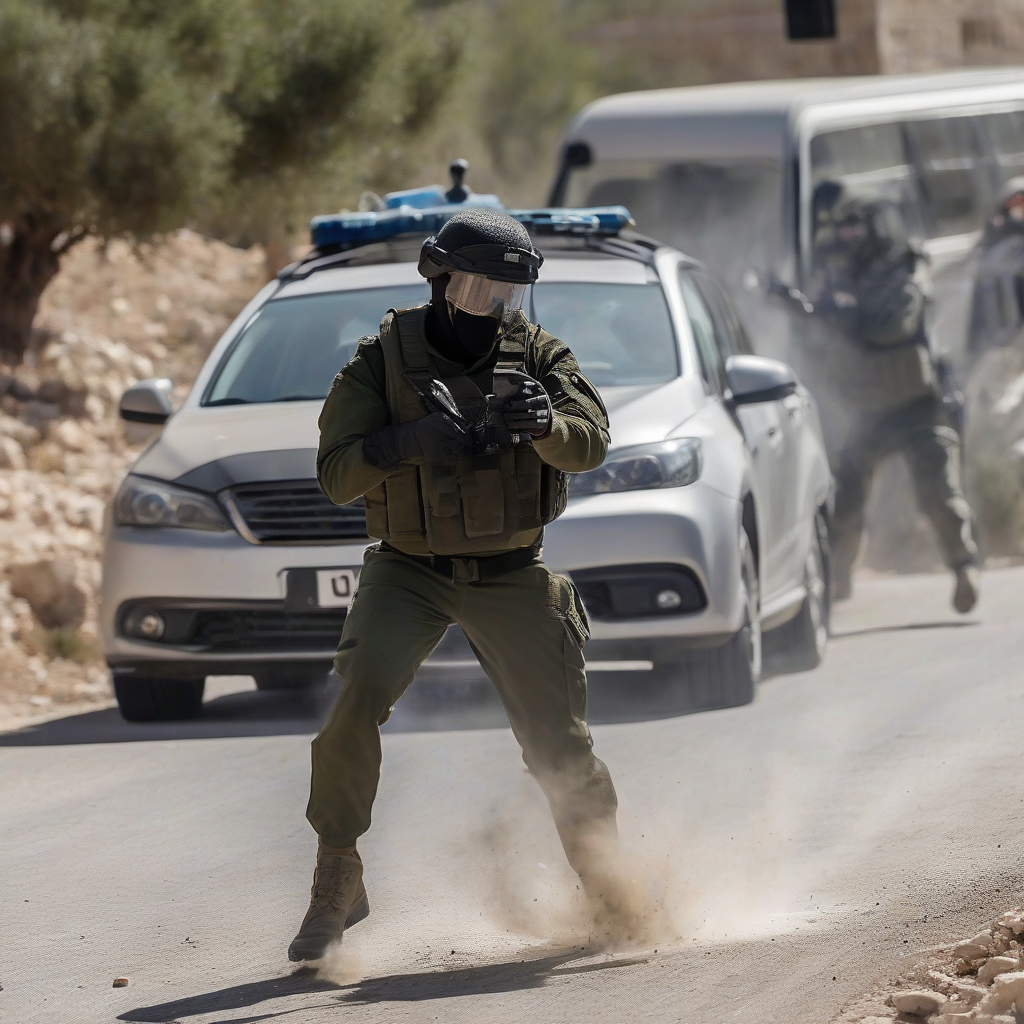
JERUSALEM –Israeli Police have launched an investigation into a border police officer after video footage showed him throwing a stun grenade into a vehicle occupied by young Palestinians during a raid on the Qalandiya refugee camp in the occupied West Bank.
The incident, captured on CCTV and released by the human rights organization B’Tselem, has drawn scrutiny toward the conduct of security forces during operations in Palestinian territories. The footage serves as the primary evidence in a case that now involves the justice ministry’s department for the investigation of police officers, the civilian oversight body responsible for probing alleged misconduct by law enforcement.
Investigation into Use of Stun Grenade
The released footage shows a border police officer approaching a car and shouting at the occupants. Following a brief exchange, the officer is seen reaching for his belt, retrieving a stun grenade, and throwing it through an open door. As the driver attempted to exit the vehicle, the officer pushed the door shut.
During the encounter, the officer is heard shouting: “Shut your mouth. Who are you talking to like that?”
The grenade detonated inside the vehicle, filling the interior and immediate area with smoke. Two passengers were seen scrambling out of the car through the opposite side. The footage further indicates that the officer appeared to fire his rifle as the individuals ducked for cover. B’Tselem confirmed that all occupants of the vehicle survived the encounter, though the full extent of their injuries was not immediately known.
Police officials stated that the officer acted “not in accordance with procedure.” The officer has been suspended from duty pending the outcome of the investigation being conducted by the justice ministry. Under Israel’s basic legal framework, security forces are required to adhere to strict rules of engagement and proportionality in the use of force, particularly in civilian areas.
Stun grenades are categorized as non-lethal weapons designed to disorient targets through a high-intensity flash and a deafening blast. However, medical and safety guidelines indicate they can cause serious injury or permanent damage when detonated in confined spaces or at close range, raising questions over whether their deployment inside a vehicle can be reconciled with existing policing protocols.
Casualties in Qalandiya Refugee Camp
The grenade incident occurred during a broader military raid on the Qalandiya refugee camp, a dense urban enclave near Jerusalem that has frequently been the focus of Israeli arrest operations. According to the Palestinian health ministry, the operation resulted in several casualties:
- Walid Abu Sneineh: A 16-year-old boy who was shot and killed by Israeli forces.
- Other Palestinians: Three individuals were wounded during the raid.
- Children: Two children were injured after being shot in the lower limbs.
The Israeli military did not provide an immediate response to requests for comment regarding these specific casualties or the circumstances in which live fire was used. Rights advocates say the lack of prompt, detailed public accounting in such cases has contributed to growing concern about transparency and command responsibility.
Medical Access and Checkpoint Delays
In a separate incident, the family of a four-month-old Palestinian baby, Ahmad Marouf Zaid, reported that the infant died after Israeli forces blocked their vehicle at a checkpoint.
The family stated they were attempting to reach a waiting ambulance when they were denied passage. Consequently, they drove the severely ill infant via unpaved and mountainous back roads to reach Ramallah, a detour that delayed medical treatment by more than an hour.
An IDF spokesperson denied the allegations, stating that forces did not block the family from crossing to seek medical aid. The episode has reignited debate over how Israel’s network of checkpoints in the West Bank affects access to emergency healthcare and whether current procedures adequately safeguard the right to life and medical treatment under international humanitarian norms.
Patterns of Civilian Deaths in the West Bank
The recent events in Qalandiya and Ramallah follow a pattern of lethal encounters in the region. This includes the death of 15-year-old Amir Ahmad Jaber, who was killed during an Israeli military raid in Ramallah.
Data provided by the United Nations regarding civilian fatalities in the occupied West Bank since 2020 shows:
- Total Palestinian civilians killed by Israeli soldiers and settlers: At least 1,175.
- Demographics: At least 25% of those killed were children.
- Legal outcomes: No charges have been filed over any of these deaths.
The figures have intensified international scrutiny of Israel’s use-of-force policies in the occupied territory and the effectiveness of domestic accountability mechanisms. Human rights lawyers note that repeated failures to secure indictments in fatal cases risk undermining both Israeli and international confidence in internal investigations.
Yuli Novak, the executive director of B’Tselem, has linked these incidents to systemic issues.
“The widespread and unprecedented killing of Palestinian children and teenagers in the West Bank is the result of a broader Israeli policy that allows the killing of Palestinians and violent abuse against them without any accountability.”
The officer involved in the stun grenade incident remains suspended while the justice ministry’s department for the investigation of police officers continues its review of the case. The outcome will be closely watched by diplomats, legal experts, and rights groups as a test of whether individual disciplinary measures can signal a broader shift in how Israeli authorities oversee and constrain the use of force in the occupied West Bank.
Related reading
