
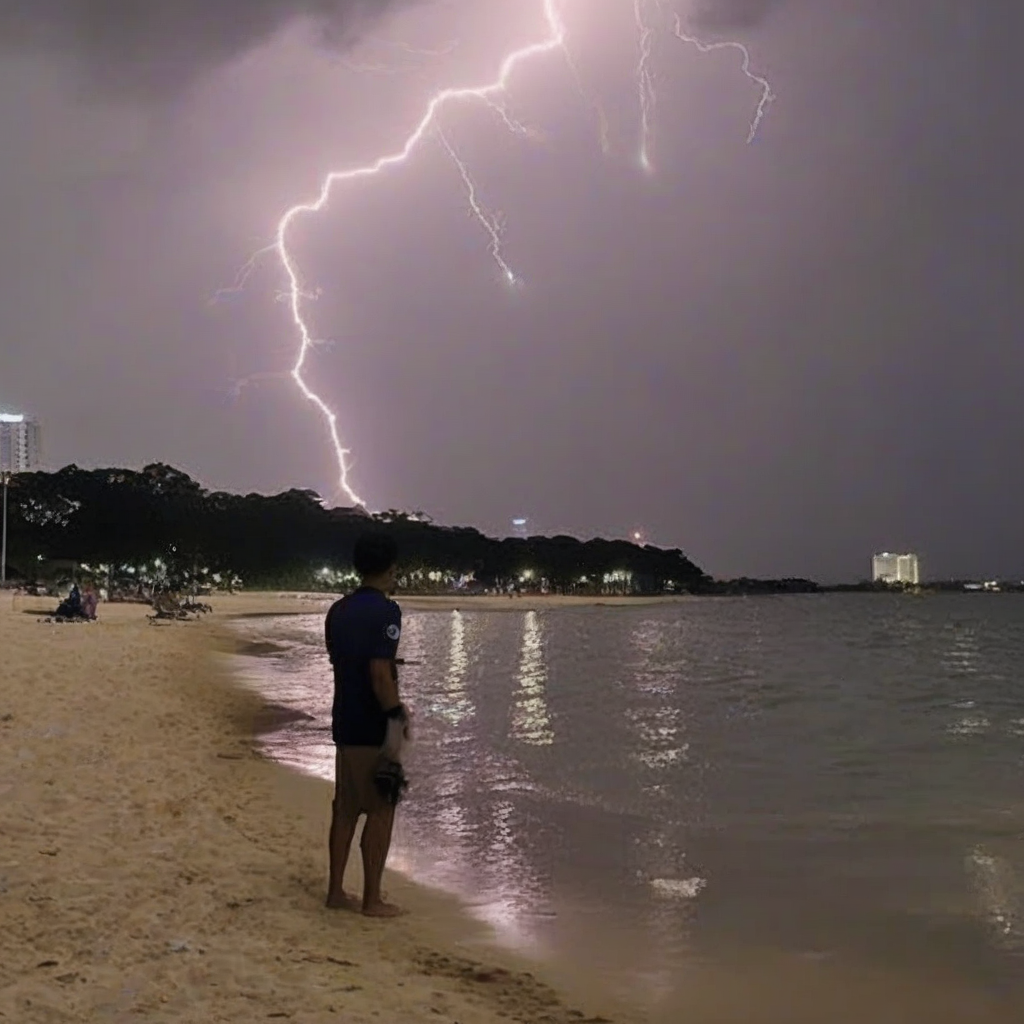
SINGAPORE – A 24-year-old certified kayaking instructor died after being struck by lightning while on the waters off Pasir Ris Beach on July 5.
Mikhail Benyamin was out with his family when the strike occurred. He was brought to shore unconscious and transported to Sengkang General Hospital, where he later passed away.
The incident has prompted reflections on the inherent risks of outdoor adventure activities in Singapore, even for those with professional training and certification.
Emergency Response at Pasir Ris Beach
The strike occurred while Benyamin was using a stand-up paddleboard. Six other individuals, aged between 13 and 54, were also in the water and were taken to the hospital conscious. All were believed to be part of the same recreational outing.
Mohammad Nordin, owner of the nearby kayak rental shop Fish On, reported that several kayaks capsized immediately following the strike, describing a “sudden flash” followed by cries for help. Benyamin’s younger brother, who was part of the group, swam to shore to seek assistance from beachgoers and staff at the rental shop.
Nordin and members of the public assisted in dragging the kayaks to the beach and moving Benyamin from his paddleboard onto the grass in a safer area away from the waterline. Bystanders administered cardiopulmonary resuscitation (CPR) until an ambulance arrived approximately 15 minutes later.
The group’s equipment on July 5 included:
- One stand-up paddleboard (used by Benyamin)
- Three kayaks (a mix of single-seat and tandem)
Authorities are expected to review CCTV footage and eyewitness accounts as part of routine investigations into serious incidents in public coastal areas.
Professional Background and Community Impact
Benyamin worked as a freelance instructor for the water activities company SeaOPS and conducted courses for its sister companies, Camp Challenge and Outdoor Adventures. He was certified to lead groups in coastal waters and had worked with schools, corporate clients and youth groups.
Andrew Chua, the founder of SeaOPS, described Benyamin as a dedicated and promising instructor who was “well-liked by participants and colleagues alike.” Chua clarified that Benyamin was not conducting a corporate or student course at the time of the incident, but was engaging in a family activity under the company’s “work-life integration” practice, which allows instructors to use equipment and facilities for personal recreation.
A former secondary school friend, who asked to remain anonymous, remembered Benyamin as a humble individual who spent his time doing what he loved in the outdoors, and said news of his death had “shocked and saddened” former classmates.
Outdoor operators said the incident has rippled through Singapore’s close-knit adventure education community, where practitioners routinely manage weather-related risks but rarely see fatalities. Some providers indicated they are reviewing internal protocols and training refreshers for staff in the wake of the accident.
Water Safety, Regulation and Meteorological Warnings
At the time of the incident, there were no Category 1 warnings or sirens active. Category 1 warnings are issued by the Meteorological Service Singapore, part of the National Environment Agency, when there is a high risk of severe thundery showers and lightning strikes in the immediate area. Such alerts are fed into risk assessments by professional outdoor operators and event organisers.
Under Singapore’s broader workplace safety framework, including the Workplace Safety and Health Act, commercial adventure operators are required to put in place systems to identify and mitigate environmental risks for staff and participants. Industry players say lightning risk management – from pre-activity checks to evacuation procedures and communications – is now central to standard operating procedures for sea-based programmes.
Delane Lim, secretary-general of the Outdoor Learning and Adventure Education (OLAE) Association, stated that while stand-up paddleboarding is increasingly popular, all practitioners must adhere to strict safety standards, regardless of whether the activity is commercial or recreational. Lim added that incidents involving professionals underline that “nature risk is never zero” even when protocols are followed.
The OLAE Association, the largest body for outdoor education in Singapore, emphasizes the following risk management protocols for water-based activities:
- Conducting risk assessments based on weather forecasts and lightning alerts before embarking.
- Prioritizing on-site professional judgment over forecasts if observed conditions indicate higher risk, including early suspension of activities when thunder is heard or skies darken rapidly.
- Maintaining continual situational awareness to manage dynamic outdoor environments, with clear contingency plans to return groups to shore quickly.
Lim noted that no single checklist can entirely eliminate the risks associated with the outdoors, stating that “good preparation” and “sound professional judgment” are essential, alongside public awareness of how fast conditions can change in tropical climates.
Regional Lightning Activity
The death of Benyamin follows another significant weather-related event on June 24, when a lightning strike triggered a fire near Pulau Ubin. That incident affected at least two floating fish farms and caused serious damage, though no injuries were reported. Singapore, located near the equator, records some of the world’s highest lightning densities, and coastal users are frequently reminded to monitor skies and heed advisories, especially during the inter-monsoon and monsoon seasons.
Police have stated that no foul play is suspected in the death of Mikhail Benyamin. The case has been classified as an unnatural death, and investigations into the circumstances surrounding the lightning strike are ongoing.
Worth a look
