
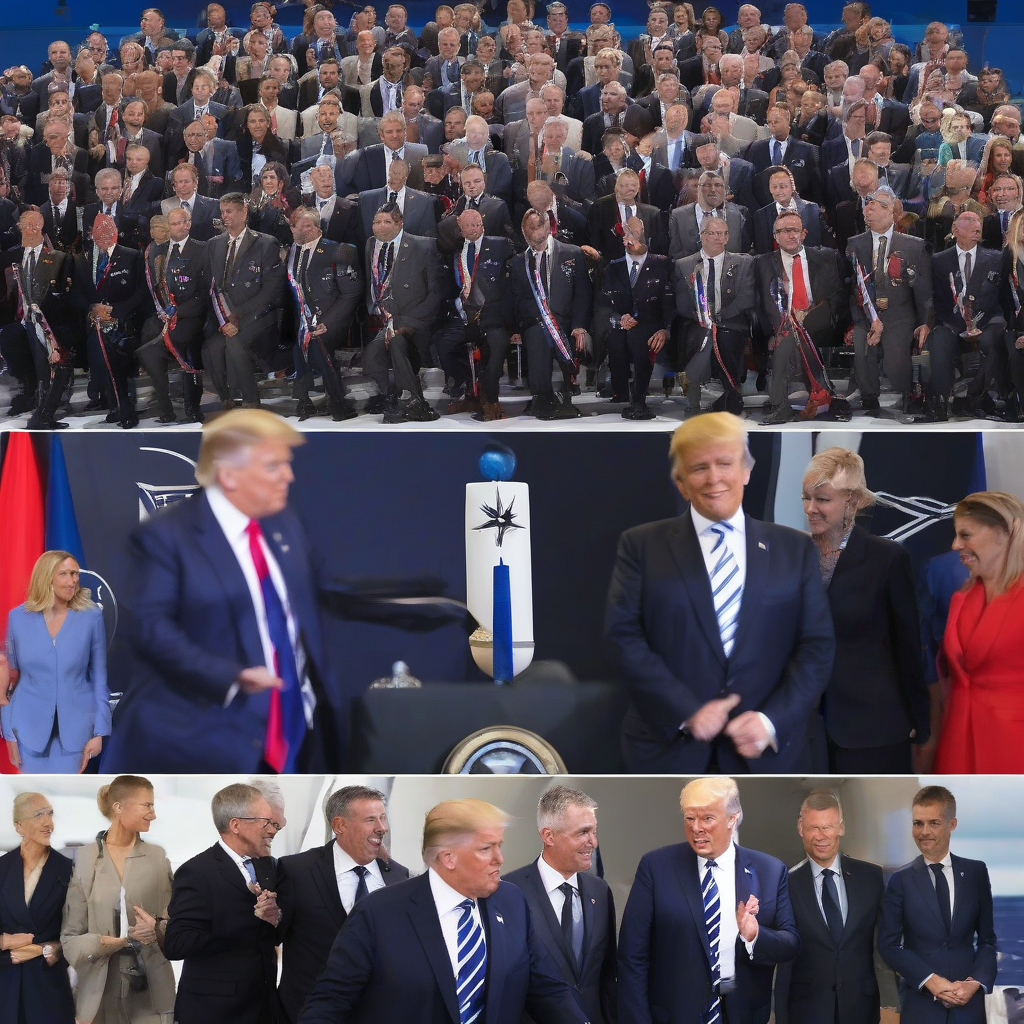
ANKARA – Donald Trump concluded a two-day NATO summit in Ankara, Turkey, by declaring a state of “unification” and “tremendous love” among Western leaders, following a morning of public grievances regarding defense spending and military cooperation.
The gathering, intended as a “delivery summit” to solidify defense pledges, was dominated by the U.S. president’s erratic messaging. While a final declaration reaffirmed the alliance’s collective defense commitment under the North Atlantic Treaty, the event highlighted deep fractures over the U.S. role in the alliance and specific diplomatic disputes with European partners.
Grievances and the Iran Conflict
The final day began with a lengthy monologue by the U.S. president alongside NATO Secretary General Mark Rutte. Trump aired a series of complaints against the alliance and its individual members, focusing heavily on what he portrayed as a lack of support for recent U.S. military actions against Iran and its regional proxies.
Trump described the leadership of Iran as “scum” and expressed frustration that alliance members “didn’t want to help us with the number one state sponsor of terror, that’s Iran.” This criticism referred to a refusal by most European countries to permit the U.S. to conduct public bombing missions from European airbases, underscoring longstanding European concerns about escalation in the Gulf and the legal basis for any strikes.
The president specifically targeted the United Kingdom, citing a delay in the use of RAF Fairford in Gloucestershire. Although British Prime Minister Keir Starmer eventually allowed limited attacks on Iranian missile sites, Trump remained critical of what he cast as an overly cautious approach from a core NATO ally.
“The United Kingdom wouldn’t let us use the island for two weeks, so we had to fly back,” Trump said, revisiting complaints he had made against Starmer earlier in the spring. The dispute added to wider questions inside the alliance about how far European governments are prepared to align operational decisions with Washington’s more confrontational stance toward Tehran.
Disputes Over Greenland and Defense Spending
The summit also saw a renewal of tensions between the U.S. and Denmark over the self-governing Arctic territory of Greenland, which holds growing strategic value for missile warning systems, shipping routes and resource access as the polar ice melts. Trump reiterated his claim that the territory “was very important for the United States, but it’s not important for Denmark,” calling the situation a “big problem for us.”
Danish Prime Minister Mette Frederiksen rejected the notion, stating upon her arrival that Denmark would defend “every inch” of its own territory and asserting that Greenland “was of course not for sale.” Her comments echoed Denmark’s insistence that decisions about the island rest primarily with its home-rule government in Nuuk and that allied interest must be channeled through existing NATO and bilateral arrangements.
Trump further criticized the alliance’s financial contributions. Despite a prior agreement for members to raise national defense budgets to 3.5% of gross domestic product by 2035, Trump claimed the U.S. pays “far, far too much” and again framed the burden-sharing debate as a test of political will rather than economic capacity.
“Billions and billions of dollars, too much, because it’s unfair, because we’re protecting them, so we protect them, but they’re not there for us,” Trump said. His remarks went beyond NATO’s long-standing 2% of GDP guideline and put additional pressure on finance ministers and legislatures across Europe already wrestling with post-pandemic fiscal constraints.
Pressure on Spain
Madrid became a primary target of the president’s ire due to Spain’s decision to reject the 3.5% GDP spending target, even as Spanish forces contribute to deployed missions on NATO’s eastern flank and in the Mediterranean.
Trump told Rutte, “Spain doesn’t agree to anything, and you shouldn’t carry them.” He then turned to U.S. Treasury Secretary Scott Bessent and stated, “I don’t want to do any trade with them, all right?” to which Bessent replied, “Yes, sir.” The offhand threat to link alliance contributions with trade relations underlined how quickly security debates can spill into economic policy, unsettling markets and businesses that rely on stable transatlantic rules.
However, the president’s position shifted later in the day. While speaking to reporters aboard Air Force One, he stated that Spain “came back all the way today” and described the country as “very generous.” Spanish officials did not immediately clarify whether that referred to a revised spending trajectory, additional military contributions, or political support for new NATO initiatives.
Shift Toward Alliance Unity
The atmosphere shifted during a private meeting of 32 NATO leaders in the late morning. During this session, Trump omitted previous criticisms of Denmark and Greenland, instead telling allies, “we want to remain with you.” Diplomats present said the conversation moved away from public recriminations toward drafting language on deterrence and long-term industrial cooperation.
This softer tone continued during a bilateral meeting with Ukraine’s Volodymyr Zelenskyy. Trump described the gathering as a “great meeting” with “a lot of love in that room, a lot of unity.” During this meeting, the U.S. president made a surprise offer to license the manufacturing of Patriot air defense missiles-advanced surface-to-air missile systems-directly to Ukraine, a step that would deepen Kyiv’s long-term integration with Western defense supply chains and potentially ease pressure on U.S. stockpiles.
The summit concluded with a press conference where Trump praised Turkish President Recep Tayyip Erdoğan and discussed the U.S. economy, while claiming he was “No 1 on TikTok.” For Ankara, which has sought to leverage its geography between Russia, the Middle East and Europe, the successful hosting of the summit was also an opportunity to showcase the Turkish capital’s role as a diplomatic hub beyond its more frequently visited cities such as Istanbul or Cappadocia.
“If there’s one word that comes out of today it’s unification,” Trump said at the end-of-day press conference.
Summit Outcomes and Military Contracts
Despite the diplomatic volatility, the summit produced several tangible military and political agreements that will shape allied planning and procurement over the next decade:
- Article 5 Affirmation: A final declaration signed by Trump and 31 other leaders affirmed an “ironclad commitment” to Article 5, the treaty provision stating that an attack on one member is an attack on all. The language is symbolically important for frontline states that have pressed Washington to restate its security guarantees in the face of Russian aggression.
- Arms Contracts: More than $50 billion in international arms contracts were announced, ranging from air and missile defense to munitions and cyber capabilities. Officials said the deals are intended both to replenish stocks drawn down for Ukraine and to expand Europe’s own industrial base.
- Deep Strike Missile Project: A 12-country commitment was established to develop deep strike missiles with ranges between 300km and more than 2,000km. The program is designed to give NATO greater ability to hold adversary assets at risk from distance, though diplomats stressed that any future deployments would comply with applicable arms control obligations.
Secretary General Mark Rutte attempted to manage the president’s volatility through flattery, comparing Trump’s efforts to increase European defense spending to the goals of President Dwight Eisenhower. “You did what [President Dwight] Eisenhower tried to do,” Rutte said. “It’s your win.” The remark reflected NATO’s longstanding concern that allied commitments be seen as domestically sustainable in Washington as well as in European capitals.
No date has been announced for the next leaders’ summit, which is scheduled to take place in Albania. The announcement comes amid anti-government and anti-Trump protests in the country, with indications that the meeting may not occur until 2028. Albanian officials say they remain committed to hosting, but the delay underscores how domestic political pressures can complicate even routine alliance calendar decisions, from summit logistics to the ratification of new defense plans. For travelers and observers looking beyond the immediate drama of the Ankara gathering, guides to the Turkish capital now stress its growing portfolio of political and cultural venues alongside older historic sites and neighborhoods.
Related reading
- Urban Infrastructure Resilience: How European and Asian Megacities Are Adapting to Extreme Climate Oscillations in 2026
- UN General Assembly 2026 Framework on Autonomous Systems: International Diplomacy Faces Algorithmic Governance
- Trump Proposes Camp David-Style Presidential Retreat at Florida Golf Club (archyde.com)
- Jay Clayton named White House AI czar by Trump to lead task force (globallypulse.com)
