
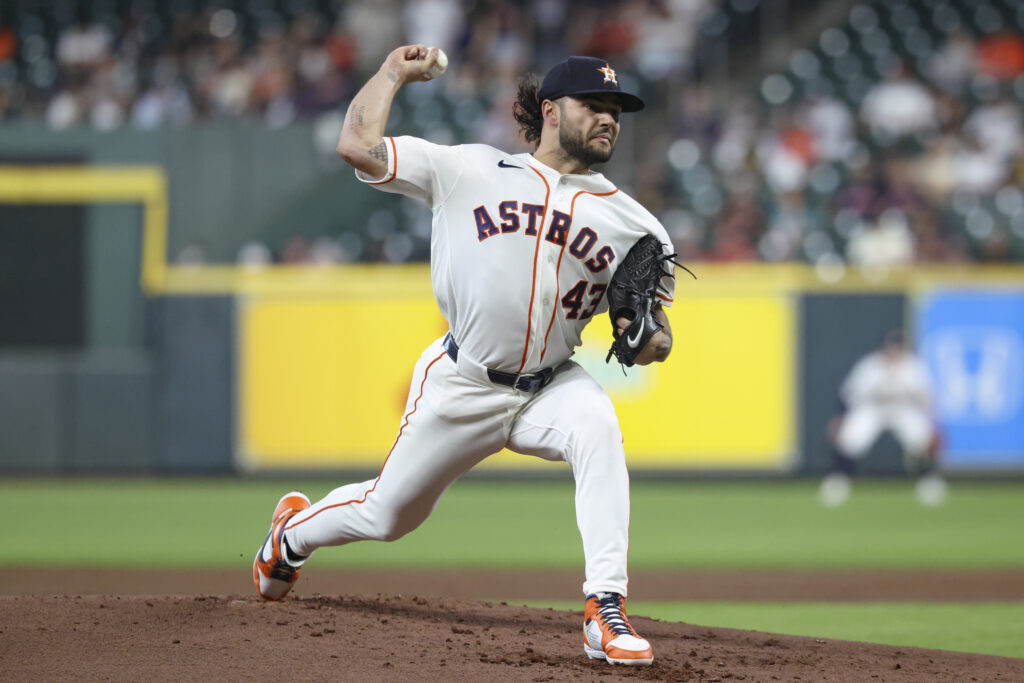
Brewers Bet on Pitching Lab and Payroll Flexibility in Complex McCullers-Gordon Deal with Astros
The Milwaukee Brewers are moving to stabilize a battered pitching staff with a trade for right-hander Lance McCullers Jr. and left-hander Colton Gordon from the Houston Astros, a deal that blends short-term risk with longer-term upside and notable payroll maneuvering.
Milwaukee is reportedly finalizing the agreement and will assume an as-yet-undisclosed portion of the salary remaining on McCullers’ contract while acquiring Gordon, a 27-year-old left-hander with minor league options and multiple seasons of club control. Houston’s return package has not been revealed, but indications are that it does not involve any of the Brewers’ most prominent prospects. The trade has not yet been formally announced.
Salary Relief for Astros, Rehabilitation Project for Brewers
For Houston, the move is fundamentally financial. McCullers is earning $17 million in the final season of a five-year, $85 million extension that included a full no-trade clause. He has agreed to waive that protection to facilitate the switch to Milwaukee.
The right-hander, now 32, has not pitched since May 13 because of a shoulder issue and has struggled for effectiveness when available. He began a minor league rehabilitation assignment on June 25 and has made three solid appearances, but his recent major league track record has been well below his earlier standard. Since the start of last season, McCullers has posted a 6.65 ERA over 94 2/3 innings and is still owed roughly $6.672 million of his current salary.
Moving even a portion of that commitment gives the Astros a measure of flexibility as they approach the Aug. 3 trade deadline under the financial and competitive framework of Major League Baseball’s Competitive Balance Tax system. Houston’s CBT payroll sat at $238,329,588 before this transaction, placing the club just $5.67 million below the first tax threshold-an area where ownership has historically shown caution.
Houston has exceeded the threshold twice in the past, and proximity to that line has previously shaped high-profile decisions, including trades that moved established players. Shedding part of McCullers’ contract eases pressure on the front office as it looks for bullpen help and a left-handed-hitting outfielder in the weeks ahead, while also resolving how to accommodate McCullers’ roster spot once his rehab assignment expires.
From Rotation Anchor to Injury Puzzle
The gamble for Milwaukee is built on McCullers’ track record before a prolonged series of injuries. From 2015-21, the 2012 No. 41 overall draft pick logged 671 innings for Houston with a 3.57 ERA, a 26.6% strikeout rate, a 9.7% walk rate and an elite 55.5% ground-ball rate. Even in an injury-shortened 2022 season, he delivered a 2.27 ERA over 47 2/3 innings in eight starts and has compiled a 3.47 ERA in 72 2/3 career postseason innings, underscoring his role in October runs during the Astros’ sustained contention window.
That version of McCullers, however, has been eroded by repeated arm issues. He missed the entire 2019 season following Tommy John surgery, did not debut in 2022 until Aug. 13 because of flexor problems, and then opened 2023 on the injured list with renewed flexor trouble that culminated in surgery to repair his right flexor tendon and remove bone spurs from his elbow.
Since returning to action in 2025, his stuff has backed up materially. McCullers’ sinker has averaged 91.4 mph-down from the 94 mph he flashed prior to his flexor and shoulder setbacks. The consequences show up across his profile: swinging-strike and strikeout rates have declined, opponents’ contact rate has climbed, and the quality of that contact has spiked. Since last season, opposing hitters have averaged 90.9 mph in exit velocity against him with a 50% hard-hit rate, compared with a combined 88.8 mph and 35.2% over the 2015-22 period.
For a Brewers team renowned for its pitching development infrastructure, that degradation is both a red flag and an opportunity. Milwaukee’s pitching group has earned a reputation for squeezing value from arms acquired at modest cost, helping unlock or revive performance from pitchers such as Quinn Priester, Kyle Harrison, Tobias Myers, Trevor Megill, Joel Payamps, Bryan Hudson and Bryse Wilson in recent seasons.
If the “pitch lab” can restore some of McCullers’ movement and deception, even without a full velocity rebound, Milwaukee could uncover mid-rotation value or a high-leverage relief option from a contract that, for Houston, had become largely a sunk cost. If not, the Brewers retain the option to use McCullers as a bullpen piece or, in the most pessimistic scenario, treat part of his contract simply as the acquisition cost for Gordon.
Gordon Brings Years of Control and Roster Flexibility
While McCullers’ name and résumé headline the deal, Gordon is arguably the more strategically important asset for Milwaukee. The 6-foot-4, 225-pound left-hander has only 95 1/3 major league innings, including 9 1/3 this season, over which he has been hit hard: a 5.95 ERA, a below-average 19.3% strikeout rate but an excellent 5.1% walk rate. The issue has been the long ball. Gordon has been too vulnerable to home runs, a problem not helped by the short left-field porch at Houston’s Daikin Park, even though he has generally avoided extreme hard contact.
The surface numbers obscure a more stable Triple-A record. Across parts of four seasons at the top minor league level, Gordon has recorded a sub-4.00 ERA in each of the last three years. In 285 innings for Houston’s Triple-A affiliate in Sugar Land, he holds a 3.85 ERA with a 21.8% strikeout rate and 7.5% walk rate, suggesting a pitcher with a reasonable command foundation and enough stuff to compete in a starting or swing role.
Originally taken in the eighth round of the 2021 draft, Gordon deploys a five-pitch mix. His four-seam fastball averages 91.1 mph, complemented by a sinker (91.4 mph), slider (81.1 mph), changeup (83.8 mph) and curveball (75.5 mph). In the majors he has been hit hard by both right- and left-handed batters, but his minor league body of work shows a stronger record against lefties and respectable numbers against right-handers; in 2024, he held hitters on both sides of the plate to an OPS below .700 across 123 1/3 Triple-A innings.
From a roster-building standpoint, Gordon’s remaining minor league options and service-time status matter almost as much as his pitch mix. He is in the second of his three option years, enabling Milwaukee to move him between the big league club and Triple-A Nashville this season and next without exposing him to waivers.
Entering 2026, Gordon carried 112 days of MLB service and has since added 14. If he accrues 46 more days on the active roster or injured list this year, he will reach one full year of service and be under club control for five further seasons, through 2031. If his remaining time in the majors is 45 days or fewer, he will fall short of that threshold and remain under team control for six full seasons, through 2032. How Milwaukee manages his usage in the second half will therefore shape both his arbitration trajectory and the long-term cost structure of the pitching staff.
Brewers Respond to Rotation Crisis with Layered Depth
The timing of the move reflects a rotation under strain in Milwaukee. The Brewers’ starting group has absorbed several significant blows:
- Quinn Priester recently underwent thoracic outlet surgery and will not pitch again this season.
- Kyle Harrison, whose 2026 emergence mirrored Priester’s 2025 breakout, was placed on the injured list a week ago after pitching through elbow discomfort for several starts.
- Brandon Woodruff has been excellent when available, posting a 2.98 ERA over nine starts, but he returned from the injured list only to make three outings before recurring symptoms forced a move to the 60-day IL.
Those setbacks have thinned both the major league rotation and the upper levels of the minor league depth chart. At present, the staff is fronted by Jacob Misiorowski, who is performing at a level that places him firmly in the National League Cy Young conversation, but the certainty drops quickly behind him.
Logan Henderson, a top-100 prospect, has opened his major league career effectively, yet he has only 53 2/3 innings at this level. Brandon Sproat, another recent top-100 arm, has stabilized after a difficult start to the year, and left-hander Robert Gasser has been “good more often than not” despite a 5.24 ERA that is heavily influenced by a seven-run outing on July 12 in his first full season back from Tommy John surgery.
Shane Drohan, acquired from Boston along with Harrison in February’s Caleb Durbin trade, has stepped in impressively, but he is a 27-year-old making his debut season in the majors. The collection of promising but inexperienced arms underlines why Milwaukee was willing to add both a veteran with postseason pedigree and a controllable left-hander who can move up and down as needs dictate.
In that context, McCullers and Gordon serve two different columns on the depth chart. Either could claim a spot in the rotation once McCullers completes his rehab assignment; both could also be deployed more flexibly, with McCullers transitioning to the bullpen if his stuff plays better in short bursts and Gordon shuttling between the majors and Triple-A to cover innings, matchups or injury gaps.
Astros Rebalance Payroll While Staying in the Market
On the Houston side, the trade is a modest but meaningful realignment of financial obligations at a time when the club wants to add rather than subtract from its major league roster. With CBT obligations just under the first threshold, owner Jim Crane’s history of operating close to but often below that line has been a recurring backdrop to roster decisions. Removing part of McCullers’ deal from the books gives the front office more room to address identified needs in the outfield and bullpen without crossing into tax penalties.
There is also a roster-management dimension. With McCullers already on a rehab assignment, his activation would have forced a 26-man and 40-man decision in short order. By moving him now, the Astros convert a future dilemma into additional flexibility to plug specific holes as they pursue postseason positioning under the structure of the 162-game Major League Baseball schedule.
Trade as a Starting Point for Both Clubs’ Deadline Plans
Both organizations are expected to remain active between now and the Aug. 3 deadline. For Milwaukee, this move is unlikely to be the only step taken to support a roster that is contending in the National League while leaning heavily on young starters. Beyond pitching depth, the Brewers are also surveying options for a right-handed bat and potential upgrades on the left side of the infield.
Houston, meanwhile, is pursuing left-handed power for its outfield mix and additional relief options. By creating CBT breathing room and clearing rotation and 40-man space, the Astros are better positioned to engage in those markets without being constrained by payroll thresholds or roster logjams.
The McCullers-Gordon trade, then, is less a standalone blockbuster than an early, complex move that reflects how modern MLB front offices operate within a framework of performance risk, financial regulation and long-term control. For the Brewers, it is a calculated wager that their development apparatus can once again extract value from a distressed asset while banking a controllable left-hander. For the Astros, it is a step toward rebalancing a payroll and roster shaped by years of deep postseason runs and the financial structures that govern the league.
Related reading
