
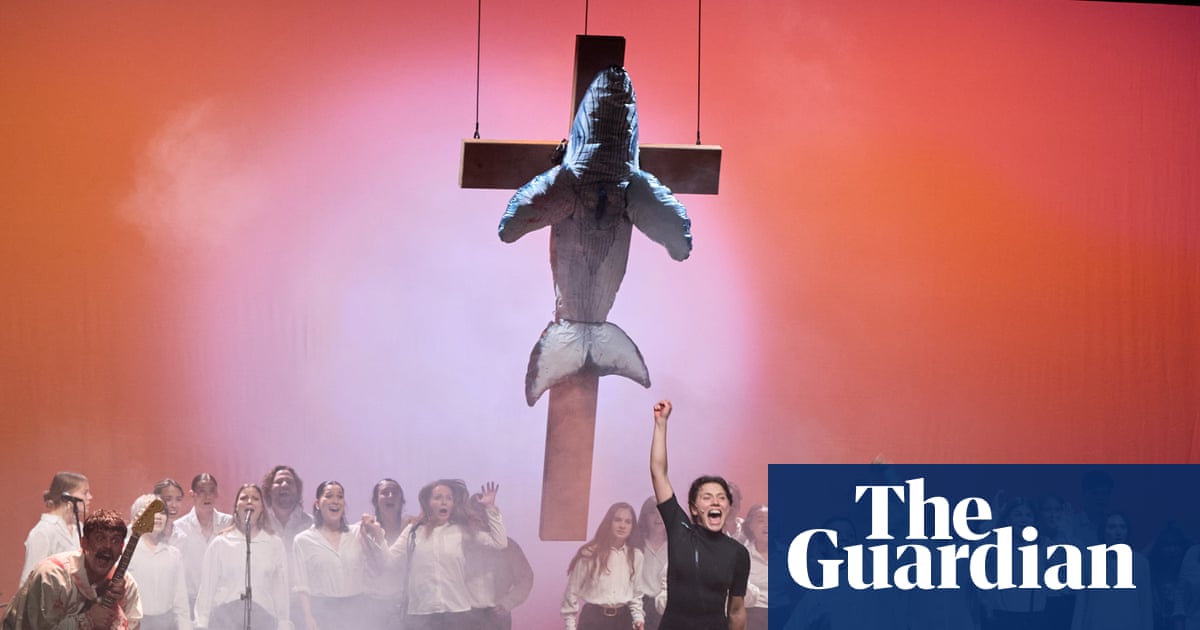
HAMBURG – A satirical production now playing in Hamburg is casting a critical light on one of Germany’s most surreal public obsessions of the past year: the rescue mission of a stranded humpback whale that evolved from a conservation effort into a proxy for national political division.
The play, Timmy: Hope Dies Last, which premiered last Saturday at the Ernst Deutsch theatre, reimagines the events surrounding a whale stranded on the Baltic coast in April 2026 as a modern passion play. By framing the animal’s struggle through a lens of quasi-religious devotion, the production explores how a country grappling with economic anxiety and deep political fractures projected its collective desperation onto a dying mammal.
The phenomenon reflects a broader global trend where ecological crises are increasingly filtered through populist sentiment, often pitting emotional “common sense” against scientific expertise. In Germany, this friction has aligned closely with the rhetoric of the far-right Alternative für Deutschland (AfD), which frequently frames institutional expertise as an instrument of an out-of-touch elite.
The Anatomy of a Spectacle
The whale, first spotted in March off the upscale Baltic resort of Timmendorfer Strand on the Bay of Lübeck[2], quickly became a national lightning rod. Originally nicknamed “Timmy”-a name that later proved to be a misgendering of the female cetacean-the animal was also referred to as “Hope,” a moniker that captured the emotional stakes for the crowds that gathered on the shore.
Timmy: Hope Dies Last portrays this gathering not as a rescue mission, but as a pilgrimage. The play features a scene where actor Noah Tomiak, dressed in liturgical robes behind an altar featuring a blow-up replica of the whale, delivers a monologue on the animal’s role as a spiritual vessel.
“In his immeasurable kindness he became a vehicle to us,” Tomiak says in the play. “And we placed everything inside: our fears, our guilt, our desires, our loneliness. And while we said: ‘We have to save him,’ it was maybe already the other way around: maybe he came to save us.”
The production incorporates raw audio snippets from interviews with people who descended on Timmendorfer. These recordings reveal a level of anthropomorphism that bordered on the mystical, with one woman stating, “I felt like he was waiting for me, I can’t explain it but he wanted me.”
Science vs. Sentiment
The “Timmy” saga highlighted a growing chasm between biological reality and public expectation. Marine biologists and experts warned that the whale was severely injured and unlikely to survive, advising that the most humane course of action would be to let the animal die in peace.
Those recommendations collided with the political and legal framework that governs interventions in German coastal waters. Any decision to sedate, move, or euthanize a protected marine mammal must navigate both federal conservation law and European obligations under the EU Habitats Directive[C], leaving regional authorities exposed to pressure from activists, donors and television cameras in real time.
These constraints did little to soften public anger. The play restages a press conference where proponents of the rescue accuse biologists of wanting to “murder” the animal, arguing that death in a bay was “undignified” and that officials were hiding behind rules instead of “doing everything possible.”
This clash culminated in a high-risk, privately funded operation. Two millionaires provided the estimated €2 million required to transport the whale back to the open sea via a water-filled barge. The mission was cleared by authorities despite the prevailing expert advice, underscoring how institutional decision-makers increasingly calibrate environmental risk not only against science and law, but against the optics of being seen to abandon a charismatic animal.
The cultural fallout was immediate and multifaceted:
- A surge in sales for whale- and sealife-themed literature.
- The creation of several songs, ranging from the sentimental to the caustic.
- The viral spread of an AI-generated rock song that attacked “cruel-hearted” experts.
The AI song, performed during the play, echoes the populist resentment prevalent in current German discourse: “While he is still breathing, they are already talking of what happens afterwards / of tests and numbers / as if he was only an empty body without a heart.”
A Mirror for National Division
For critics and observers, the fervor surrounding the whale was a symptom of a secular society searching for new forms of meaning. Writing in Der Spiegel, the magazine noted that the episode revealed “how willing a secularised public seeks refuge in quasi-religious structure as a vehicle for hope.” The Hamburg production pushes that framing further, suggesting that the whale became a canvas onto which voters projected broader anxieties about inflation, migration and a perceived loss of control.
However, the play suggests the “hope” was often weaponized. In one scene, an actor in a wetsuit rails against officials for allowing the whale to die and calls for ordinary people to “wake up,” while a large German flag is raised in the background-a direct nod to the imagery and rhetoric used by the AfD. The implication is that distrust of experts over the fate of one animal can be mobilized into a wider revolt against institutions.
The Süddeutsche Zeitung summarized the duality of the event following the premiere, noting that while “Timmy brought out the best in people,” it also “brought out the worst.” Volunteers organized night watches and fundraising campaigns; online, conspiracy theories flourished about what officials and scientists were allegedly hiding.
The rock band Tulpe closed the Hamburg premiere with their hit Sprengt den Wal! (“Blow up the whale!”), a satirical track featuring a chorus that calls to “Let it rain whale salami and cutlets,” mocking the perceived absurdity of the national obsession and the way a single rescue mission dominated airtime normally reserved for debates on budgets, climate targets and defense.
The whale was found dead on May 14, nearly two weeks after its release, near the island of Anholt in the Kattegat strait between Denmark and Sweden. Debates regarding the ethical justification and the financial cost of the €2 million rescue mission remain ongoing, with environmental lawyers and policymakers now citing “Timmy” in discussions over who should ultimately decide-and pay-when emotion, politics and wildlife collide.
Keep reading
