
NEW DELHI – India is strategically positioning itself as a “non-hegemonic” security partner in Southeast Asia, prioritizing technical capacity building and disaster response over the rigid geopolitical alignments that often characterize Great Power competition in the Indo-Pacific.
By focusing on “capability without domination,” New Delhi is attempting to carve out a specific diplomatic niche that appeals to ASEAN member states wary of being caught in the escalating friction between the United States and China. This approach seeks to enhance regional security through a patchwork of maritime cooperation and institutional integration, avoiding the creation of parallel structures that could undermine ASEAN centrality as set out in the region’s foundational ASEAN Charter.
The strategy rests on the premise that India can provide essential security tools-such as maritime domain awareness and humanitarian assistance-without demanding that recipient nations pivot their foreign policies. For policymakers in Southeast Asia, this offers a way to strengthen practical security cooperation while preserving the principles of sovereignty and non-interference that underpin ASEAN’s consensus-based decision-making.
Operationalizing Maritime Cooperation
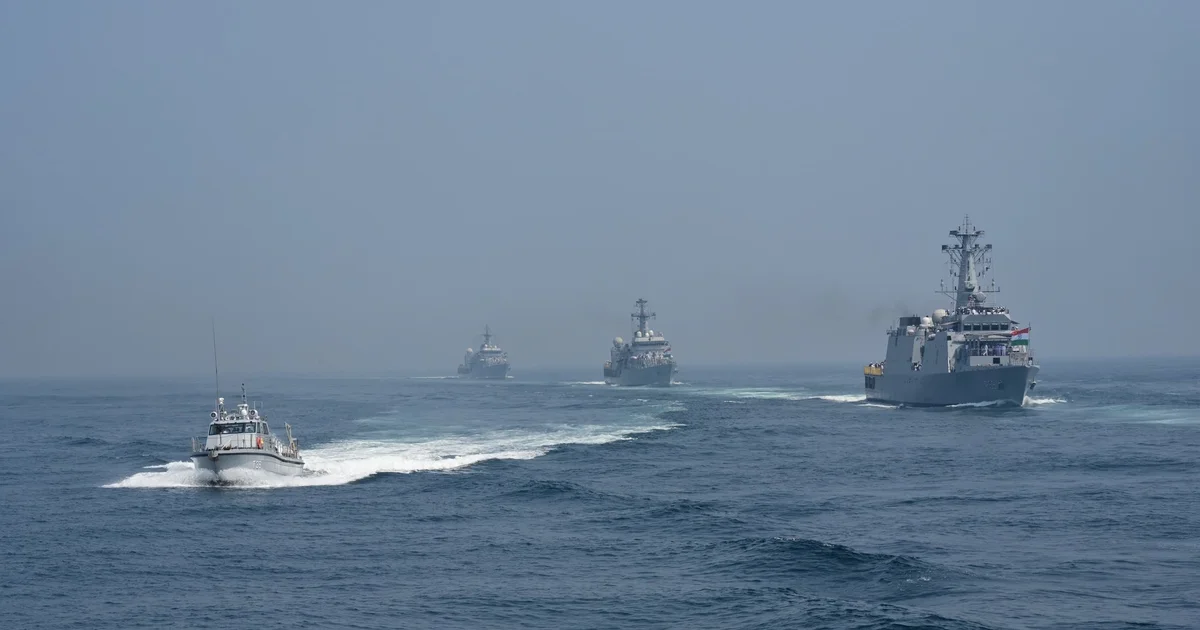
The foundation of this strategy is a shift from high-level rhetoric to granular, everyday maritime cooperation that directly affects how coast guards, navies, and disaster authorities operate. In May 2023, the Indian and Singaporean navies co-hosted the inaugural ASEAN-India Maritime Exercise, marking the first time India conducted exercises with the bloc as a collective entity and signaling New Delhi’s willingness to work through ASEAN-wide formats rather than purely bilateral channels.
This milestone was supported by years of targeted, bilateral efforts designed to build the foundational policing capabilities of regional partners. Key operational pillars include:
- Coordinated Patrols: Ongoing collaboration with Indonesia and Thailand to combat illegal, unreported, and unregulated (IUU) fishing, human trafficking, and piracy, with an emphasis on information-sharing and interoperable procedures rather than hard security guarantees.
- Institutional Integration: India’s decision to co-chair ASEAN Defence Ministers’ Meeting Plus (ADMM-Plus) working groups rather than establishing independent, competing frameworks, reinforcing ASEAN’s role as the convening hub for regional security agendas.
- Disaster Response: A late 2024 Memorandum of Intent between India’s National Disaster Management Authority (NDMA) and the ASEAN Coordinating Centre for Humanitarian Assistance (AHA Centre), the region’s primary hub for disaster response operating under ASEAN’s political-security community framework.
These initiatives are designed to create a “crisis capability” that is embedded within existing regional machinery, ensuring that when a disaster or security breach occurs, the response is seamless rather than improvised. For governments in the region, that means more predictable access to Indian assets-such as naval lift, reconnaissance, and medical support-without having to negotiate ad hoc arrangements in the midst of an emergency.
The Synergy of Non-Alignment
New Delhi’s comparative advantage is not unique, but it is complementary. Australia shares a similar strategic profile, offering capability-building support that does not carry the same heavy demand for geopolitical alignment as that of the United States, while still operating broadly within a rules-based Indo-Pacific framework.
The two nations already maintain close coordination in the Bay of Bengal and the eastern Indian Ocean. Strategic analysts suggest that extending this partnership further into Southeast Asia-specifically through joint Humanitarian Assistance and Disaster Relief (HADR) planning and shared training for coast guards-would multiply the effectiveness of both nations’ regional footprints. Joint exercises and standardized operating procedures would also make it easier for ASEAN officials to plug external partners into their own, charter-defined crisis coordination mechanisms.
This “partnership of reassurance” provides ASEAN states with a diversified security menu, allowing them to upgrade their maritime domain awareness without triggering a diplomatic crisis with Beijing. For regional decision-makers, the political value lies in being seen to strengthen national resilience while keeping formal treaty commitments and overt military alignments to a minimum.
The Risk of Institutional Overload
Despite the benefits of increased support, the region faces a growing risk of “capacity congestion.” ASEAN is currently the target of a flurry of overlapping capacity-building initiatives from India, Australia, Japan, the European Union, and the United States, as each seeks to demonstrate commitment to Southeast Asia’s security and connectivity.
Much of this aid is concentrated in a few narrow sectors: cyber security, HADR, and maritime domain awareness. Without a coordinated division of labor, these initiatives risk duplicating efforts and overwhelming the limited administrative capacity of the officials and institutions they are intended to help. In smaller ASEAN states in particular, the same handful of desk officers are often responsible for managing multiple training offers, workshops, and funding streams.
To prevent this, policymakers are advocating for a sector- and sub-region-based division of labor, channeled through established networks like the East Asia Summit and the ASEAN Regional Forum (ARF). The goal is to ensure that ASEAN sets the priorities and external partners “slot in” behind them, keeping ASEAN centrality an operational reality rather than a rhetorical device. In practice, that would mean clearer regional planning documents, more transparent project tracking at the ASEAN Secretariat, and closer alignment between national line ministries and ASEAN-level agendas.
Structural Limitations
While India’s role as a dependable contributor and convener is growing, it remains distinct from the security architecture provided by Washington. India does not offer the overarching security guarantees that the United States provides, and its engagement with ASEAN remains a “patchwork of exercises and memoranda” rather than a permanent, standing architecture.
However, for many Southeast Asian capitals, this lack of a rigid structure is an asset. It allows for a flexible, crisis-driven relationship that provides tangible help during emergencies without imposing a permanent strategic burden or raising politically sensitive questions about basing rights and alliance commitments. For bureaucracies already wary of treaty entanglements, the ability to scale Indian involvement up or down on a case-by-case basis is part of the appeal.
At the same time, this model depends heavily on political continuity in New Delhi and sustained investment in maritime and disaster-response assets. Without predictable funding lines and transparent coordination with ASEAN mechanisms, India’s “non-hegemonic” offer risks being seen as episodic rather than embedded.
This analysis follows a June 2026 private workshop hosted by the Lowy Institute on ASEAN’s crisis coordination mechanisms, led by Director of the Southeast Asia Program Hunter Marston and Abdul Rahman Yaacob, which examined how external partners such as India and Australia can support ASEAN’s own structures without displacing them.
