
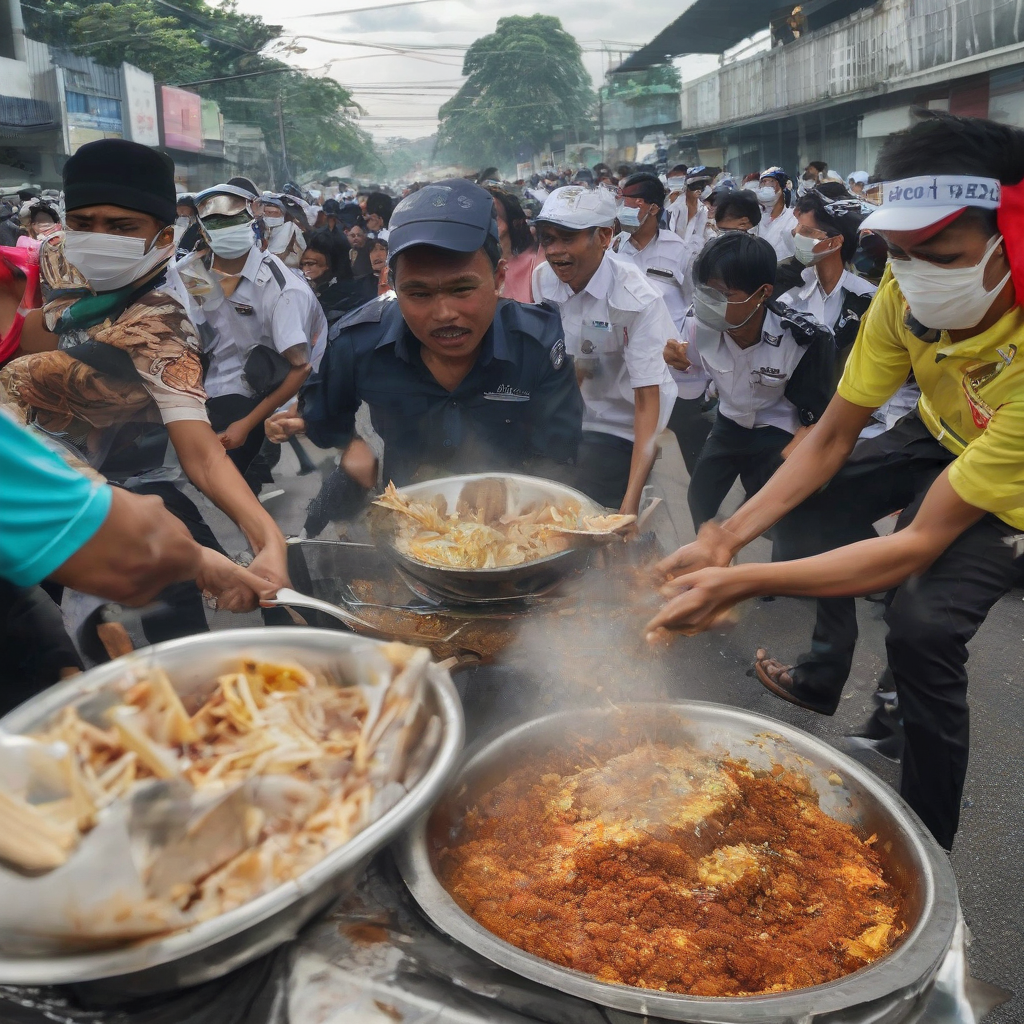
JAKARTA – The Indonesian government has reduced the budget for President Prabowo Subianto’s flagship free nutritious meal programme following weeks of nationwide protests calling for the initiative’s complete suspension.
The scaling back of the social welfare project reflects a tension between the administration’s nutrition goals and fiscal stability, as the government attempts to balance a high-cost mandate with public opposition and budgetary constraints.
Fiscal Reductions and Budgetary Pressure
Finance Minister Purbaya Yudhi Sadewa confirmed the cuts, stating that the initiative to reduce spending came from the National Nutrition Agency (BGN), which manages the programme under Indonesia’s broad social protection framework set out in the 2009 Social Welfare Law. While Sadewa approved the reductions, he indicated a preference for even deeper cuts to the budget.
“I actually want it to be zero, but that’s not possible, the budget is out already, but stopping it altogether is not right either, because it’s a good programme,” Sadewa said. “All that’s left to do is improve the implementation.”
When questioned on the specific amount of the latest reduction, Sadewa declined to provide a definitive figure but described the cut as “significant” and noted that it would make the national budget “more secure.” He responded with “maybe” when asked if the reduction amounted to 40 trillion rupiah (US$2.2 billion).
The finance chief framed the move as part of a broader effort to protect Indonesia’s fiscal deficit targets and debt ratios, signalling that large-scale social spending under Prabowo will face ongoing scrutiny from economic managers.
Programme Scale and Funding Shifts
The initiative is designed to provide meals to 83 million recipients, including schoolchildren and pregnant mothers across Indonesia’s vast archipelago, from urban Java to remote communities scattered over more than 17,000 islands. At full operational scale, the state would require approximately 335 trillion rupiah annually to fund the programme.
The current funding trajectory shows a steady decline from initial projections, underscoring how political ambitions are being recalibrated against fiscal realities:
- Full-scale requirement: 335 trillion rupiah per year
- Original budget allocation: 268 trillion rupiah
- Current annual budget: 228 trillion rupiah
- Total reductions to date: 39.62 trillion rupiah (via two separate cuts)
Officials have not clarified whether the lowered allocation will delay nationwide rollout, reduce the number of daily meals offered, or narrow geographic coverage. However, planners acknowledge that the programme now competes more directly with other priorities in the state budget, including infrastructure, energy subsidies and existing social assistance schemes.
BGN Operational Refocusing
Deputy BGN head Agustina Arumsari stated on June 18 that the budget had been reduced twice this year. She noted that actual expenditure might fall below the 228 trillion rupiah allocation as the agency implements a “refocusing” strategy in response both to fiscal ceilings and to criticism over waste and leakage risks in such a large-scale food distribution effort.
Arumsari explained that the agency is narrowing the criteria for beneficiaries to ensure that meals are directed to “those who actually need them, so the benefits of the programmes can be felt optimally.” The refocusing is expected to prioritise poorer districts and areas with high rates of child stunting, aligning the initiative more closely with national nutrition indicators tracked under Indonesia’s medium-term development plans.
The Finance Minister has refrained from specifying which components of the programme will be scaled back, stating that the detailed implementation plan will be announced by the BGN. Any revised guidelines will need to be aligned with the annual state budget law and accompanying fiscal notes published by the Finance Ministry, making the next budget cycle a key test of how far Prabowo’s flagship pledge survives in its original form.
Related reading
- Urban Infrastructure Resilience: How European and Asian Megacities Are Adapting to Extreme Climate Oscillations in 2026
- UN General Assembly 2026 Framework on Autonomous Systems: International Diplomacy Faces Algorithmic Governance
- Why the Federal Fiscal Year Starts Oct. 1, and Why It Rarely Helps (daybreakwire.com)
- Spanish election: Pedro Sanchez calls snap election for 29 November after housing protests (globallypulse.com)
