
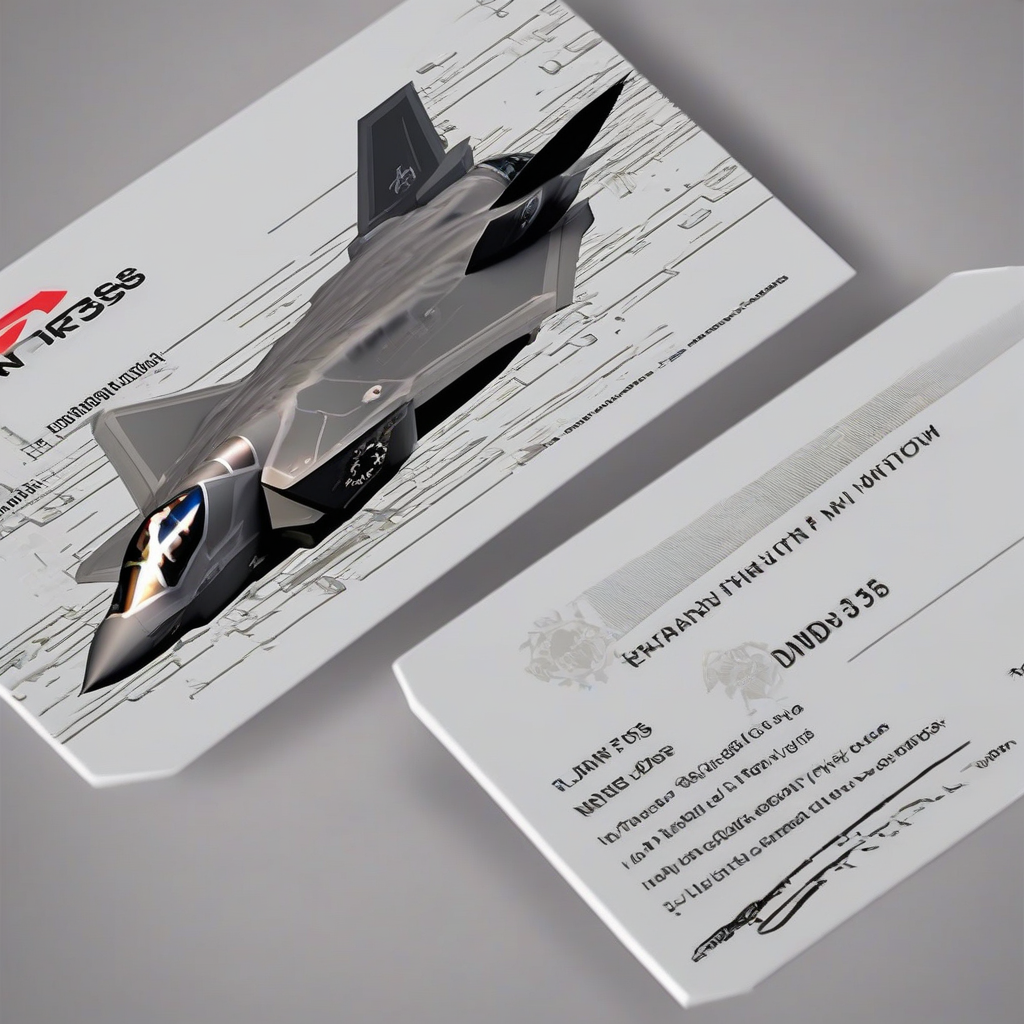
OTTAWA – A high-ranking federal official has been rebuked for distributing custom-made business cards featuring Lockheed Martin F-35 fighter jets at a military trade show, triggering a debate over bureaucratic neutrality during a volatile procurement review.
Crista-lynn Ferguson, the director general of the National Defence Fighter Aircraft Capability Program, distributed the cards at the CANSEC trade show in late May. The incident comes as the Canadian government evaluates whether to proceed with a full fleet of American-made jets or diversify with Swedish-made aircraft.
The controversy highlights a deepening rift between the political objectives of the federal government and the operational preferences of the military establishment, and raises fresh questions about how rigorously senior officials are respecting long-standing rules on non-partisanship in public administration.
Violation of Federal Identity Guidelines
The business cards were obtained by Radio-Canada and found to be in direct violation of the government’s Federal Identity Program. Under these standardized guidelines, all federal business cards must follow a specific template where the Canadian flag serves as the sole illustration, part of a broader effort to ensure that federal communications are neutral, consistent and not used to promote particular policies or suppliers.
Ferguson’s cards departed from this standard in several ways:
- Front: Featured a metallic logo depicting the outlines of an F-35 and a CF-18, visually emphasizing one of the two aircraft types at the heart of the current decision.
- Back: Displayed a photograph of two American F-35s flying alongside two Canadian CF-18s during a joint training mission, effectively turning the card into a miniature promotional image for the U.S.-built jet.
“The card in question was not produced in accordance with the [department’s] standardized business card production process,” said Department of National Defence (DND) spokesperson Kened Sadiku.
Sadiku confirmed that Ferguson would be asked to stop using the cards and that all DND employees will be reminded to comply with federal identity provisions. Such reminders are typically issued department-wide when breaches of the identity rules risk being perceived as signalling institutional preferences during sensitive policy debates.
The F-35 Procurement Timeline
The dispute over a business card is situated within a multi-year, multi-billion dollar acquisition process that has become a flashpoint for diplomatic tension and domestic political scrutiny over defence spending and industrial benefits.
- January 2023: The F-35 procurement process officially launched, including an existing contract for 16 aircraft, marking Canada’s formal move toward replacing its aging CF-18 fleet.
- March 2025: The fighter acquisition program was placed under formal review, halting further orders and opening the door to reassessing the mix and number of aircraft.
- Early 2026: Canada held a signing ceremony for its first F-35, though Ottawa has since refused to release photographs of the event, citing security and commercial sensitivities.
- Late 2026: Canada is preparing to take delivery of its first aircraft, even as the broader fleet composition remains under review.
The 2025 review was initiated amid economic and diplomatic friction with the administration of U.S. President Donald Trump, who imposed tariffs on Canadian steel and aluminum. Against that backdrop, any perception that senior Canadian officials are promoting an American defence contractor over potential European partners is particularly politically charged.
Political Neutrality vs. Military Pride
The use of the cards has been interpreted by critics as a signal of bias at a moment when cabinet has not yet taken a final decision on the long-term fleet mix. Geneviève Tellier, an emeritus professor of political science at the University of Ottawa, described the move as “highly ill-advised.”
“The primary duty of public servants is neutrality, so they must not show any appearance of bias or conflict of interest,” Tellier said. “Here, it gives the impression of someone showing a preference.”
Tellier further suggested the incident symbolizes a “disconnect” between the government’s desire to change policy and a DND that is not ready to make those changes, underscoring how major defence procurement files often become tests of whether the public service is implementing elected officials’ directives at arm’s length from industry.
Conversely, military analyst Richard Shimooka, a senior fellow at the Macdonald-Laurier Institute, argued that the cards simply reflect the reality of the current acquisition.
“This is what we’re buying,” Shimooka said. “The military is very proud of its capabilities, what it does and the systems it uses. And to some degree, this [business card] kind of reflects that.”
The clash of views illustrates a broader tension in Westminster-style systems: uniformed and civilian officials frequently work closely with specific platforms for years, while elected governments reserve the right to revisit or redirect policy at any time.
Strategic Implications of a Mixed Fleet
The federal government is currently weighing a decision between the American F-35 and the Swedish JAS39 Gripen manufactured by Saab. This choice has significant implications for the North American Aerospace Defense Command (NORAD), where Canada and the United States jointly monitor and defend continental airspace.
While the government considers a mixed fleet to broaden defence partnerships and preserve industrial leverage, DND officials have cautioned that the military lacks the resources and personnel to integrate two different aircraft systems simultaneously. A split buy would require parallel training pipelines, maintenance regimes and supply chains – complexities that could strain a force already managing aging legacy jets and new fifth-generation platforms.
Jean-Christophe Boucher, a professor of political science at the University of Calgary, characterized the distribution of the cards as a “tone-deaf attitude” regarding the political ramifications of the project, suggesting that what might appear as benign enthusiasm inside the defence community carries very different optics when billions of dollars and allied relationships are at stake.
Operational Urgency and Global Threats
Despite the political review, the Royal Canadian Air Force continues preparations to integrate the F-35, which is a fifth-generation fighter and the backbone of several allied air forces. Defence planners argue that delaying key steps in the transition would risk leaving capability gaps as CF-18s age out of service.
Lt.-Gen. Jamie Speiser-Blanchet, commander of the Royal Canadian Air Force, has testified that the transition from the CF-18 is a matter of urgency due to the capabilities of global adversaries.
“Both China and Russia have fifth-generation fighter aircraft and fifth-generation missiles, which are able to go at much greater speeds and with much more lethality and are putting western allies at risk at this moment in time,” Speiser-Blanchet said.
For critics of Ferguson’s business cards, that operational urgency does not lessen the obligation of senior officials to be – and to appear – impartial as cabinet weighs options. For defenders, the cards are an expression of institutional identity in a program that has already passed several political milestones.
When reached by email, Ferguson stated she had nothing to add.
DND has ordered the cessation of the custom card’s use and is issuing a directive to all staff regarding the mandatory use of the Federal Identity Program templates, a move intended to close the episode quickly and reaffirm the government’s broader rules on visual identity and non-partisan communications.
Keep reading
