
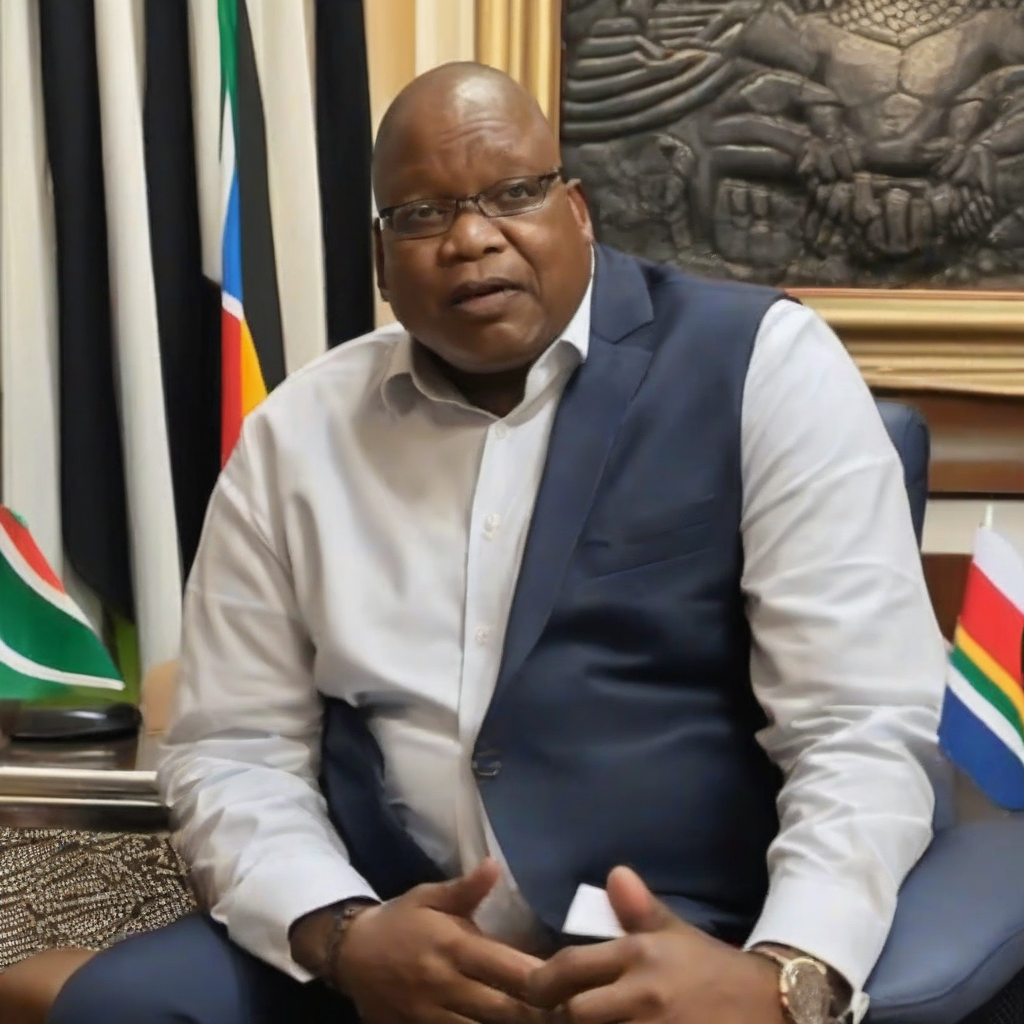
PRETORIA – Minister in the Presidency Khumbudzo Ntshavheni has condemned South African High Commissioner to India Anil Sooklal, describing his appearance alongside former president Jacob Zuma and fugitive Ajay Gupta as a “disgrace” to the nation.
The incident has sparked a diplomatic row within the South African government, highlighting tensions over the conduct of state representatives and the ongoing efforts to repatriate the Gupta brothers, who are accused of orchestrating systemic corruption during Zuma’s presidency.
Speaking during a post-Cabinet press briefing on Friday, Ntshavheni stated that Sooklal’s decision to appear at a press briefing with Zuma, his confidante Mzwanele Manyi, and Ajay Gupta was an affront to the public.
Diplomatic Breach in India
The controversy centers on a meeting in India where Sooklal, the official representative of the South African government, was pictured with Ajay Gupta. The Gupta family has been central to allegations of “state capture,” a process involving the undue influence of government appointments and the looting of state resources for private gain, as documented by the judicial commission of inquiry chaired by Chief Justice Raymond Zondo.
Ntshavheni argued that the High Commissioner’s actions directly contradicted the state’s legal and diplomatic objectives, including South Africa’s formal requests for international cooperation under mutual legal assistance frameworks.
“You will recall that South Africa has applied for mutual assistance to bring back the fugitive Gupta brothers back into the country. Therefore, it’s [another] level of disgrace that our own employee, the representative of the government of South Africa, hobnobs with the criminals instead of doing his work and making sure that the fugitives are brought to book.”
The Minister further asserted that Sooklal was showing a “middle finger to South Africans, who are paying his salary,” by failing to perform his official duties in line with the government’s stated anti-corruption agenda.
The Status of the Gupta Fugitives
Ajay Gupta and his brothers are accused of looting billions of rands from the South African state through kickbacks and the manipulation of government contracts. While they were central figures during Jacob Zuma’s tenure as president, they became fugitives after his departure from the Union Buildings in 2018 to avoid prosecution.
The legal efforts to return the Gupta brothers to South Africa have faced significant international hurdles, despite the powers available under the International Co-operation in Criminal Matters Act and related extradition frameworks:
- Ajay Gupta: Declared a fugitive and remains wanted by South African authorities; a 2018 arrest warrant was reportedly cancelled in 2019, but his status as a fugitive remains a political and legal flashpoint.
- Extradition Failures: In February 2023, the United Arab Emirates rejected a request to extradite the Gupta brothers to face trial for fraud and money laundering related to the Nulane scam, dealing a significant setback to South Africa’s cross-border anti-corruption drive.
Despite the lack of a specific extradition request for Ajay, he is widely regarded as the architect of the family’s influence over the state and a test case for South Africa’s ability to enforce accountability beyond its borders.
Pattern of Diplomatic Friction
Ntshavheni noted that this is not an isolated instance of former president Jacob Zuma undermining the country’s official foreign policy or creating ambiguity around who speaks for South Africa abroad.
The Minister referenced an incident from August of last year when the South African government voiced “strong objection and deep concern” regarding Zuma’s bilateral meeting with Morocco’s foreign affairs minister, Nasser Bourita, despite Pretoria’s longstanding stance on Western Sahara and its preference for engagements to be channelled through official diplomatic structures.
“We also are very clear: The messaging is very wrong, both from Ambassador Sooklal and [Zuma],” Ntshavheni said. “This is not the first incident where this [former] state president has undermined the foreign policy of this country and also the laws of the country when he’s supported by the country.”
Accountability and Policy Review
The South African government is now moving to address both the conduct of its diplomats and the funding of former heads of state, framing the India incident as a governance and accountability issue rather than a purely political spat.
International Relations Minister Ronald Lamola has formally requested a report from the officials involved in the India visit and has warned that “drastic steps” will be taken, signalling possible disciplinary action under the public service and diplomatic codes that govern envoys’ behaviour abroad.
Additionally, Ntshavheni revealed that the Presidency is reviewing the current policy regarding the funding of trips for former presidents. She noted that while the state funds these travels, the government does not have access to the diaries of former presidents to monitor their activities, raising questions about how taxpayer-funded travel aligns with official foreign policy and constitutional oversight of public expenditure under the Constitution.
International Relations Minister Ronald Lamola is currently awaiting the requested report to determine the disciplinary actions to be taken against the officials, in a move likely to test how firmly the administration can enforce standards on both serving diplomats and politically influential former leaders.
- Urban Infrastructure Resilience: How European and Asian Megacities Are Adapting to Extreme Climate Oscillations in 2026
- UN General Assembly 2026 Framework on Autonomous Systems: International Diplomacy Faces Algorithmic Governance
- India vs New Zealand: Bhuvneshwar Kumar returns to India's T20I squad (globallypulse.com)
