
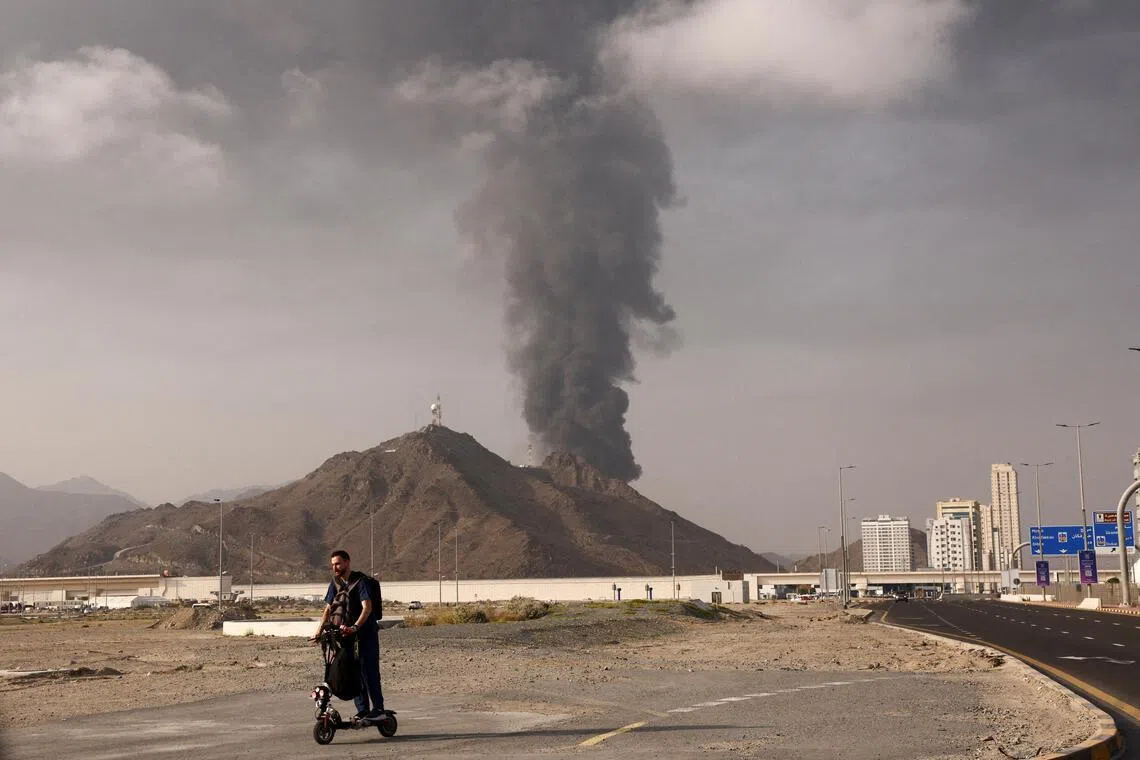
BEIRUT – Israel and Iran traded attacks on March 7 as the war entered a second week, and Iranian President Masoud Pezeshkian issued a rare apology to Gulf neighbours for damage from Iranian strikes. Hours later, Iran’s Revolutionary Guards said their drones hit a U.S. air combat centre at Al Dhafra Air Base near Abu Dhabi, while Israel said it launched a new wave of strikes on Tehran and Isfahan. Multiple Gulf states reported drone and missile activity and brief air-travel disruptions.
The exchanges pushed a conflict already spreading across borders deeper into the region’s commercial heart, with authorities citing interceptions over major Gulf hubs and oil prices surging as the Strait of Hormuz was described as effectively shut, raising questions about the security of one of the world’s most critical energy corridors under international maritime law as reflected in the UN Convention on the Law of the Sea.
“I personally apologise to neighbouring countries that were affected by Iran’s actions,” Pezeshkian said, urging them not to join US-Israeli attacks on Iran.
Pezeshkian signals conditional pause; Trump calls for “unconditional surrender”
Pezeshkian dismissed President Donald Trump’s demand for Iran’s “unconditional surrender” as “a dream,” and said a temporary leadership council had agreed to suspend attacks on nearby states unless strikes on Iran originated from their territory. Iranian officials framed the move as a conditional pause intended to prevent further escalation with Gulf Arab governments that host U.S. forces.
Trump cast Iran’s apology as a surrender and said the country would be “hit very hard” on March 7. On March 6, he wrote on his Truth Social platform: “There will be no deal with Iran except UNCONDITIONAL SURRENDER!” His comments underscored the widening gap between Tehran’s attempt to reassure neighbours and Washington’s insistence on maximalist terms.
Claims, counterstrikes and independent verification
Military claims on all sides continued to outpace what could be independently confirmed on the ground:
– Iran’s Revolutionary Guards said drones struck a U.S. air combat centre at Al Dhafra Air Base near Abu Dhabi. The claim could not be independently verified.
– State media in Iran reported huge explosions in several parts of Tehran following what it said were Israeli strikes.
– The Israeli military said it launched a new wave of strikes on Tehran and Isfahan and conducted overnight strikes into March 7 against targets in Lebanon it described as Hezbollah military sites.
– The Israeli military said Iran fired seven missile barrages at Israel on March 7, triggering air raid sirens, interceptions and temporary shelter orders in multiple cities.
Diplomats said they were still assessing the full extent of the damage amid competing narratives and restricted access to many of the reported sites.
Spillover across the Gulf and into Lebanon
Officials across the region reported attacks and interceptions spanning one week into March 7, underscoring how a conflict that began between Israel and Iran has drawn in states hosting U.S. military infrastructure and key energy and aviation hubs:
– Countries reporting drone or missile attacks or interceptions: United Arab Emirates, Kuwait, Qatar, Bahrain, Oman, Saudi Arabia, Iraq.
– The UAE defence ministry said it destroyed 15 ballistic missiles and intercepted 119 drones from Iran on March 7.
– Emirates airline briefly suspended flights to and from Dubai on March 7; authorities cited a “minor” debris incident after an interception near flight paths. Emirates later said it would resume flights following a security review.
Israel’s operations extended to Lebanon after Hezbollah fired across the border, while Iran said it hit Israel and Gulf Arab states that host U.S. military installations, highlighting the vulnerability of civilian airspace and regional logistics to military confrontation.
Iran’s additional operations and warnings
Early on March 7, Iran’s army said its navy carried out drone strikes against targets in Israel and against U.S. gathering points and bases in Abu Dhabi and Kuwait, describing the action as a response to the reported U.S. submarine attack on the Iranian ship IRIS Dena off Sri Lanka that killed dozens of sailors. U.S. officials did not immediately comment on the allegation.
The Revolutionary Guards said they struck three positions of separatist groups in Iraq’s Kurdistan region at 4.30am local time, and an armed forces spokesman warned that if separatist groups in the Kurdistan region took any action against Iran’s territorial integrity, “we will crush them.” Iraqi officials condemned earlier cross‑border strikes as violations of sovereignty, adding a diplomatic dispute to the already volatile military picture.
Casualties and competing narratives
With communications disrupted in parts of Iran and access restricted in some affected areas of Israel and the Gulf, casualty figures remained contested:
– Iran’s ambassador to the United Nations, Amir Saeid Iravani, said the U.S.-Israeli attacks have killed at least 1,332 Iranian civilians and wounded thousands.
– Iranian attacks have killed 11 people in Israel, and at least six U.S. service members have been killed, according to reported figures from Israeli and U.S. officials.
– Russian President Vladimir Putin expressed condolences to Pezeshkian over civilian casualties from what the Kremlin described as “the armed Israeli-American aggression against Iran” and called for an immediate halt to hostilities.
None of the figures could be independently verified, and diplomats at the UN Security Council – which has repeatedly met on the crisis under its mandate to maintain international peace and security defined in the UN Charter – warned that civilian harm was likely to rise if the cross‑border strikes continued.
Oil, shipping and insurance: Strait of Hormuz under strain
The war has shaken global markets, with oil prices at multi-year highs as the Strait of Hormuz was described by regional officials as effectively shut to routine traffic. About one-fifth of global oil moves daily through the narrow waterway, and even short interruptions can force governments and traders to tap strategic reserves, reroute tankers and reassess sanctions and export policies.
Washington will provide reinsurance for losses up to US$20 billion in the Gulf region to bolster confidence for oil and gas shippers, according to the U.S. International Development Finance Corporation. The move, coordinated with U.S. Treasury and energy officials, is aimed at keeping cargoes moving despite surging war-risk premiums.
Trump said the U.S. Navy could escort ships in the Gulf, while Iran’s Revolutionary Guards spokesperson Alimohammad Naini said Iran “welcomes” and is “awaiting” any U.S. presence in the strait, according to state media – a statement likely to fuel further debate among Gulf capitals over whether additional Western naval deployments would deter or invite confrontation.
Leadership questions in Tehran
Trump also reiterated his demand to have a say in selecting Iran’s new supreme leader, a notion rejected by Iravani, who said leadership would be chosen “in accordance with our constitutional procedures and solely by the will of the Iranian people – without any foreign interference.”
Iranian media reported that three influential hardline clerics urged the swift selection of a new supreme leader to project stability as the country faces external attacks and domestic anxiety. Iran has described the killing of Supreme Leader Ayatollah Ali Khamenei as an assassination, and the temporary leadership council has been seeking to demonstrate continuity of command over the armed forces and security services.
Key developments on March 6-7
– March 6: Trump posts, “There will be no deal with Iran except UNCONDITIONAL SURRENDER!” on Truth Social, reiterating his demand for far-reaching concessions from Tehran.
– March 7: Pezeshkian apologises to neighbours and says attacks on nearby states would be suspended unless strikes on Iran originate from their territory, signalling a conditional pause aimed at Gulf capitals.
– March 7: Israel reports seven Iranian missile barrages; says it launches strikes on Tehran, Isfahan and targets in Lebanon described as Hezbollah military sites.
– March 7: UAE says it destroyed 15 ballistic missiles and intercepted 119 drones; Emirates briefly halts Dubai flights, then resumes operations after inspections.
Washington will provide reinsurance for Gulf-region shipping losses up to US$20 billion, the U.S. International Development Finance Corporation said, as regional governments weigh how to protect their own critical infrastructure while trying to avoid being drawn more deeply into a war moving closer to their shores.
Related reading
