
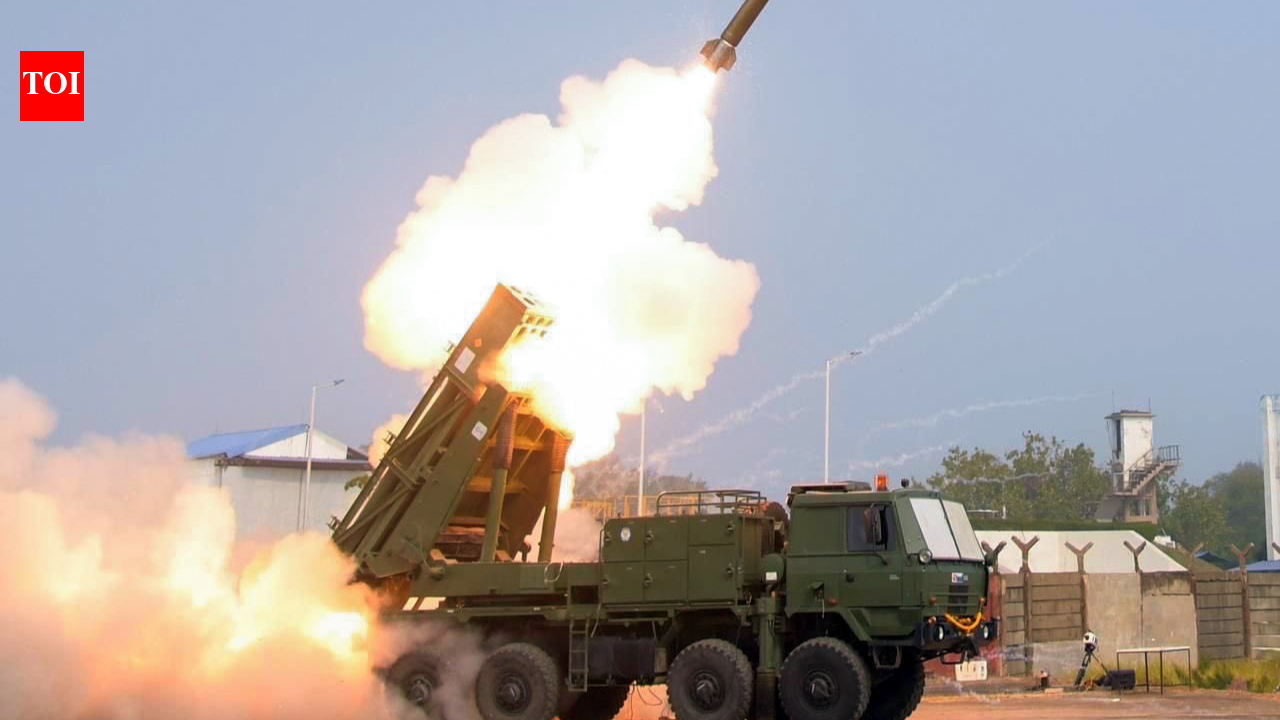
NEW DELHI – India’s defence minister Rajnath Singh flagged off the first export batch of guided Pinaka rockets for Armenia from a facility in Nagpur, marking the start of overseas deliveries of the precision‑guided variant of the indigenous multi‑barrel rocket system.
The move is being presented by New Delhi as a milestone for India’s defence industry and a signal of growing demand for the Pinaka family, which has evolved from a 37.5‑km system to variants tested for significantly longer ranges. It also underscores the government’s push under its “Atmanirbhar Bharat” self‑reliance agenda to reposition India from one of the world’s largest arms importers to an emerging supplier, a shift reinforced by recent changes to the defence acquisition and export rules under the Defence Acquisition Procedure.
Singh said exports from the Solar Defence & Aerospace facility have begun, linking the shipment to a broader export drive and increased private‑sector participation in defence manufacturing. The facility operates under licensing and export‑clearance norms overseen by the Ministry of Defence and the Ministry of External Affairs, which vet overseas sales for strategic and end‑use considerations.
“India is no longer just an importer but is rapidly moving towards becoming an exporter,” he said.
What India is sending and why it matters
The Pinaka system is a guided and unguided multi‑barrel rocket launcher designed for rapid, high‑volume fire support against area targets such as troop concentrations, artillery positions and logistics nodes. Current operational variants in India can strike targets at up to 75 km, and a newer trial version has reached 120 km. According to the Army’s plan, the 120‑km rockets can be launched from the same Pinaka launchers that already fire 40‑km and 75‑plus‑km rounds, reducing the need for new platforms and simplifying logistics.
Unlike traditional unguided rockets, the guided Pinaka variant incorporates navigation and control for improved accuracy, making it more suitable for precision strikes and limiting collateral damage – a capability that is increasingly important as export customers face tighter rules of engagement and scrutiny under international humanitarian law.
The Armenia contract and delivery sequence
Armenia is the first confirmed foreign buyer for Pinaka. The country signed a contract in September 2022 for four Pinaka batteries along with anti‑tank rockets, ammunition and other equipment, a package valued at about Rs 2,000 crore (approximately $250 million). The deal was cleared through India’s defence export authorisation mechanism, which assesses such sales against foreign‑policy priorities and technology‑security thresholds.
Key milestones:
– July 2023-November 2024: Deliveries of initial Pinaka unguided systems and associated ground equipment to Armenia.
– Flag‑off from Nagpur: First export batch of guided Pinaka rockets dispatched for Armenia, marking the start of deliveries of the longer‑range, precision‑capable rounds under the same contract.
Officials said the sequencing – first launchers and unguided rockets, now guided munitions – is intended to allow Armenia to build operational familiarity with the system before fielding the more advanced variant.
Domestic induction and ongoing trials
The Indian Army has inducted the Pinaka Mk‑I Enhanced (EPRS) variant after successful trials in April 2022. This upgraded version offers improved range and payload options over the original system and is now being deployed with artillery regiments along key frontiers.
A proposal worth around Rs 2,500 crore is advancing to induct 120‑km rockets on a larger scale, subject to user trials and final government approval. A trial of the 120‑km round was conducted in December 2025, and defence officials say data from those firings will shape decisions by the Defence Acquisition Council on future orders and potential upgrades.
Exports, production and industry footprint
Singh linked the shipment to wider export and production trends:
– Defence exports: Less than Rs 1,000 crore a decade ago; now at a record Rs 24,000 crore, reflecting a sharp rise in orders for missiles, artillery systems and aerospace components.
– Domestic defence production: Rs 46,425 crore in 2014; now at Rs 1.51 lakh crore, driven by import‑substitution projects, higher budget allocations and policy incentives for local manufacturing.
Pinaka’s development began at the Defence Research and Development Organisation (DRDO) in the late 1980s as an Indian alternative to Russian multi‑barrel systems such as the ‘Grad’. Since then it has become a flagship case of public‑private collaboration in defence: DRDO leads design and testing while production today involves Indian industry partners including Tata Advanced Systems, Solar Industries, Munitions India Ltd and Economic Explosives Ltd.
Officials argue that the Armenia order validates this model by demonstrating that equipment developed through India’s state‑backed research ecosystem and produced by domestic firms can now compete in the international market on both performance and cost.
Additional systems on offer
Beyond Pinaka, India is offering its Akash air‑defence system for export. Armenia was also the first buyer for Akash, receiving the first battery in November 2024 under a $720 million deal for 15 systems. Other countries cited as showing interest in Akash include the Philippines, Brazil, Egypt and Vietnam, with discussions at various stages.
These exports are being promoted through the government’s defence export facilitation cell and dedicated lines in the Union Budget for export promotion, even as each sale remains subject to case‑by‑case scrutiny in line with India’s international obligations under the Arms Trade Treaty and national security assessments.
International interest and the road ahead for Pinaka
Officials have said interest in Pinaka extends beyond Armenia, with prospective buyers in Southeast Asia and in Europe, including France. For many of these countries, Pinaka is being pitched as a cost‑effective alternative to Western and Russian multi‑rocket systems, with the added advantage of flexible co‑production or offset arrangements.
For now, the concrete status is clear: the first batch of Pinaka guided rockets has been flagged off from the Nagpur facility for delivery to Armenia, moving the system from India’s own proving ranges into active service with a foreign military and marking a significant step in New Delhi’s bid to become a serious player in the global defence market.
Worth a look
- Urban Infrastructure Resilience: How European and Asian Megacities Are Adapting to Extreme Climate Oscillations in 2026
- UN General Assembly 2026 Framework on Autonomous Systems: International Diplomacy Faces Algorithmic Governance
- Oppo F35 Pro, F35 launched in India with 8,000mAh battery, 50MP selfie camera (globallypulse.com)
