
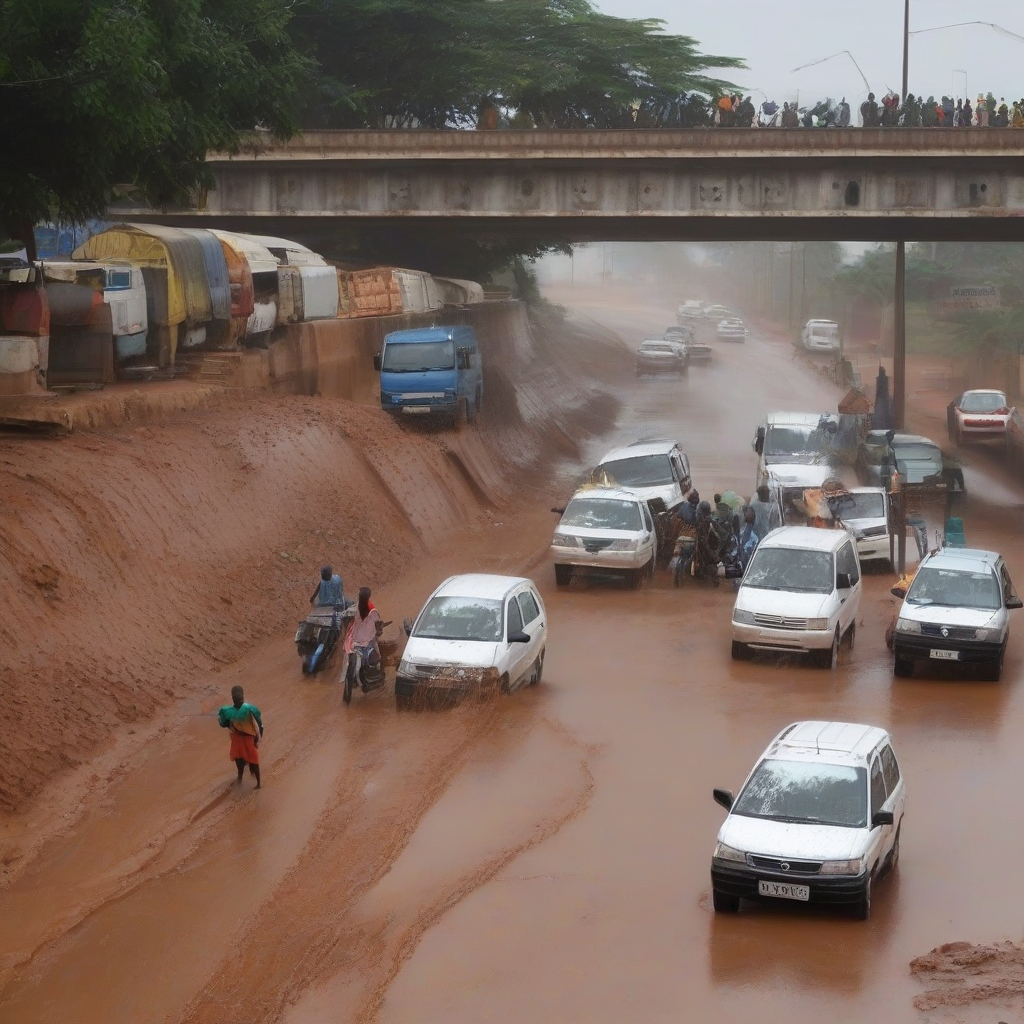
LAGOS – Weeks of heavy rainfall across Lomé, Accra, Lagos, and other coastal cities in West Africa have caused widespread flooding, resulting in significant damage to roads, bridges, and drainage systems.
West African governments are now facing a critical fiscal dilemma as the costs of repairing this destroyed transport infrastructure threaten to deplete funds previously allocated for new highway and transit projects.
The immediate need to restore essential transport links is creating a budgetary tug-of-war, where the urgency of disaster recovery is delaying long-term strategic expansion.
Economic Impact of Climate Hazards
The financial burden of these events is part of a broader systemic trend across the continent. According to the World Meteorological Organization’s (WMO) State of the Climate in Africa 2023 report, African nations lose between 2% and 5% of their annual GDP to climate-related hazards.
In severe instances, governments are forced to redirect up to 9% of total public spending toward disaster response. This diversion of capital limits the ability of states to invest in proactive economic development.
The long-term costs of adaptation are even more substantial. The WMO estimates that sub-Saharan Africa requires an annual investment of $30 billion to $50 billion over the next decade to strengthen climate resilience, a figure representing 2% to 3% of the region’s GDP.
Those pressures are landing on finance ministries already working within debt and deficit constraints and under the scrutiny of regional and international rules on fiscal discipline, including the African Union’s framework for economic convergence, which encourages member states to keep public deficits and debt ratios within agreed thresholds.
Quantifying Infrastructure Damage
While comprehensive data on road damage specifically within West Africa remains limited, recent project costs and reports from international bodies highlight the scale of the loss. A September 2025 report from the Coalition for Disaster Resilient Infrastructure (CDRI) estimates that natural disasters cause an average of $12.7 billion in damage to African infrastructure every year.
Transport officials across the region say this recurrent destruction is steadily eroding the value of decades of public investment in roads and bridges, with implications for everything from food prices to cross-border trade.
Recent specific losses include:
- Nigeria: The reconstruction of the Mokwa Bridge in Niger State, destroyed by floods in May 2025, is estimated to cost 16.7 billion naira (approximately $12.1 million).
- Ghana: The 2026 budget has allocated 3 billion cedis (approximately $260.5 million) for road repairs, though analysts suggest this is insufficient following recent rains.
- Mozambique: Flooding in January 2026 damaged over 5,000 kilometers of roads across nine provinces, with repair costs estimated at nearly $3.5 billion.
- Malawi: World Bank data indicates climate-related events cost the national road network approximately $163 million annually, or 1.3% of GDP.
In West Africa, these losses are particularly acute along major trade corridors that underpin the Economic Community of West African States (ECOWAS) integration agenda, where washed-out sections can rapidly disrupt regional supply chains.
Maintenance Gaps and Project Delays
The pressure to rebuild is compounded by a pre-existing failure to fund routine maintenance. When existing roads are not maintained, they become more susceptible to flood damage, creating a cycle of expensive emergency reconstruction.
In Nigeria, Minister of State for Works Bello Goronyo stated that the country requires approximately 880 billion naira annually to maintain its road network, yet available funding covers only about 20% of that requirement.
The necessity of repairing bridges and drainage systems to maintain trade and supply chains means that new highway projects are often the first to be paused. This trade-off risks slowing the movement of goods to major economic centers and hindering regional integration.
Senior officials in transport and finance ministries say they are being forced into triage budgeting: prioritising assets that keep ports, border crossings, and food-producing regions connected, while flagship expansion projects – often central to political manifestos – are quietly pushed back.
Shift Toward Climate-Resilient Engineering
To break the cycle of recurring destruction, international financial institutions are now mandating that climate resilience be integrated into the design phase of all new projects.
This engineering shift moves away from standard construction toward specifications that can withstand extreme weather, including:
- Increased capacity and strength of drainage systems to handle higher rainfall volumes.
- Reinforced culverts and bridges designed for higher hydraulic pressure.
- The use of high-durability construction materials resistant to water erosion.
- Requirement for comprehensive hydrological studies prior to the commencement of construction.
While these requirements increase the initial capital expenditure for road projects, they are being adopted as a mechanism to reduce long-term reconstruction costs and safeguard transport investments.
Governments are currently evaluating additional financing options from international development partners to cover the gap between standard construction costs and these new resilience benchmarks, including climate-finance windows linked to the Paris Agreement on climate change. For public works ministers, that means every new bridge or highway contract is now as much a test of fiscal strategy and regulatory alignment as it is of engineering design.
Worth a look
