
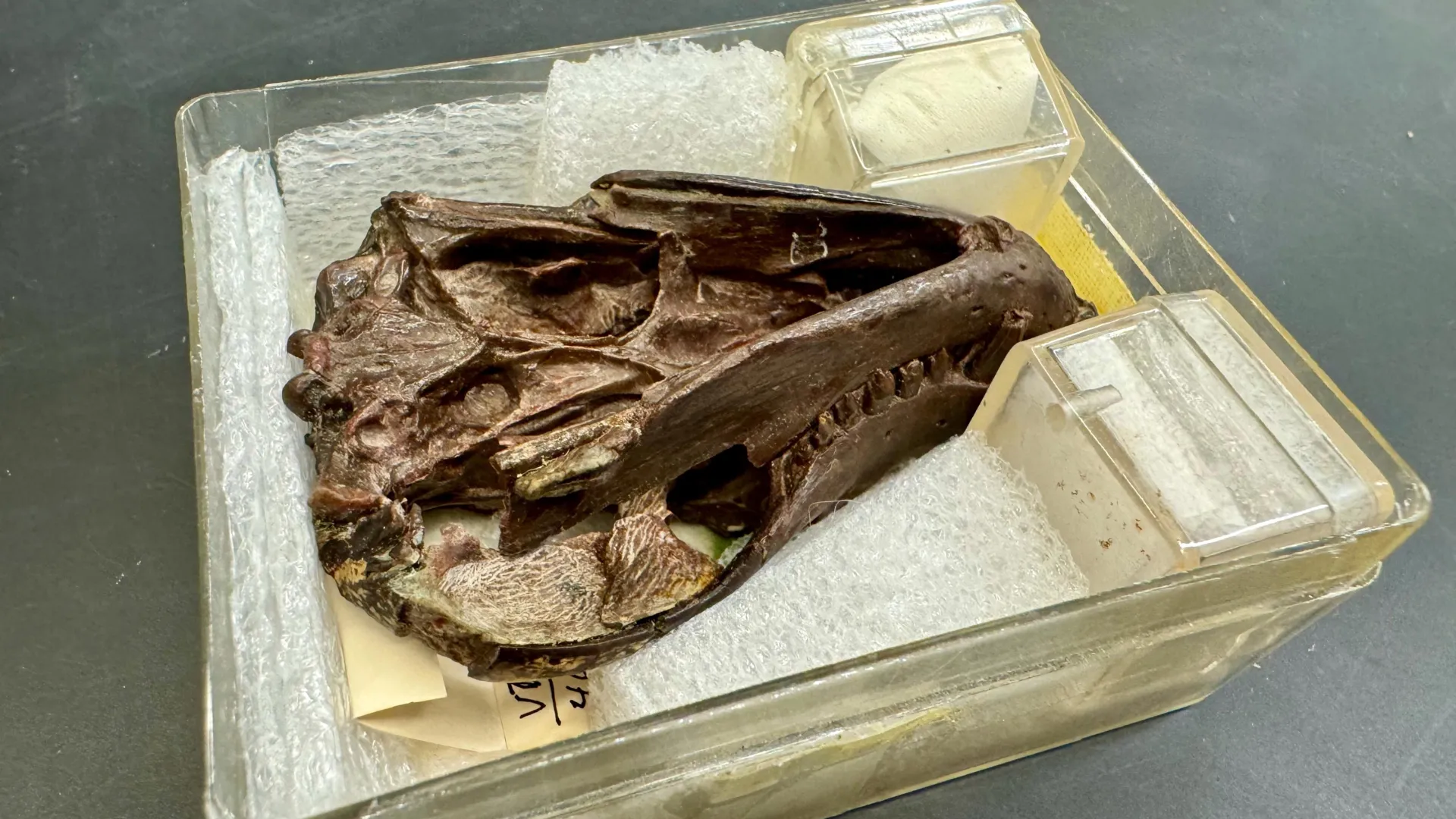
A digital ear reshapes the early mammal playbook
High-fidelity CT scanning and engineering-grade simulation have revived the hearing of a small, 250-million-year-old cynodont and, in doing so, nudged a key evolutionary milestone deeper into time. Using a precision 3D reconstruction of the skull and jaw of Thrinaxodon liorhinus, researchers tested how sound would have moved through its head. The modeling points to a functional eardrum large enough to transmit airborne vibrations efficiently, implying mammal-style sensitivity emerged roughly 50 million years earlier than once assumed.
“For almost a century, scientists have been trying to figure out how these animals could hear. These ideas have captivated the imagination of paleontologists who work in mammal evolution, but until now we haven’t had very strong biomechanical tests,” said Alec Wilken, a graduate student who led the study, which was published recently in PNAS. “Now, with our advances in computational biomechanics, we can start to say smart things about what the anatomy means for how this animal could hear.”
From jaw listening to a membrane that moves bones
Cynodonts sit near the base of the mammalian family tree, carrying a mosaic of reptile and mammal traits. In early forms, the tiny bones that would later become the malleus and incus were still braced against the jaw. A long-standing idea posited that a membrane stretched across a hooked part of the lower jaw-an early tympanic surface-could have captured airborne sound well before those bones fully decoupled to form the modern middle ear.
The new modeling places Thrinaxodon at a critical transitional moment, when a mandibular middle ear was still physically tied to the jaw yet already behaving in ways that anticipate the highly sensitive, three-bone apparatus in modern mammals. That bridge position makes the fossil a powerful test case for how small anatomical shifts can rewire entire sensory systems.
| Hearing pathway | Primary interface | Signal route | Typical strengths | Typical limitations |
|---|---|---|---|---|
| Bone conduction (“jaw listening”) | Lower jaw contacting substrate | Vibrations travel through jaw and skull to inner ear | Effective for low-frequency ground-borne cues | Less efficient for airborne sound; limited bandwidth |
| Tympanic membrane (airborne) | Flexible eardrum-like membrane | Membrane drives ossicles, stimulating auditory nerves | Higher sensitivity to weak airborne signals | Depends on membrane size, tension, and coupling efficiency |
Turning a fossil into a testable acoustic system
The team transformed a museum fossil into a computational testbed by pairing imaging and mechanics normally reserved for aircraft and bridges. The result is effectively a digital twin of Thrinaxodon‘s auditory apparatus, allowing the researchers to swap in different plausible ear configurations and ask which ones the physics can support.
- CT imaging: High-resolution scans produced a 3D model capturing skull and jaw geometry at anatomical detail sufficient for physics-based analysis.
- Structural mesh: The model was partitioned into elements with assigned material properties informed by measurements from living animals (bone, ligaments, soft tissue analogs).
- Finite element analysis: Engineering software simulated how a jaw-based tympanic membrane would vibrate across sound pressures and frequencies, and how those motions would drive the ear bones.
The simulations converged on a clear outcome: a membrane seated within a curved recess of the jaw could have handled most of the animal’s day-to-day hearing, with bone conduction remaining as a complementary channel for lower-frequency, substrate-borne cues.
“Once we have the CT model from the fossil, we can take material properties from extant animals and make it as if our Thrinaxodon came alive,” Luo said. “That hasn’t been possible before, and this software simulation showed us that vibration through sound is essentially the way this animal could hear.”
What robust modeling requires
Engineering-grade reconstructions of extinct systems must balance anatomical fidelity with physical realism. For policymakers, funders, and regulators who increasingly rely on simulations in domains from infrastructure to pharmaceuticals, the safeguards in this study mirror best practice in digital evidence more broadly.
- Geometry fidelity: Validate segmentation choices against comparative anatomy to avoid over-smoothing features that govern vibration.
- Material assumptions: Bracket analyses with plausible ranges for tissue stiffness and damping; report sensitivity to those ranges.
- Boundary conditions: Test alternative muscle tensions and ligament constraints to ensure results are not artifacts of a single posture.
- Mesh quality: Use convergence checks so predicted resonances and displacements are not mesh-dependent.
- Frequency sampling: Cover biologically relevant bands to capture both low-frequency substrate cues and higher-frequency airborne signals.
Those checks do not eliminate uncertainty, but they make clear which conclusions are robust and which hinge on modeling choices-a distinction that matters when such methods are later cited in environmental assessments, device approvals, or courtroom testimony.
A design playbook for sensors, not just species
Beyond paleontology, this work exemplifies how CT-to-simulation workflows can inform contemporary acoustics. Jaw-mounted membranes that efficiently couple air-borne vibration into rigid structures offer a blueprint for bio-inspired microphones, hybrid bone-air conduction headsets, and vibration sensors where protective housings must double as transducers. The platform logic-build an anatomically faithful model, assign defensible material properties, then iterate across stimuli-mirrors pipelines now common in aerospace and medical-device development, where digital twins increasingly inform regulatory submissions under frameworks such as the U.S. Food and Drug Administration’s guidance on computer modeling and simulation.
Rethinking the evolutionary timetable
Evidence that a cynodont deployed an effective tympanic membrane suggests mammal-like airborne hearing emerged earlier and perhaps more broadly than the traditional narrative allowed. It also meshes with the view that the definitive mammalian middle ear evolved through stepwise decoupling from the jaw, with different lineages refining similar solutions across deep time.
The revised timeline sharpens how researchers think about resilience and recovery after the end-Permian mass extinction. An advanced auditory system just 250 million years ago implies that early synapsids were already exploiting richer acoustic environments-an insight that feeds into broader models of how ecosystems reassemble after global shocks.
| Interval | Ear architecture snapshot | Functional signal path |
|---|---|---|
| Early Triassic (~250 million years ago) | Mandibular middle ear in cynodonts; jaw-linked ossicles | Airborne tympanic membrane in jaw plus bone conduction |
| Jurassic (later) | Progressive separation of post-dentary bones into dedicated middle ear | Specialized ossicular chain amplifies tympanic input |
| Modern mammals | Definitive middle ear (malleus-incus-stapes) fully decoupled from jaw | High-sensitivity airborne hearing with expanded frequency range |
Data stewardship, compute, and public value
Turning fossils into high-resolution datasets also raises governance questions that echo across digital science. Once a museum specimen is scanned, the resulting files can be copied, improved, and reanalyzed indefinitely, long after the physical object returns to storage.
- Infrastructure: High-resolution CT, 3D meshing, and finite element solvers demand substantial storage and compute; reproducibility benefits from standardized workflows and documented parameters.
- Data governance: Museum-held specimens gain new life when scanned, but digital derivatives require clear rights, versioning, and persistent identifiers to remain citable and reusable. Emerging research-data policies increasingly expect such datasets to be findable, accessible, interoperable, and reusable, aligning with open-science commitments in national strategies and in the U.S. public-access guidance for federally funded research.
- Public funding: Support from research institutions and federal agencies such as the National Institutes of Health and the National Science Foundation underwrites shared tools and training that keep these models transparent and auditable.
As more disciplines lean on virtual replicas-from bridges to brains-the standards set in comparatively low-stakes arenas like paleontology can still influence how digital evidence is weighed in risk regulation and long-term infrastructure planning.
The value of testing old ideas with new tools
Half-century-old hypotheses about a jaw-based eardrum could not be stress-tested until imaging and simulation matured to today’s levels. Creating a fossil’s “digital ear” made the hypothesis falsifiable, not just plausible.
“That’s why this is such a cool problem to study,” he said. “We took a high concept problem — that is, ‘how do ear bones wiggle in a 250-million-year-old fossil?’ — and tested a simple hypothesis using these sophisticated tools. And it turns out in Thrinaxodon, the eardrum does just fine all by itself.”
The approach offers a repeatable path for probing other long-standing debates in evolutionary biology: digitize the anatomy, encode hypotheses as boundary conditions, and let the physics speak. As governments update research-integrity rules and standards for computational models-from national science agencies to bodies such as the OECD principles on research integrity-studies like this one signal what it looks like when speculative ideas are made testable, auditable, and ultimately more trustworthy.
Worth a look
- Quantum Networking Milestones: How Quantum Key Distribution (QKD) Testbeds Are Moving to Financial Hubs in 2026
- The Rise of Specialized Small Language Models (SLMs) in Enterprise On-Premise Deployments
- Study reveals how seven days of fasting changes the human body (archyde.com)
- Does the MLB Playoff Bye Help or Hurt? What Four Years Show (daybreakwire.com)
