
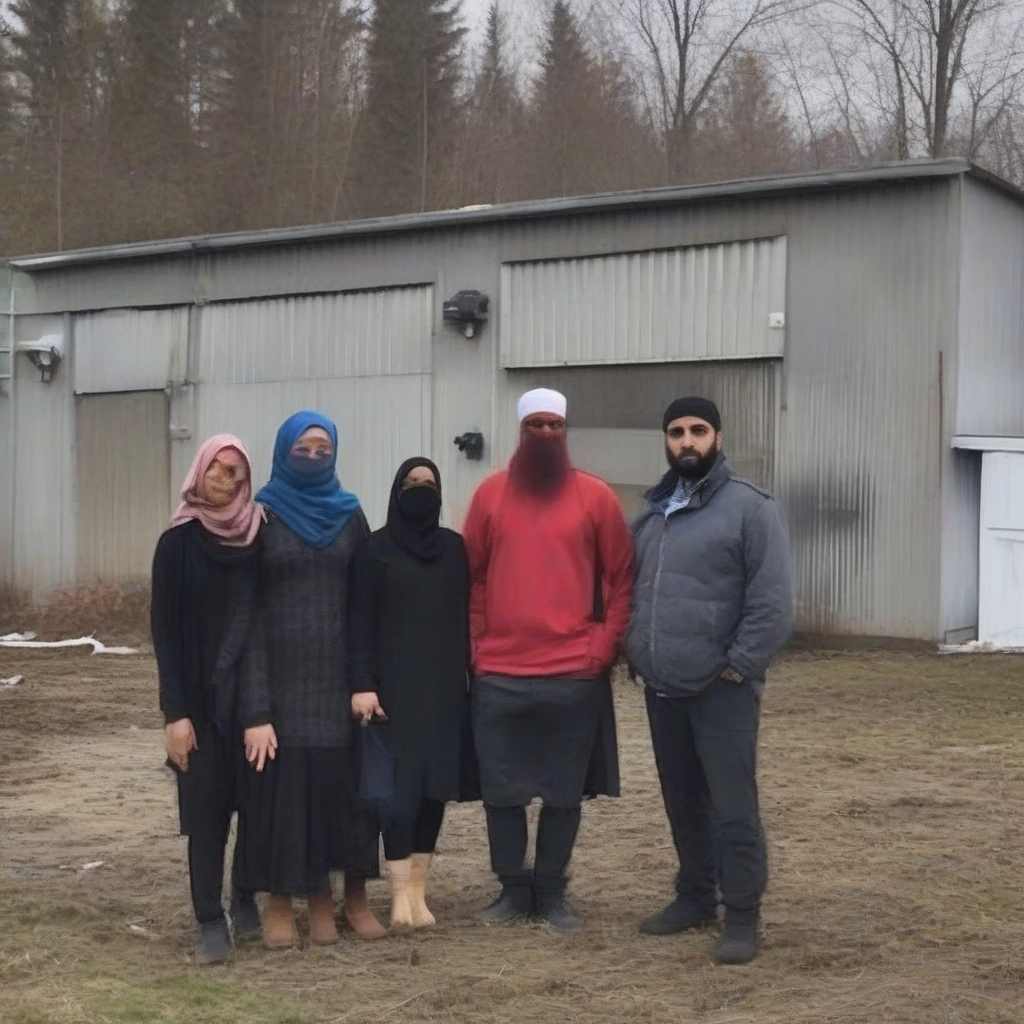
CLARINGTON, Ont. – Mohsin Bhuiyan, a hobby farmer in Clarington, Ontario, and his family are reporting a campaign of harassment and threats following the spread of false online allegations that his property is operating an illegal slaughterhouse.
The situation has escalated from social media rumors to real-world intimidation, including drone surveillance and threats of violence, prompting an investigation by the Durham Region Police Service (DRPS) into potential Criminal Code offenses.
The harassment began approximately one month ago after screenshots circulated on social media claiming the farm was slaughtering Canada geese and operating an illegal business, Bhuiyan said.
Regulatory Clearances and Inspections
The allegations triggered a series of unannounced inspections from four separate regulatory bodies tasked with oversight of agriculture, health, and land use, highlighting how quickly online claims can mobilize formal enforcement systems.
The agencies involved in the investigations included:
- Ontario’s Ministry of Agriculture, Food and Agribusiness (OMFA)
- Clarington bylaw officers
- Municipal building inspectors
- Durham Region’s public health unit
Under Ontario’s meat inspection and food safety framework, including requirements administered by the province’s agriculture ministry and by municipal authorities, any commercial slaughter operation would be subject to licensing, inspection, and enforcement powers similar to those set out in the Safe Food for Canadians Act.
Documentation from all four bodies indicates there was no evidence of a slaughterhouse on the property. A letter from the ministry sent on June 15 stated, “This letter confirms your premises is in compliance with OMFA regulations.”
The Municipality of Clarington confirmed following a thorough investigation that it found “no evidence” of illegal slaughterhouses in Clarington, including Bhuiyan’s property. Bhuiyan stated he is raising ducks on the site, a practice legal under Clarington’s zoning bylaws, and maintained that no animal slaughter is occurring at his home.
Escalation of Harassment
Despite official clearances, Bhuiyan says his family has been “terrorized” by individuals pushing misinformation online. The harassment has included the publication of the family’s home address, drones flying over the property, and social media comments calling for the house to be burned.
“We cannot sleep at night because they’re taking pictures. We do not know who is coming and who is passing by,” Bhuiyan said.
Earlier this week, Bhuiyan and his wife were confronted outside their home, an interaction that left the family “traumatized.” The confrontation was filmed by John Mutton, the former mayor of Bowmanville.
Mutton, a lobbyist previously identified as “Mr. X” in a report regarding the removal of Greenbelt land, was banned from lobbying the province for a minimum of two years following that inquiry. His involvement has drawn the dispute beyond a neighbourhood conflict and into the realm of local political influence and regulatory pressure.
Mutton told investigators he was acting on behalf of an “army of people” concerned about animal welfare violations. He denied that his actions or those of other residents constitute harassment.
“People came to me to raise the issue,” Mutton said. “I’m not in charge of [the protest]. I’m just a guy that’s going out there and talking at the residents’ request.”
The Bylaw Dispute
Mutton has disputed the municipal findings that cleared the farm, citing his experience as a former mayor to claim expertise in bylaw issues. He alleged that a pond on the property was an “illegal” expansion and violated building bylaws.
The municipality confirmed that building inspectors found building code matters at the site, though it specified these were “unrelated” to meat processing.
According to a letter received by Bhuiyan, the violations pertained to:
- Two structures built without the required building permits.
Bhuiyan was not fined and was not issued a teardown order; he was instead requested to apply for the necessary permits before an order-to-comply was issued, a standard step in municipal enforcement intended to bring properties into compliance rather than immediately penalize owners.
Mutton has also used social media to call for investigations into other properties across Clarington and Canada, specifically targeting those he claims operate as halal slaughterhouses. He insisted his motivations are “strictly regulatory” and “has nothing to do with race, nothing to do with religion.”
Islamophobia, Online Hate and Legislative Response
Omar Khamissa, chief mobilization officer for the National Council of Canadian Muslims (NCCM), described the targeting of Bhuiyan’s farm as part of a “spike of Islamophobia” where online spaces serve as a “safe haven” for conspiracy theories and coordinated pile-ons against visible Muslim families.
“It started as something that was online and now it’s transformed into real-life harassment, real-life campaigns, real-life threats,” Khamissa said, warning that hyperlocal disputes can be amplified nationally by viral posts and influencers.
The NCCM is advocating for stronger online harm legislation to prevent digital campaigns from inciting physical violence. Khamissa cited the 2017 Quebec City mosque shooting and the 2021 terror attack in London, Ontario, as precedents for the danger of unchecked hate.
“There’s got to be a line here,” Khamissa said. “We’re not just talking about one family anymore. Now we’re talking about what kind of country we have.”
This escalation coincides with the federal government’s “Combatting Hate Act,” which reforms Canada’s hate-crime laws to increase protections against hate-related incidents and would interact with existing Criminal Code provisions on hate propaganda and incitement. The Act is scheduled to go into effect later this month, positioning Bhuiyan’s case as an early test of how online hostility, zoning disputes, and hate-motivated conduct are treated under an evolving national framework to address harmful content and extremist mobilization on digital platforms such as Facebook.
Police Action
The Durham Region Police Service has confirmed it is investigating the matter. Const. Nick Gluckstein stated that the service is aware of the increase in social media commentary and has received formal complaints.
“DRPS continues to investigate and assess the circumstances to determine whether any offences under the Criminal Code have occurred,” Gluckstein said, noting that investigators are reviewing both online posts and conduct at the property.
Police confirmed they will be present this Friday at a planned protest at the farm to maintain peace and ensure public safety, saying their role will be to balance the right to lawful protest with the family’s safety and potential evidence-gathering in any hate-motivated or harassment-related offences.
Worth a look
- Urban Infrastructure Resilience: How European and Asian Megacities Are Adapting to Extreme Climate Oscillations in 2026
- UN General Assembly 2026 Framework on Autonomous Systems: International Diplomacy Faces Algorithmic Governance
- Mark Zuckerberg faces harsh onscreen portrayal in The Social Reckoning (archyde.com)
