
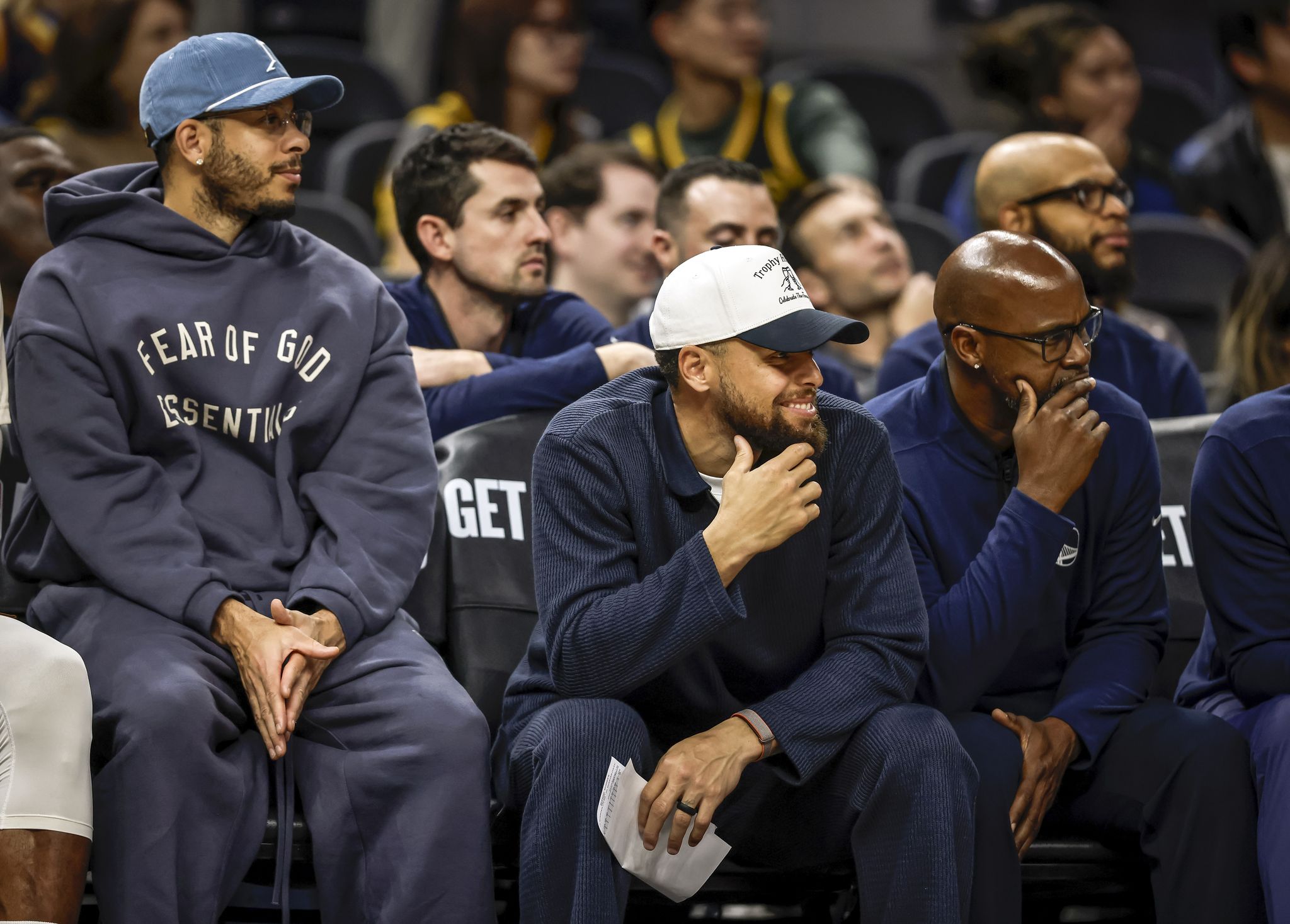
Warriors stress runway for Stephen Curry’s return as evaluation continues; star to miss Nuggets after sitting vs. Wizards
Stephen Curry remains sidelined as Golden State navigates a crucial stretch without its centerpiece. The Warriors said the 17th-year guard “continues to make good progress” following a re-evaluation but have not set a return-to-play date. Curry will work toward five-on-five scrimmage sessions in the coming days and is due for another evaluation next week. He was out again for Friday’s matchup with the Washington Wizards at Chase Center and is also set to miss Sunday’s game against the Denver Nuggets, extending his absence to at least 25 consecutive games and forcing the team to continue reshaping its identity without its primary offensive engine.
Coaching stance: no shortcuts to game readiness
Head coach Steve Kerr underscored that any comeback must leave room for rhythm and conditioning rather than a last-minute appearance. “We’re not bringing him back for … (just) the play-in game,” Kerr said. “He needs to play some games and we need to give him a runway if this is going to work and we are running out of games.” He added that vice president of player health and performance Rick Celebrini “is working with him with the mind set that he will be back,” and acknowledged Curry has “at times been frustrated” by the lingering knee soreness.
The insistence on a runway reflects the broader competitive and institutional calculus inside the Warriors’ program. The NBA’s postseason now includes a play-in format that places additional value on late-season cohesion and availability. Even a brief ramp-up offers outsized dividends-establishing rotation clarity, game speed, and late-clock execution-before the knockout dynamics intensify. For a franchise that has built its governance model around long-term player health and continuity, rushing a 36-year-old star back for short-term gain would run counter to the internal standards medical staff and front office executives have put in place.
At league level, that approach is shaped by the NBA’s own rules: the collective bargaining agreement and related player-health provisions overseen by the National Basketball Players Association and the league office frame how teams can manage workloads, disclose injuries, and structure return-to-play protocols. While decisions on Curry’s status ultimately rest with the Warriors’ medical and performance groups, they sit within that larger regulated environment.
Injury timeline and ramp-up plan
Curry has not played since January 30, when he exited in the third quarter of a loss to the Detroit Pistons with right kneecap soreness. The discomfort first surfaced on January 24 during a workout in Minneapolis. He played through the issue for three games before the extended shutdown. The current plan emphasizes progressive on-court work-individual shooting and movement, controlled contact, and then increased intensity-culminating in five-on-five scrimmaging, followed by next week’s medical check to determine subsequent steps.
Internally, that ramp-up represents more than a health sign-off. It gives coaches and sports science staff a controlled environment to monitor how Curry’s knee responds to game-speed cutting, off-ball screening and defensive slides, all of which underpin his value even on nights when his shot volume is modest. Only once he clears those benchmarks is he expected to return to full NBA minutes, rather than a series of cameo appearances.
Schedule pressure without their fulcrum
Golden State’s spacing, pace, and late-game structure typically flow from Curry’s off-ball movement and shot gravity. In his absence, the staff faces an ongoing balance between defensive stability and half-court creation while preserving minutes continuity for the closing stretch. The burden has shifted more heavily to secondary creators and role players, with the coaching staff using extended looks at alternative ball-handling combinations and small-ball fronts to mimic Curry-centric spacing as closely as possible.
That task tightens with a compact slate over the next week:
- Friday: Washington Wizards (Chase Center)
- Sunday: Denver Nuggets
- Wednesday: San Antonio Spurs
- Thursday: Cleveland Cavaliers
Each contest is another opportunity to refine closing lineups and usage patterns that can carry over once Curry clears scrimmage work and returns to game action. With seeding scenarios shaped by both traditional standings and the play-in bracket, even marginal improvement in late-game execution during this stretch could be the difference between direct playoff qualification and a single-elimination path.
Elsewhere on the injury front
In separate updates around the league, center Al Horford’s right calf strain is making “good progress.” The 19th-year big man, out an eighth straight game Friday, has begun on-court workouts and is slated for another evaluation next Friday. For his team, the priority is similar: protect a veteran core piece while sustaining enough frontcourt stability to avoid overtaxing younger bigs during a dense portion of the schedule.
Seth Curry missed an eighth straight game Friday and is listed day-to-day with a left adductor strain, though he has resumed scrimmaging and on-court work. Quinten Post (right foot soreness) missed a third straight game and is considered day-to-day.
Day-to-day designations typically indicate daily monitoring without a fixed return date, often contingent on how players respond to incremental workload increases in practice and individual drills. Teams are required under league policy to provide timely, good-faith updates on player availability, a transparency standard that has taken on added weight in recent seasons as the NBA and its broadcast and betting partners push for predictability around who takes the floor.
For Golden State, the immediate focus remains unchanged: convert practice progress into controlled scrimmage reps for Curry, then translate that into meaningful minutes before the postseason picture hardens. As Kerr framed it, the emphasis is on readiness, not just clearance-a distinction that could determine whether this season ends with a surge or a brief stay in the league’s most unforgiving phase of competition.
Keep reading
