
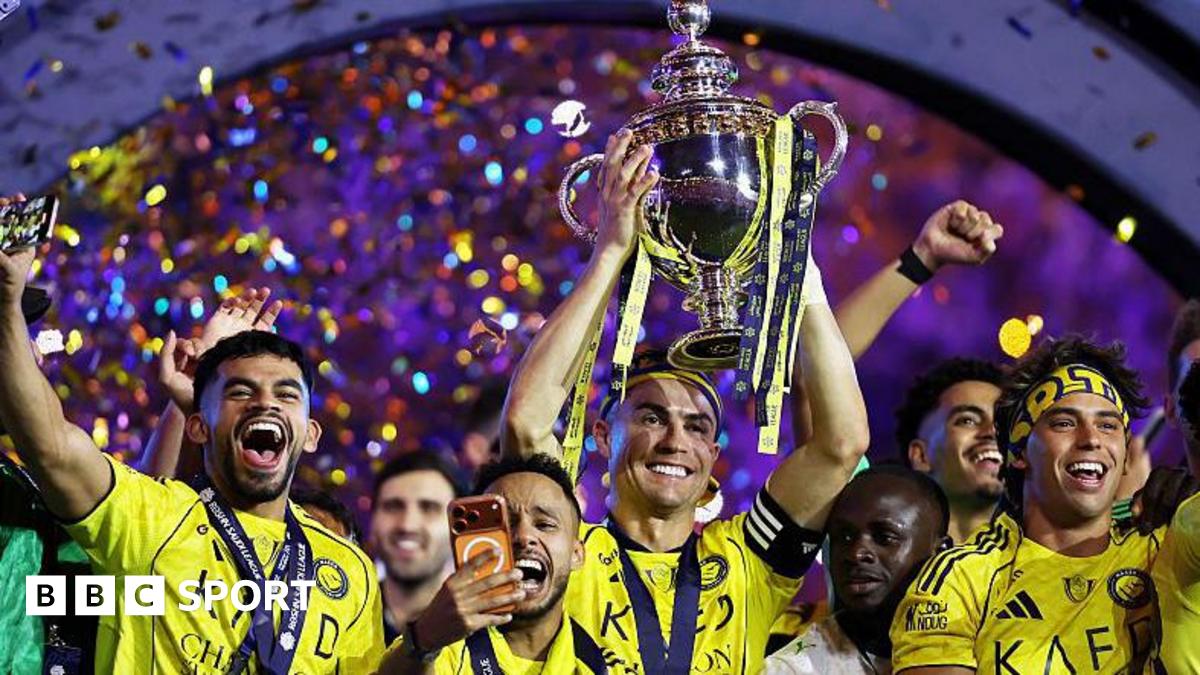
Ronaldo’s Contentious Season Puts Saudi Sports Project Under the Spotlight
The season has not been without controversy.
In February, Cristiano Ronaldo missed two league games, reportedly amid concerns over how Saudi Arabia’s Public Investment Fund (PIF) has run Al-Nassr compared to title rivals Al-Hilal. At the same time, some domestic opponents argue the league bends too far in his favour, exposing tensions at the heart of the country’s flagship football project.
Accusations of Favouritism and a League Under Strain
Al-Ahli’s Toney and Brazilian winger Galeno are among those who have publicly suggested the competition favours Ronaldo and Al-Nassr. Their complaints have echoed a wider unease among players and fans about consistency in refereeing decisions and the broader direction of the league.
Ronaldo has rejected the idea that any individual should sit above the competition, instead turning his criticism on the overall climate surrounding match control and governance.
“I think this is not good for the league. Everyone complains. This is football, this is not a war… but not everything is allowed. I am going to speak at the end of the season because I’ve seen many, many bad things.
“Many players have complained, doing posts on Instagram, on Facebook, speaking about the referees, speaking about the league, speaking about the project. This is not good. This is not the goal of the league.”
The public nature of those remarks matters in competitive terms. The Saudi Pro League, overseen by the Saudi Arabian Football Federation and operating under the global regulatory umbrella of FIFA, relies heavily on perceptions of fairness to attract and retain both high-profile players and international broadcast partners. Persistent claims of favouritism risk undermining that credibility, especially as the league seeks to position itself alongside Europe’s major competitions in global relevance.
PIF’s Wider Sports Push Faces New Questions
The strain is not confined to football. The overall Saudi Arabian sports project has come into question of late as high-profile initiatives have been scaled back or reshaped.
In April, PIF announced it would stop funding LIV Golf at the end of the current season, a significant move given how central the breakaway tour had been to the country’s push into global golf.
In January, the 2029 Winter Asian Games, which were due to be held in Saudi Arabia, were postponed indefinitely. The decision removed a major multi-sport event from the country’s medium-term calendar and signalled a reassessment of timelines for delivering large-scale winter-sport infrastructure in a desert climate.
There has also been reporting that the WTA’s season-ending tennis finals will leave Saudi Arabia once its three-year deal with the country ends this year, further contributing to uncertainty over which elite events will still be on the ground in the kingdom by the end of the decade.
Taken together, these developments suggest that Saudi Arabia’s initial burst of spending across multiple sports is entering a second phase, in which sustainability, regulatory scrutiny and long-term returns are weighed more heavily against headline-grabbing announcements.
From Transfer Hype to Consolidation in the Saudi Pro League
Football reflects that shift as clearly as any other sport. The days when the media was saturated with rumours and rolling reports about big-name European stars heading to the Saudi Pro League have receded. Instead, club recruitment has started to look more structured and selective.
Chadwick, a sports business academic quoted in the original piece, argues that Ronaldo’s and Al-Nassr’s shared achievement this season may still inject fresh energy into Saudi football, which in recent years has struggled to sustain the same hype and appeal that surrounded the early wave of arrivals.
There are, crucially, still substantial deals being done. Al-Qadsiah paid about £57m for Italian striker Mateo Retegui last summer, underlining that ambitious clubs are prepared to commit major transfer fees for players they believe can develop further. Al-Hilal, meanwhile, spent around £46m on Uruguay forward Darwin Núñez, a move that reinforces their intent to remain a dominant force in both domestic and regional competitions.
Yet, compared with the peak of 2023, there is now more emphasis on signing younger footballers with clear sell-on value rather than focusing almost exclusively on ageing superstars nearing the end of their European careers. That evolution aligns the league more closely with established global transfer-market logic, where future resale potential and sporting longevity are weighed alongside immediate marketing impact.
Targeted Superstars and the Economics of Risk
Even with this adjusted lens, the door has not closed on elite veterans. Sources in Riyadh indicate there are still funds available for the right high-profile figure, with Mohamed Salah repeatedly cited as a template. The Egyptian forward, leaving Liverpool in the summer, is wanted by Al-Ittihad – but only if the price is right.
That caveat is instructive. Saudi clubs once operated as if there were virtually no financial ceiling when pursuing marquee names. Now there appears to be sharper internal debate over how much premium can be justified for short-term commercial impact versus the longer-term sporting and financial risk. For the league’s competitive balance, that recalibration matters: it influences which clubs can realistically enter bidding for such players and how evenly top-level talent is distributed.
Ronaldo’s Triumph as a Turning Point
While Ronaldo’s triumph with Al-Nassr may be viewed by some as vindication for the scale of investment poured into Saudi football, it can equally be read as a final flourish of an earlier, more extravagant era – one in which Saudi clubs spent around £700m in a single transfer window.
That phase propelled the Saudi Pro League onto global front pages and screens, but it also raised questions around governance, sustainability and alignment with international transfer rules. As the league matures within the broader regulatory framework of bodies such as the Asian Football Confederation, decisions taken now on spending, squad-building and competitive safeguards will shape how credible the competition appears to neutral observers.
What happens next remains open. Future seasons could see a more balanced model in which domestic development, academy pathways and data-led recruitment sit alongside a handful of carefully chosen star signings. Alternatively, renewed political or commercial impetus could trigger another wave of headline deals, albeit under closer institutional oversight than before.
Responsibility Shifts to Clubs and Decision-Makers
“It is now for all the clubs, the league and the country’s decision-makers to capitalise upon the success that Ronaldo has helped to deliver,” Chadwick said, capturing the strategic dilemma facing those running the project.
The onus is on stakeholders to convert short-term global attention into durable structures: stronger youth systems, coherent financial regulations, transparent refereeing frameworks and competitive parity that can withstand scrutiny from fans and players at home and abroad. How effectively those areas are addressed will influence not only the league’s sporting quality but also its ability to withstand future criticism over fairness and institutional priorities.
For the moment, however, the yellow half of Riyadh and Ronaldo’s worldwide fanbase have much to celebrate. His performances have given Al-Nassr a focal point and have ensured that, even amid questions about spending, governance and long-term vision, Saudi football remains firmly embedded in the global conversation.
Related reading
