
Trump’s Balogun Intervention Drags World Cup Discipline Into Political Storm
Host president admits calls to Fifa as European federations warn of “red line” breach
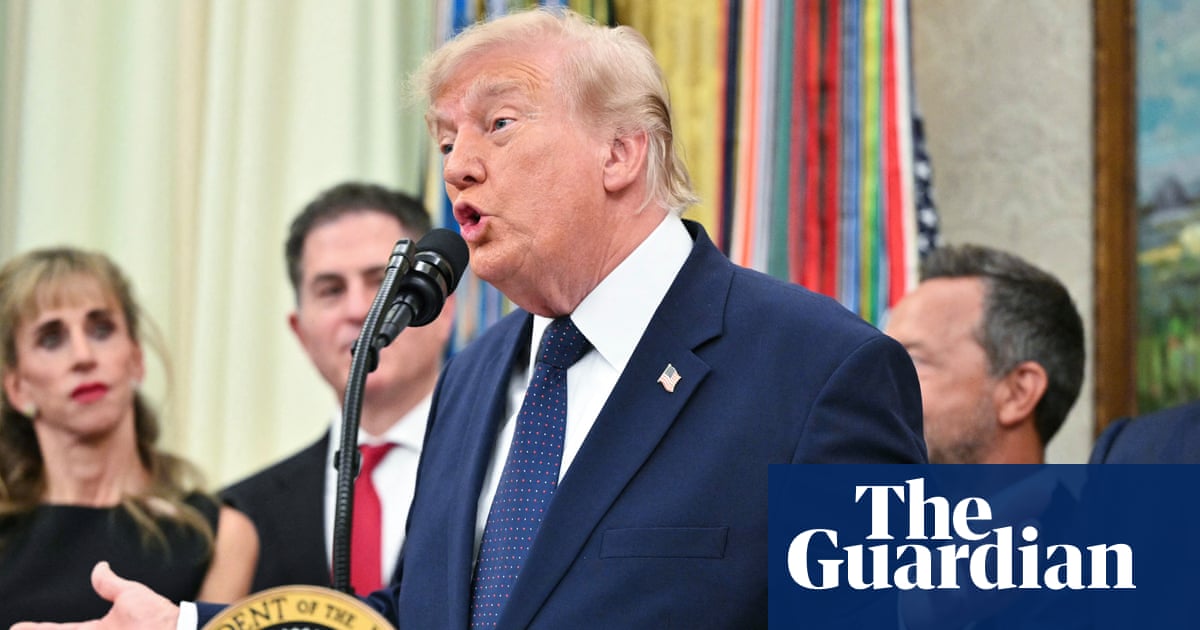
Donald Trump said on Monday that he personally asked Fifa president Gianni Infantino to review the red card shown to USA striker Folarin Balogun, saying he believed the dismissal was unfair but insisting he did not pressure football’s governing body to overturn the suspension.
The intervention by the president of a World Cup host nation has thrust Fifa’s disciplinary process into the spotlight and prompted an angry response from Belgium, who face the USA on Monday night for a place in the quarter-finals.
Uefa, the European game’s governing body, also issued a furious statement, accusing Fifa of crossing “a red line” by making an “incomprehensible and unjustifiable” decision to rescind Balogun’s automatic one-match ban, which it claimed undermined “the integrity of the game and the credibility of the competition”.
Trump’s remarks were his first public acknowledgment that he had personally intervened after Balogun was sent off in the USA’s 2-0 victory against Bosnia and Herzegovina last Wednesday in the last 32. Fifa had suspended the striker’s automatic one-match ban on Sunday despite officials previously saying the sanction could not be appealed under the governing body’s disciplinary code.
Sources told the Guardian that Trump made three calls to Fifa beginning on Wednesday in an effort to secure the reversal.
Oval Office defence and a high-stakes knockout tie
“All I did was ask for a review because I didn’t think it was a foul,” Trump told reporters in the Oval Office. “I didn’t tell him what to do. I can’t tell him what to do.”
On Monday, Trump repeatedly said Balogun’s challenge should never have resulted in a dismissal. “I’ve never seen anything like it,” he said. “So I saw the play, and I’m a person that loves sports and was a good athlete. I understand sports really well. Really well.
“That wasn’t a foul. That wasn’t even an infraction. That was two guys running full speed that happened to crash into each other. You can’t take your foot and properly place it on somebody else’s foot when you’re going full speed. These were two great athletes that got tangled up.
“If he punched him in the face, if he did something wrong, I’d feel differently.”
Framing the decision explicitly in competitive terms, Trump added: “We’re going to have a full team, and Belgium is going to have a full team, and you know what? If they beat us, then they can be really proud. The other way, if they beat us … I say it was rigged, just like the election was rigged in 2020.”
With a quarter-final place on the line, Balogun’s availability is not a marginal issue. The 25-year-old is the USA’s leading scorer at the tournament and opened the scoring against Bosnia and Herzegovina before being sent off after 64 minutes. For a host nation carrying both sporting and commercial expectations deep into a World Cup, the presence or absence of its main striker materially alters the competitive landscape of the knockouts as well as the value of the event to broadcasters and sponsors.
Referee criticised as rules confusion exposed
Trump described the Brazilian referee Raphael Claus as “very suspect” and said the official had made “a call that nobody could believe”. He also suggested reporters examine Claus’s record, without elaborating.
The president said he only learned after the match that a straight red card carried an automatic suspension. “It’s one thing to penalize somebody for the game,” he said. “But how do you penalize them for a game that hasn’t been played yet? It’s very unfair.”
Under the disciplinary frameworks used across elite football, straight red cards routinely trigger automatic suspensions – a key deterrent against serious foul play and violent conduct. Trump’s comments highlight how little of that regulatory structure is visible to occasional viewers, even as its consequences can define a nation’s tournament.
Trump said he believed Balogun’s absence would have diminished the tournament and praised Fifa’s eventual decision to restore the striker’s eligibility. “We’ve got to have our best players and they have to have their best,” Trump said. “If we win or we lose, it’s fair.”
Infantino stresses independence as Fifa leans on Article 27
Trump also sought to distance Infantino from the decision. “I don’t believe he made the decision,” Trump said. “I think it was a committee that made the decision, and they made the right decision because, number one, it wasn’t a foul.”
In a statement issued after Trump’s remarks, Infantino confirmed that he had received a call from the US president but said he told Trump the matter was before Fifa’s independent disciplinary bodies.
“Fifa’s judicial bodies are independent,” Infantino said. “They operate autonomously, apply the Fifa disciplinary code, and decide cases based on the applicable regulations and the specific facts before them.”
He added that while he sometimes agreed and sometimes disagreed with disciplinary decisions, he “always” respected the autonomy of the bodies that made them.
Neither Trump nor Fifa explained the legal basis on which Balogun’s suspension was lifted. Fifa announced on Sunday that Balogun’s ban had been lifted for a 12‑month probationary period, an unprecedented decision during a tournament that was justified with a brief reference to Article 27 of the Fifa disciplinary code, which gives its judicial committee the authority to “fully or partially suspend the implementation of a disciplinary measure.”
In practical terms, that means Balogun can play while effectively under review for a year, with the sanction capable of being reactivated. The use of such a provision during the World Cup’s knockout stages, and in the wake of direct contact from a head of state, is what has set alarm bells ringing among rival federations.
European federations and politicians close ranks
Uefa claimed that the world governing body had ignored its own rulebook for political reasons. “Football, like any other sports, relies on rules, which are the basis for fair, honest and transparent competition,” read a statement. “Sometimes rules are open to interpretation. In this case not …
“When the certainty of rules is no longer guaranteed by its guardians, the integrity of the game is at stake and the credibility of a competition is undermined. We express our disbelief at such an unprecedented, incomprehensible and unjustifiable decision.”
The Royal Belgian Football Association (RBFA) expressed its own “astonishment” at the decision, with national team manager Rudi Garcia comparing it to an April Fools’ Day joke. Their appeal was rejected by Fifa’s appeals committee on the grounds that it was “not a party to proceedings”.
The RBFA has also received strong support from some of their European counterparts. The German Football Association (DFB) questioned whether the outcome was the result of political interference, and said that Fifa’s credibility was at stake. “The impression that there has been active political interference in sport must be dispelled swiftly and conclusively,” read a statement. “The integrity of the competition and the credibility of Fifa are at stake.”
Lisa Klaveness, president of the Norwegian Football Association (NFF), said it shared Uefa’s “serious concern”, adding: “This is about more than tonight’s Round of 16 match between the United States and Belgium. It is about the integrity of football as a whole and the protection of the fundamental principles of fair play, both at the Fifa World Cup and across the world’s biggest sport.”
The Football Association declined to comment when contacted by the Guardian, but England manager Thomas Tuchel criticised the decision following his side’s thrilling 3-2 win over Mexico that secured their place in the last‑16, where they will meet Norway in Miami on Saturday. “Where does it end now?” he said. “Do we appeal if a yellow card is not a yellow card? Do we think it’s not a red card or who thinks so? Where does it start and where does it end? I don’t have an answer. It’s just strange for me. We just want to have consistency in the decisions.”
For European teams, the concern extends beyond the immediate advantage gained by a direct rival. If political weight can be seen to alter disciplinary outcomes during a World Cup, it risks eroding confidence in the neutral application of sanctions that underpin continental club competitions and future international tournaments.
Social media celebrations and a politically charged backdrop
Trump’s involvement first emerged after he publicly thanked Fifa for “reversing a great injustice” on Sunday afternoon. The White House official X account then responded to Trump’s post by writing: “USA-USA-USA” next to an image of a bald eagle.
The close relationship between Trump and Infantino has been a recurring theme of the World Cup and the buildup to the tournament, most notably when the former was awarded the inaugural Fifa Peace Prize at the World Cup draw in Washington DC last December. While Fifa has used that relationship to secure some tax exemptions for competing teams from the US government, it has not everything it wanted from the Trump administration and suffered some major embarrassments, such as the host’s treatment of the Iran national team and refusal to grant a visa to the Somali referee, Omar Artan, on national security grounds.
Infantino’s predecessor, Sepp Blatter, who resigned in disgrace following FBI raids on Fifa’s headquarters in 2015 and was subsequently banned from football, was another to criticise Trump’s role in the process. “Red cards are not overturned by political phone calls,” Blatter wrote on X. “They are overturned by rules, evidence and independent bodies. If a US president intervenes with the Fifa president – and a player is suddenly cleared before a World Cup knockout match – the question is unavoidable: Quo vadis [where are you going], Fifa?”
Members of the Fifa Council, the global governing body’s decision-making arm, also expressed deep surprise over the shelving of Balogun’s suspension and its circumstances.
Political figures weigh in as sporting boundaries blur
Several European politicians took a similar stance, with Belgian foreign minister Maxime Prévot accusing Fifa of violating the rules of football. “As a former football referee, I have always been committed to upholding the rules and ensuring decisions are fair,” Prévot told Politico. “This decision clearly raises many questions. If a phone call is really the reason for this incomprehensible decision, it would be a blatant violation of the most basic rules of football and sport”.
Earlier Monday, Republican senator Ted Cruz publicly thanked Trump for Balogun’s reinstatement during the Oval Office event organized to launch the administration’s new “Trump accounts” savings program for children.
“On behalf of all Americans, thank you for getting rid of that ridiculous red card,” the Texas Republican said.
“That was interesting,” Trump replied.
“It was spectacular,” Cruz continued. “There was a reason the Fifa trophy sat here for as long as it did.”
Trump said he had spoken with Infantino after watching England’s victory against Mexico on Sunday night, which he described as evidence of the tournament’s popularity in the US. “Each one is turning out to be a Super Bowl,” Trump said of the World Cup matches.
Trump also singled out the England captain, Harry Kane, for praise. “I don’t know the players, although I think Kane is a great player,” Trump said. “I played golf with him and I like him a lot. He’s a good golfer. But he’s really great.”
For players and coaches, such public endorsements and interventions from senior politicians add another layer of scrutiny to already intense knockout fixtures. For administrators, they sharpen long‑running debates about how to protect disciplinary mechanisms from external pressure without undermining host‑nation engagement that helps grow the sport.
Sporting consequences for USA, Belgium and the wider game
Balogun’s availability is a major boost for the USA side. As the team’s leading scorer at the tournament, his reinstatement changes the tactical equation for both benches, allowing the hosts to set up around their preferred spearhead and forcing Belgium to prepare for the striker who already scored in the last round.
For Belgium, the timing of the decision – on the eve of a last‑16 tie – and the justification given have combined to create a sense of procedural disadvantage. For the USA, there is a risk that any progress in the tournament will be viewed by some as benefiting from political leverage, however robust Fifa insists its judicial processes remain.
More broadly, the use of a discretionary suspension of sanction during a World Cup knockout phase invites questions that will not end with this tournament: under what circumstances can Article 27 be used again; how transparent must Fifa be when invoking it; and what safeguards are in place to ensure that future hosts, whether in football or other global events, cannot be perceived to shape disciplinary outcomes for competitive gain.
Nick Ames contributed additional reporting
Keep reading
