
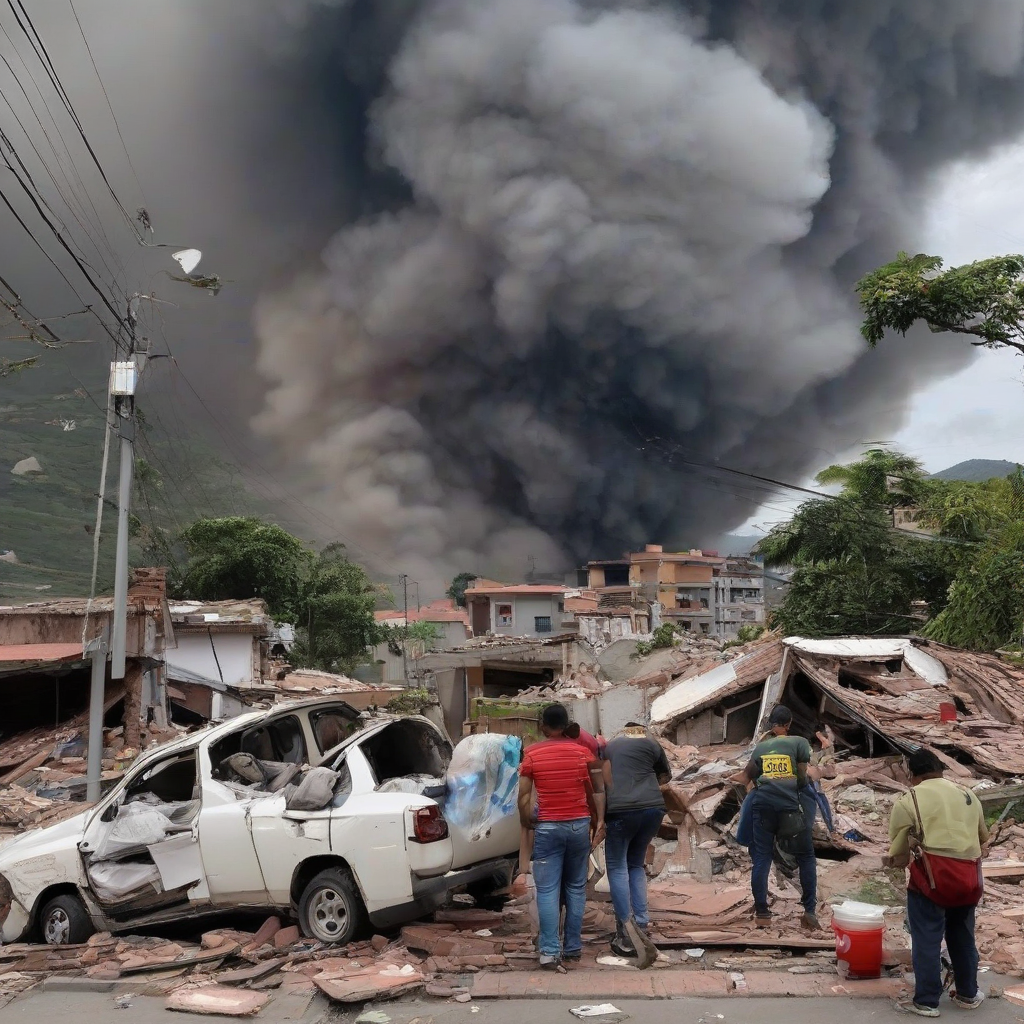
CARACAS – A magnitude 4.6 aftershock struck northern Venezuela, triggering widespread panic in the capital and the port city of La Guaira five days after twin earthquakes killed 1,719 people.
The tremor arrived as rescue crews continued searching for tens of thousands of missing persons amidst a deepening humanitarian emergency. While official reports suggest no immediate new damage from the aftershock, the event forced residents from makeshift shelters back into the streets and disrupted critical infrastructure.
The disaster represents the most severe seismic activity to hit the country in over a century, striking a population already weakened by a decade of economic collapse that has hollowed out public services and hospitals.
Panic and Infrastructure Disruption
The aftershock, measured at magnitude 4.6 by the US Geological Survey and 5.1 by Colombia’s geological survey, shook Caracas and the devastated port of La Guaira. In the capital, several lines of the metro system were shut down due to concerns that further tremors could collapse already weakened structures, compounding transport paralysis in a city where fuel shortages and unreliable buses were already the norm.
In San Bernardino, search operations at the 22-unit Rita apartment building-which suffered a total collapse during the initial quakes-were suspended for approximately 90 minutes following the tremor as structural engineers reassessed the stability of surrounding buildings.
Residents in hardest-hit areas, including Altamira and San Bernardino, abandoned tents and makeshift sidewalk shelters, fearing falling debris and additional collapses. Amarelis Mendoza, a resident of El Hatillo in Caracas, described the experience: “I was asleep when the shaking woke me up. It felt almost as strong as Wednesday’s earthquake, even though I hadn’t felt the other aftershocks.”
Authorities released new aerial imagery showing dense residential blocks reduced to rubble and key access roads cracked or blocked by landslides, underscoring the scale of the challenge for emergency crews.
Updated seismic hazard maps of northern Venezuela circulated among government agencies on Monday, as civil protection officials weighed whether to expand exclusion zones around compromised high-rise clusters.
Search and Recovery Efforts
International and local teams are continuing to comb through rubble, though the window for successful rescues is narrowing. Rescue operations typically prioritize the first 72 hours; however, recent finds have provided limited optimism and reinforced pressure on the government to keep heavy machinery out of some sites where families insist loved ones may still be alive.
Interim president Delcy Rodríguez stated, “Today we have rescued people who are still alive and therefore these efforts will not be suspended,” following the rescue of a man and his teenage son in La Guaira. Her remarks came after an emergency session of the national security council, which has been coordinating response efforts with state governors and the armed forces.
Despite these successes, rescue workers report a grim reality. A Salvadoran rescue worker told Agence France-Presse: “At this point, they are probably dead bodies. Thanks to God maybe we can find people still alive.”
The scale of the tragedy is reflected in the current casualty and damage figures:
- Confirmed deaths: 1,719
- Injuries: 5,034
- Buildings severely damaged: Nearly 800, including hospitals, schools, and public administration offices
- Estimated people affected: 6.76 million
The United Nations has provided 10,000 body bags to authorities. Gianluca Rampolla del Tindaro, UN coordinator for Venezuela, stated that while he declined to speculate on official figures, “we are definitely looking at a number that is higher than the one already reported.” The UN is working within the framework of the country’s disaster risk reduction commitments under the Sendai Framework for Disaster Risk Reduction, which calls on governments to strengthen building codes and emergency preparedness.
International Aid and Logistical Response
A massive international coalition has mobilized to assist the recovery, with 27 countries deploying over 2,000 personnel and 160 search dogs. Specialized urban search-and-rescue teams have been assigned sectors of Caracas and La Guaira under a common incident command structure led by Venezuela’s civil protection agency.
U.S. military forces have focused on restoring critical logistics. US Marines completed repairs to one of the nation’s two primary ports, allowing the USS Fort Lauderdale to deliver emergency supplies and opening a corridor for commercial cargo vessels carrying fuel, generators, and modular field hospitals.
The financial and material aid includes:
- Total supplies: 521 tonnes from 24 nations
- Search-and-rescue personnel: More than 2,700
- U.S. aid package: Increased from $150 million to $300 million for medical care, food, water, and logistics
- UN repair estimate: $6.7 billion (approximately 6% of Venezuela’s GDP), a figure that will test the government’s fiscal capacity and its access to multilateral financing
Diplomats say decisions taken in the coming days on customs waivers, emergency procurement rules, and access for foreign medical teams will shape not only the speed of the response but also Venezuela’s broader reintegration into global financial and humanitarian channels.
Humanitarian Crisis and Civil Unrest
The disaster has displaced hundreds of thousands. In Caracas, families have established camps in the 200-acre Parque del Este, erecting tarps and salvaged materials in what has rapidly become an improvised city within the city. Health officials have warned of the risk of waterborne disease if sanitation and clean water are not stabilized quickly.
Katiuska Asuaje, 35, who fled her home in Bello Campo with four children, said, “Life is worth more than anything else. We weren’t going to wait for the house to collapse on top of us because one of the concrete roof slabs had already come loose.”
In west Caracas, survivors like Maryuri Pérez, 36, and Jaime Blanco, 40, report a critical lack of basic shelter. “What we need most is a tent or at least a mattress to sleep on,” Pérez said, echoing complaints that official distributions have favored politically connected neighborhoods.
This desperation has led to instability in La Guaira, where pharmacies and supermarkets have been ransacked. Residents have criticized the government’s slow response and inadequate aid distribution. In the Tanaguarena area, the tension escalated into direct confrontations with security forces, with one man shouting to soldiers, “The country needs you. Put down your weapon,” urging them to assist in rescue work with tools rather than arms.
The remains of buildings in El Junquito, Venezuela on Monday. Photograph: Federico Parra/AFP/Getty Images
To manage the situation, authorities have barred international journalists from entering collapse zones in La Guaira for 48 hours, citing security reasons. Press freedom groups have condemned the move as a blow to transparency, while government officials insist it is necessary to protect ongoing operations and prevent interference with forensic work.
Political Implications
The disaster has prompted a response from the political opposition. María Corina Machado, an opposition figure currently in exile, announced her intention to return to the country. Speaking to Fox News, she stated: “The time has come. We need to be together, to embrace, to grieve and mourn together, but also to give each other strength at this difficult time.” Her possible return injects fresh uncertainty into an already polarized political landscape, where control over reconstruction funds and aid delivery could become a new frontline.
The US State Department confirmed that the doubled aid package of $300 million will be allocated toward emergency medical care, food assistance, water, sanitation, shelter, and protection. Officials in Washington have stressed that assistance will be channeled in line with international humanitarian principles and existing U.S. sanctions regulations, including the humanitarian carve-outs under the U.S. Venezuela sanctions program, to ensure that support reaches civilians rather than government security structures.
Keep reading
