
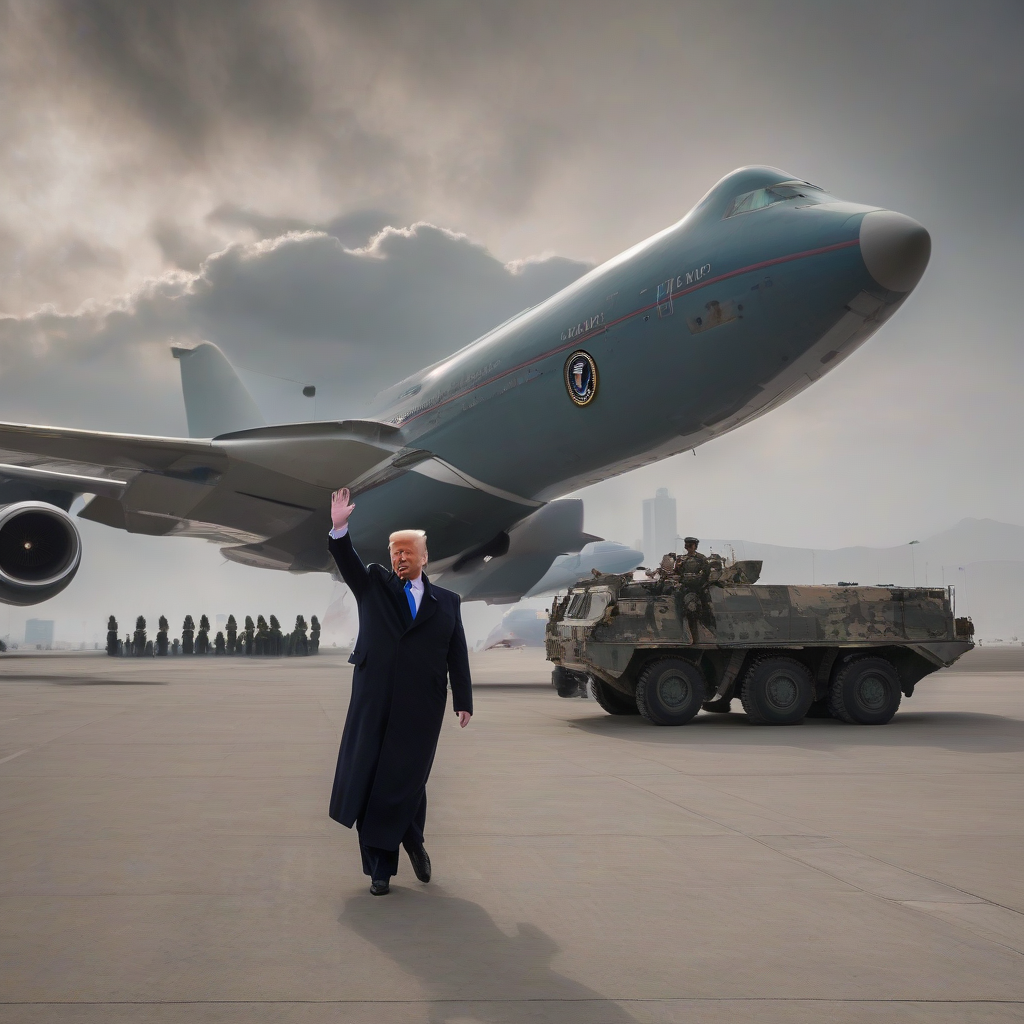
BEIJING – US President Donald Trump departed China on Friday following a two-day summit with President Xi Jinping, ending a visit that failed to secure concrete commitments from Beijing to help terminate the war in Iran.
While both leaders stated they felt “very similar” regarding the need for the conflict to end and for the Strait of Hormuz to be reopened, the visit concluded without tangible diplomatic breakthroughs on the war.
The summit highlighted a divergence in priorities between the two nations, with the U.S. focusing on immediate commercial wins and China emphasizing a broader framework of long-term diplomatic stability.
Iran Nuclear and Military Constraints
During the visit, President Xi promised that China would not provide military equipment to Iran – a pledge that, if implemented, would touch directly on existing United Nations arms restrictions and wider nonproliferation norms embedded in the UN Charter.
Speaking on the Sean Hannity show, President Trump characterized Xi’s assurance as a “big statement,” presenting it as evidence that Beijing is prepared to tighten its posture toward Tehran’s military ambitions.
The leaders also reached a consensus that Iran should never possess a nuclear weapon, according to a White House readout. However, the U.S. president specified that any suspension of Iran’s nuclear program would require a significant timeframe and a “real” commitment from Tehran, echoing longstanding U.S. insistence on verifiable limits under international safeguards.
“Twenty years is enough, but the level of guarantee from them, it’s got to be a real 20 years,” Trump said, suggesting that Washington will seek concrete monitoring and enforcement provisions rather than purely political assurances.
Despite these discussions, external analysts suggested the results were limited. Patricia Kim, a foreign policy fellow at the Brookings Institution, noted that the meeting ended with “no Chinese commitment to do anything specific” about the war, underscoring a gap between high-level rhetoric and operational steps that could alter conditions on the ground.
Energy Shifts and Sanctions
A central point of negotiation involved China’s energy security and its reliance on Iranian fuel, which flows through the Strait of Hormuz – a chokepoint vital to global oil markets and maritime trade. In an effort to decrease future dependence on that corridor, President Xi expressed interest in increasing the purchase of American oil.
This shift in procurement has led President Trump to reconsider the current U.S. sanctions regime targeting Chinese oil companies that purchase Iranian oil, of which China is the largest buyer. Those measures, imposed under U.S. sanctions law and enforced by the Treasury Department, have been a key tool of Washington’s maximum-pressure strategy on Tehran.
While leaving Beijing, Trump informed reporters that he and President Xi discussed the sanctions and that he is “going to make a decision over the next few days,” signaling that any relaxation could be calibrated to Chinese cooperation on energy diversification and Iranian compliance with international obligations.
Boeing Order Shortfall
The summit’s primary commercial objective saw a significant reduction in scale. A deal for the purchase of Boeing jets, which had been discussed at a volume of 500 aircraft, was finalized at only 200, limiting the headline value Trump had hoped to bring home as proof of stronger bilateral trade ties.
Following the announcement of the smaller deal on Thursday, Boeing stock fell 4 per cent, reflecting investor concern that political risk and export controls remain a constraint on large-scale aerospace sales into the Chinese market.
Boeing Agreement at a Glance:
- Initial discussions: 500 jets
- Finalized agreement: 200 jets
- Upside clause: Potential increase to as many as 750 jets, contingent on the performance and delivery of the initial 200
Strategic Stability and Pageantry
The diplomatic tone of the meeting marked a departure from previous U.S. administrations. President Xi described the bilateral relationship as having “constructive strategic stability,” a phrase that contrasts with the “strategic competition” terminology utilized by former President Joe Biden and signals Beijing’s desire to frame ties as managed rivalry rather than open contest.
The high-level talks were accompanied by significant pageantry, including a welcome ceremony at the Great Hall of the People and a tour of the Zhongnanhai compound, designed to project continuity and respect even as the two sides remain divided on core security and economic issues.
During the tour, President Xi showed the U.S. leader centuries-old trees in a secluded garden. When asked if other foreign leaders were typically received in the compound, Xi responded, “Very rarely.” He noted that while they previously did not hold diplomatic events there, they have started to do so in extremely rare instances, mentioning that Russian President Vladimir Putin had also toured the garden. The carefully choreographed access underscored the personal diplomacy both capitals hope can contain tensions.
This visit marked the first time a U.S. president has visited China since Trump’s previous trip in 2017, closing a years-long gap in presidential-level engagement that spanned trade wars, the COVID-19 pandemic and a sharp deterioration in strategic trust.
China’s Foreign Minister Wang Yi confirmed that President Xi will visit the United States in autumn at the invitation of President Trump. Diplomats on both sides say the return visit is expected to advance discussions on trade, military-to-military communication and guardrails to prevent incidents in contested regions, alongside continued debate over implementation of global trade rules under the framework of the World Trade Organization agreements.
Worth a look
- Urban Infrastructure Resilience: How European and Asian Megacities Are Adapting to Extreme Climate Oscillations in 2026
- UN General Assembly 2026 Framework on Autonomous Systems: International Diplomacy Faces Algorithmic Governance
- Trump bashes Democrats on crime while campaigning for Whatley (archyde.com)
- Japan vs China: 2026 Asian Games Men’s Basketball Semifinal Guide (archysport.com)
