
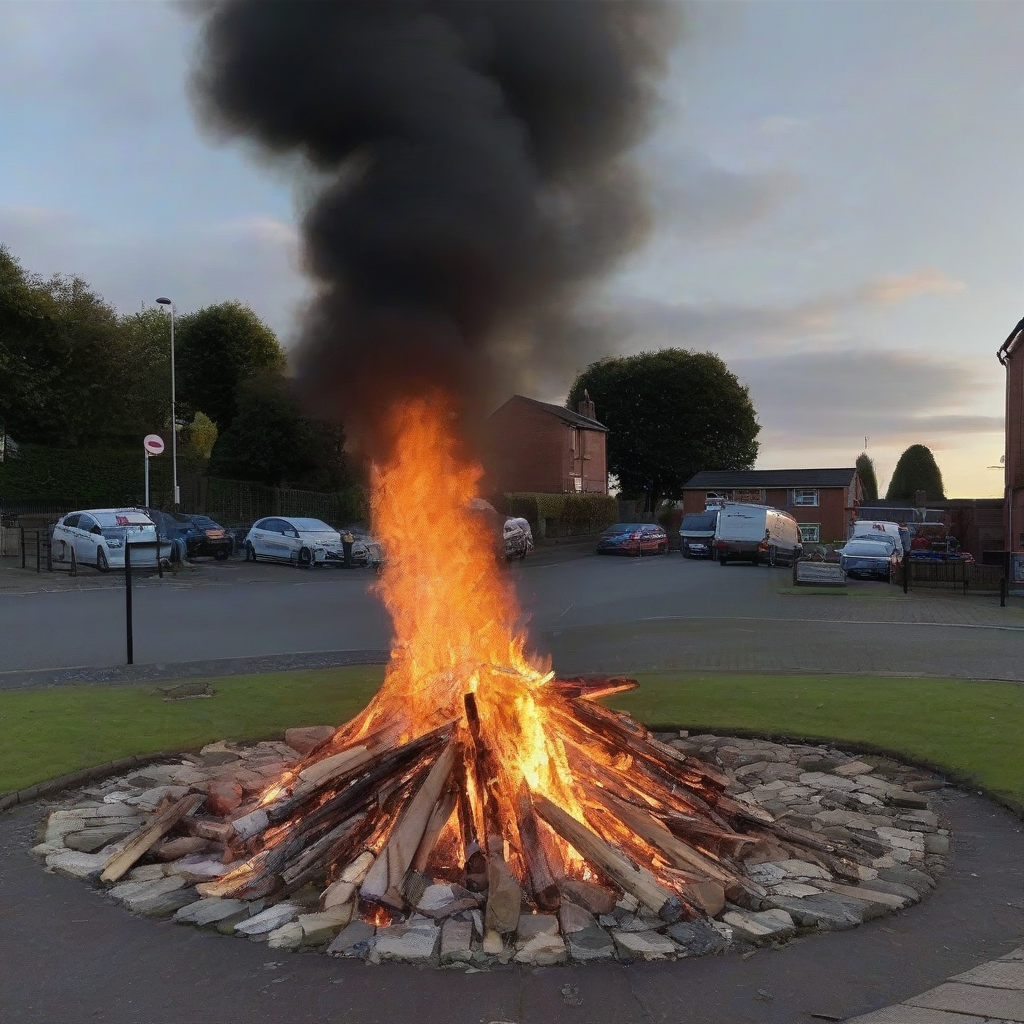
MOYGASHEL – A loyalist bonfire in County Tyrone was ignited a day ahead of schedule as the Police Service of Northern Ireland (PSNI) attempted to remove a replica of a mosque from the top of the structure.
The early ignition was a deliberate act to prevent authorities from dismantling a display that police are treating as a hate-motivated criminal offence. The event has triggered widespread condemnation from government officials, religious leaders, and human rights organizations across Northern Ireland.
The incident occurs during a period of heightened tension as communities prepare for the Orange Order’s July 12 parades, a time when bonfires are traditionally lit across the region.
Police Operation and Criminal Charges
The PSNI launched what it described as a “significant and complex policing operation to remove a hate display” from the pyre in Moygashel. However, the operation was disrupted when the bonfire was set alight in the early hours of the morning.
Chief Superintendent Norman Haslett stated: “Before police arrival, the bonfire was set alight a day in advance to prevent removal of the criminal material.”
The PSNI confirmed that the operation was at “an advanced stage” when the fire was started. As a result of the investigation, a 56-year-old man has been charged with incitement to hatred, an offence pursued under Northern Ireland’s hate crime and public order laws, including the Public Order (Northern Ireland) Order 1987, which criminalises the incitement of hatred or fear against protected groups.
Police said further evidence-gathering, including from drone footage and body-worn cameras, is ongoing, and that additional arrests and charges have not been ruled out.
Condemnation of the Display
The replica mosque, which was visible atop the pyre, drew sharp criticism from political and spiritual leaders who viewed the act as an attempt to intimidate the Muslim community and other minorities living in Northern Ireland.
Northern Ireland Secretary Hilary Benn described the display as a “sickening and cowardly act of intimidation,” adding in a social media post: “This is not about tradition, and in no way does it represent the vast majority of people in Northern Ireland. We must stand united and completely reject such hatred.”
Amnesty International labeled the structure a “vile display” and a “blatant attempt to stir up anti-Muslim hatred and intimidate local families.”
Religious leaders also issued a joint rebuke, focusing on the violation of fundamental democratic principles:
- Catholic Archbishop Eamon Martin and Church of Ireland Archbishop John McDowell stated that freedom of religion is a fundamental principle of a democratic society.
- They described the placement of the mosque model as “grossly offensive.”
- They argued that “Christians of all traditions would be aghast at the wanton destruction of Christian imagery” and should likewise be “appalled at the provocative denigration of symbols associated with faiths that are sincerely held by others.”
Community advocates warned that the imagery risks deepening mistrust at a time when local councils, police and civil society groups are working to expand integration initiatives and reassure minority communities that they are protected under the law.
Defense of the Bonfire
The Moygashel Bonfire Association defended the display, framing it as a “political protest” rather than a hate crime. In a social media statement, the association claimed its opposition was directed at “ideology and Government policy” rather than people.
The association stated that the display focused on “an issue of significant public interest,” specifically targeting what it described as “uncontrolled illegal mass immigration.”
The pyre, constructed from pallets, featured several signs, including:
- “Secure our borders”
- “End the threat of radical Islam”
The association further argued that their “cultural expression” and their “traditional act of political protest” are distinct concepts that they have established a position of combining at their yearly event. They insisted the replica mosque and accompanying slogans should be viewed as commentary on policy rather than an attack on any community, a characterisation firmly rejected by police and rights groups.
Watch: Replica of a mosque placed on top of a loyalist bonfire pyre in Co Tyrone.
Tradition versus Intimidation
The Moygashel site has a history of controversy. In the previous year, the association faced condemnation after burning effigies of migrants in a boat, prompting criticism from human rights organisations and renewed calls for clearer regulation of bonfire content.
The Democratic Unionist Party (DUP) stated that while it supports the right to express lawful political opinions, effigies should not be placed on bonfires. A party spokesperson noted that the July 11 bonfires “are a historic and cultural tradition stretching back to the fires lit to welcome the arrival of King William III” and should remain “positive cultural celebrations.”
Ulster Unionist Party leader Jon Burrows called for the “immediate removal of the offensive display,” stating that the tradition of the unionist community is “undermined when bonfires are used to intimidate, provoke or demean others.” Burrows warned that such images damage Northern Ireland’s global reputation and complicate efforts to attract investment and tourism.
Other political responses included:
- Colm Gildernew (Sinn Féin MLA): Described the display as “deplorable” and stated there is “no place in our society for racism.”
- Eddie Roofe (Alliance Party Councillor): Called the placement of the model “utterly abhorrent” and “hateful.”
Local representatives said the incident would likely feature in upcoming discussions between Stormont departments, councils and the PSNI on how to manage contentious bonfires, alongside wider community relations strategies set out in frameworks such as the Together: Building a United Community policy.
The 56-year-old man charged by the PSNI is due to appear before Dungannon Magistrates’ Court, where prosecutors are expected to set out in more detail how the display is alleged to have crossed the line from protected political expression into criminal hate speech.
