
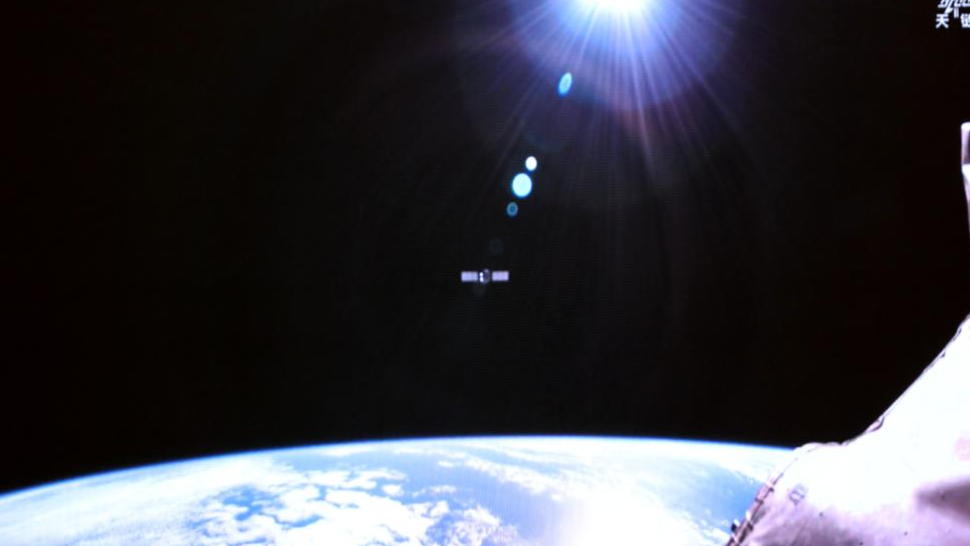
The successful controlled re-entry of the Tianzhou-9 cargo craft marks the completion of a critical logistics cycle for the Tiangong space station and underscores China’s growing competence in routine, tightly managed operations in orbit. The craft entered the atmosphere at 7:49 am (Beijing Time) Thursday, following a precision-timed descent designed to mitigate orbital debris risks and demonstrate adherence to emerging international norms on the safe disposal of large spacecraft.
Managing the disposal of spent hardware is a cornerstone of modern space governance. The China Manned Space Agency (CMSA) confirmed that “a small amount of debris that survived the ablation fell into the designated safe waters,” ensuring that the remnants of the mission did not pose a risk to populated landmasses or active maritime lanes. Such controlled splashdowns are increasingly viewed by regulators as a baseline requirement for responsible operations in orbit, rather than a technical bonus.
Orbital Logistics and Station Sustainability
The Tianzhou series serves as the primary supply chain for China’s modular space station, providing the consumables, scientific equipment and propellant needed to maintain long-term human presence in low Earth orbit. These flights are not simple cargo runs: each mission is built into the station’s life-support and propulsion architecture, often acting as a temporary storage and logistics module before its eventual decommissioning.
| Mission Phase | Detail / Timeline (Beijing Time) |
|---|---|
| Launch Date | July 15, 2025 |
| Launch Site | Wenchang Spacecraft Launch Site, Hainan |
| Primary Payload | Astronaut consumables, propellant, experiment equipment |
| Undocking Time | Wednesday, 4:34 pm |
| Controlled Re-entry | Thursday, 7:49 am |
The transition from a docked state to independent flight is a high-risk maneuver requiring precise algorithmic synchronization between the cargo craft and the station’s guidance, navigation and control (GNC) systems. Any misalignment can impart unwanted forces on the station, so Tianzhou-9’s undocking sequence is carefully choreographed to preserve Tiangong’s attitude, orbital trajectory and the safety margins defined in mission rules.
Once separated, the cargo craft’s final tasks include performing avoidance burns, disposing of onboard waste and executing the braking sequence that brings it back into the atmosphere-an end-of-life phase that mission planners now treat as seriously as launch.
The Physics and Policy of Atmospheric Ablation
Controlled re-entry is fundamentally an exercise in thermal and risk management. As the craft hits the upper atmosphere at hypersonic speeds, it converts kinetic energy into heat through a process known as ablation. The heat shield is designed to erode in a predictable way, carrying away thermal energy to protect the internal structure until the vehicle reaches denser layers of the atmosphere where friction completes the destruction of the craft.
This technical process is framed by global rules on how and where large objects may be brought down. Operators plan trajectories toward “safe waters”-often remote ocean zones such as the South Pacific Ocean Uninhabited Area-to minimize the probability of surface casualties and interference with commercial traffic. Space agencies shape these procedures around international space law and non-binding best practices, including debris-mitigation guidelines developed under the Outer Space Treaty framework, which place responsibility on states to avoid harmful contamination of Earth and space.
Infrastructure Capacity at Wenchang
The deployment of Tianzhou-9 from the Wenchang Spacecraft Launch Site highlights the strategic importance of this coastal facility within China’s broader launch portfolio. Located in Hainan province, Wenchang provides a geographical advantage for sending heavy payloads to orbit: its proximity to the equator allows rockets to tap more of the Earth’s rotational velocity, translating into additional lift capacity or fuel savings compared with higher-latitude sites.
The site’s ground infrastructure supports a sophisticated standardized interface for cargo modules, enabling faster integration and turnaround between missions. That standardization is not merely an engineering choice; it is central to keeping the station on a predictable resupply cadence and ensuring that propellant and life-support stocks remain within the limits mandated by internal safety protocols. In practical terms, it allows Tiangong to perform the periodic “re-boost” maneuvers needed to counteract atmospheric drag, prevent orbital decay and maintain the station’s assigned altitude corridor in an increasingly crowded low-orbit environment.
Tianzhou-9’s end-to-end mission-from launch and docking to undocking and controlled disposal-illustrates how cargo flights have become an operational test of both technical reliability and policy compliance. As more countries and commercial operators move into orbit, the kind of managed re-entry demonstrated here is likely to be treated less as a specialist capability and more as a baseline expectation of responsible spaceflight.
Related reading
