
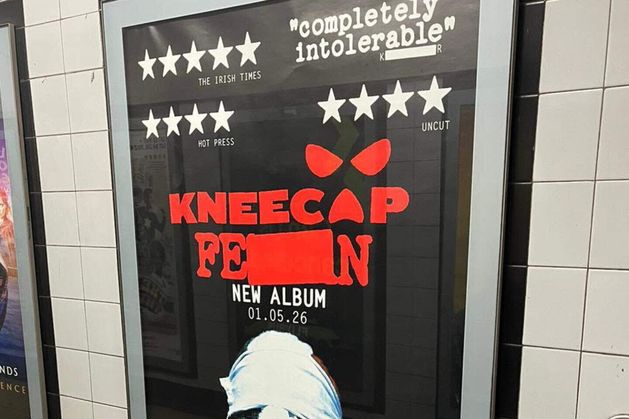
LONDON – A dispute has emerged between the rap group Kneecap and Transport for London (TfL) regarding the content and approval process of promotional advertising posters displayed on the London Underground.
The disagreement centers on the redaction of specific terms and the role of Global, the media and entertainment group that holds an eight-year advertising contract with TfL. The conflict highlights the tensions between artistic branding and the regulatory standards governing public infrastructure advertising, particularly where politically sensitive language and images are concerned.
Advertising Approval and Redaction
Daniel Lambert, manager for Kneecap, alleged that the London Underground was “only accepting” promotional posters for ‘Fenian’ if the words ‘Fenian’ and ‘Keir Starmer’ were blacked out.
Lambert stated that the agency used to book the advertisements communicated that the original artwork was “NOT accepted by Transport for London and the word ‘FENIAN’ would have to be removed.” According to Lambert, this necessitated a redacted poster and caused a one-week delay in approval, leading the campaign to miss its planned launch window around the release of the band’s album.
“We were told that this hold up was TfL making the decision to approve the redacted one.”
Lambert further suggested that the intervention blurred responsibility between TfL, which oversees standards on the network, and Global, which sells and manages advertising space on its behalf.
TfL has denied this account. The organization stated that “the redacted style of the poster reflects the version that was submitted to us for approval” and asserted, “We did not request any changes to the artwork before the current advertising campaign commenced.”
TfL further clarified that “the posters on display are the copy the band provided to us which we subsequently approved,” indicating that, from its perspective, any decision to obscure words in the design was taken upstream in the commercial booking process rather than mandated by the transport authority.
Regulatory Standards and Content Governance
The current dispute follows a previous instance where TfL prohibited the rappers from advertising a poster featuring their balaclava logo. At that time, TfL claimed the imagery “would likely cause widespread or serious offence to reasonable members of the public”, a formulation drawn from the UK advertising industry’s harm-and-offence rules.
Advertising on the Underground is governed by TfL’s own Advertising Policy, which requires campaigns to comply with the UK Code of Non-broadcast Advertising and Direct & Promotional Marketing (the CAP Code), overseen by the Advertising Standards Authority and set by the Committee of Advertising Practice. Among other things, the code restricts content likely to cause serious or widespread offence, including on the basis of political opinion, religion, or ethnicity.
Within that framework, the term ‘Fenian’ has multiple historical and contemporary meanings. It originally referred to a band of warriors who defended Ireland in the 2nd and 3rd centuries AD, and later to the 19th-century Fenian Brotherhood, a revolutionary organization seeking the overthrow of British presence in Ireland. The word has also been commonly used as a derogatory term for Irish Catholics, giving it a charged status in British and Irish public life.
TfL stated there is no blanket ban on the term ‘Fenian’ within its advertising estate.
“If it featured in an advertising campaign submitted to us, as with any copy, we would review it on a case-by-case basis, taking into consideration its specific context and any guidance from the Committee of Advertising Practice,” TfL responded. That approach reflects a broader move by public authorities to treat contentious political and sectarian language through contextual assessment rather than automatic prohibition.
Institutional and Legal Context
The unredacted versions of the posters feature a quote from Labour leader and UK prime minister Keir Starmer, who described the band’s views as “completely intolerable”. Including a sitting prime minister’s remarks on a commercial poster places the campaign squarely at the intersection of political expression and the rules limiting overt political advertising on taxpayer-funded transport infrastructure.
The advertising dispute coincides with recent legal developments involving band member Mo Chara. A High Court decision recently dismissed a terror charge against Mo Chara following allegations that he displayed a flag in support of Hezbollah during a London performance in November 2024. The case drew attention to the boundaries between artistic performance, political symbolism and the UK’s counter‑terrorism framework under the Terrorism Act 2000, which criminalises certain forms of support for proscribed organisations.
For Kneecap, the London Underground posters are part of a broader strategy to project a deliberately provocative brand that engages with Irish nationalism, anti-establishment politics and clashes with officialdom. For TfL, the episode underscores the scrutiny it faces when applying content rules to politically charged material on one of the world’s busiest public transport systems.
The redacted advertisements are currently active on the TfL network, even as both sides continue to contest who ultimately drew – and enforced – the black lines through Kneecap’s message.
Keep reading
