
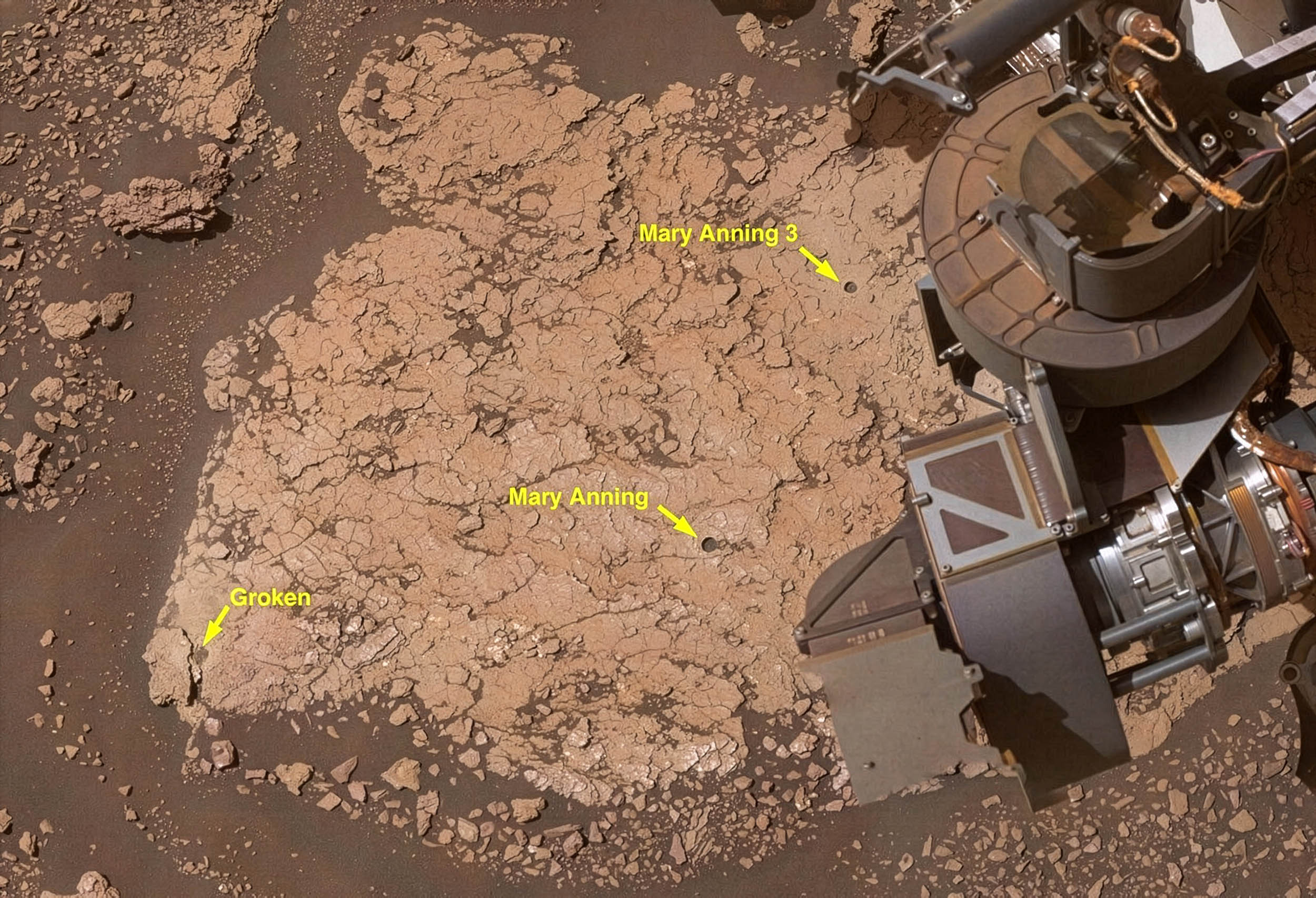
The scientific perception of Mars is shifting from a desolate, radiation-scorched wasteland to a world with a complex chemical history. Recent data from the Curiosity rover has identified seven previously undetected organic, carbon-based molecules, expanding the known diversity of organic chemistry on the Red Planet.
Chemical Preservation in Martian Clay
The discovery centers on a rock sample dubbed “Mary Anning 3,” extracted from the lower slopes of Mount Sharp in Gale Crater. This region is historically significant due to its evidence of ancient lakes and streams, which created clay-rich sedimentary layers and, with them, long-lived archives of Martian climate and water chemistry. These layers act as a natural protective shield, sequestering organic molecules and shielding them from the intense ionizing radiation and oxidizing surface conditions that typically dismantle complex molecules on the Martian surface.
Analysis of this specific sample revealed 21 different carbon-containing molecules. The ability of clay to preserve these compounds allows scientists to examine chemical signatures that have survived for billions of years, providing a window into the planet’s early environmental conditions and the stability of water over geologic time. For mission planners and funding agencies, such “sweet spots” for preservation now become priority targets in the competition for future landing sites.
The Architecture of the SAM Laboratory
Executing complex chemical analysis millions of miles from Earth requires a highly integrated hardware stack designed under strict reliability and safety standards. The Sample Analysis at Mars (SAM) instrument functions as a miniaturized, autonomous laboratory integrated into the rover’s chassis. The system utilizes a combination of gas chromatography and mass spectrometry to identify chemical compositions based on molecular weight and fragmentation patterns, effectively bringing techniques normally confined to Earth-based laboratories into a remotely operated platform.
The analytical workflow for the Mary Anning 3 sample involved a specific sequence of technical operations:
| Process Stage | Technical Action | Objective |
|---|---|---|
| Sample Acquisition | Percussive drilling and powdering | Convert solid rock into a fine, homogeneous powder for processing |
| Thermal Extraction | Controlled oven heating | Release volatile organic compounds as gases |
| Wet Chemistry | TMAH solution mixing | Break down large complex molecules into detectable fragments |
| Gas Analysis | Mass spectrometry | Identify specific molecular structures via gas ions |
The use of tetramethylammonium hydroxide (TMAH) marked a significant operational milestone, as it was the first time this wet chemistry technique was applied to a sample on Mars. To validate the integrity of this process, researchers mirrored the experiment using the Murchison meteorite on Earth, confirming that the detected molecules often result from the degradation of even larger, more complex organic compounds. For space agencies and national research councils deciding how aggressively to invest in in situ laboratories versus sample-return campaigns, SAM’s performance is an early demonstration that high-value organic chemistry can be done robotically on another world.
Genetic Precursors and Molecular Diversity
Among the findings, the detection of a nitrogen heterocycle-a ring of carbon atoms with integrated nitrogen-is particularly significant. On Earth, these structures are fundamental components in the synthesis of RNA and DNA and are central to how living systems store and transmit genetic information.
“That detection is pretty profound because these structures can be chemical precursors to more complex nitrogen-bearing molecules,” said the study’s lead author, Amy Williams, of the University of Florida. “Nitrogen heterocycles have never been found before on the Martian surface or confirmed in Martian meteorites.”
Additionally, the presence of benzothiophene, a molecule containing both carbon and sulfur, suggests a link to interstellar chemistry. Such molecules are common in meteorites, supporting the theory that the building blocks of chemistry were distributed across the solar system via asteroid and comet impacts. While the current data do not demonstrate biology, the growing catalog of Martian organics is reshaping how scientific advisory panels and exploration roadmaps assess Mars’s past habitability and prioritize follow-up missions.
Infrastructure Constraints and Planetary Protection
Operating a laboratory in the Martian environment introduces extreme engineering risks. The SAM system must maintain precise thermal control despite fluctuating external temperatures and operate on a limited power budget, all within a spacecraft design certified under international safety and reliability guidelines. Data integrity is further challenged by the latency of the Deep Space Network, which manages the telemetry required to command the rover and retrieve high-resolution spectral data, shaping how often complex experiments can be scheduled and how quickly teams on Earth can iterate.
Beyond the hardware, these missions adhere to strict planetary protection protocols managed by international standards to prevent forward contamination. NASA and its partners classify Mars as a world of high biological interest, which triggers the requirements of the Committee on Space Research’s Planetary Protection Policy for the design, sterilization, and operation of spacecraft and onboard chemistry experiments. Ensuring that the TMAH and other reagents do not introduce Earth-based biological contaminants is critical to maintaining the validity of “life-detection” signatures and directly informs how regulators and mission review boards assess risk before launch.
Expanding the Extraterrestrial Analytical Framework
The success of the Mary Anning 3 analysis serves as a proof-of-concept for future autonomous chemistry missions. The ability to perform wet chemistry in situ reduces the dependency on sample-return missions, which are logistically complex, politically sensitive, and expensive because they must satisfy both scientific priorities and public risk tolerances for bringing alien material back to Earth.
“This is Curiosity and our team at their best. It took dozens of scientists and engineers to locate this site, drill the sample, and make these discoveries with our awesome robot,” said Ashwin Vasavada of NASA’s Jet Propulsion Laboratory. “This collection of organic molecules once again increases the prospect that Mars offered a home for life in the ancient past.”
This operational experience is now being integrated into the design of next-generation instruments. A refined version of the SAM system is slated for the European Space Agency Rosalind Franklin rover, while similar analytical payloads will be deployed on the Dragonfly mission to Saturn’s moon, Titan. As international programs converge on common standards for planetary protection and data sharing, the techniques proven in Curiosity’s clay drill hole are likely to inform not only where humanity looks for life, but also how spacefaring nations negotiate responsibilities and risks in the search.
“It was a feat just figuring out how to conduct this kind of chemistry for the first time on Mars,” said Charles Malespin of NASA’s Goddard Space Flight Center. “But now that we’ve had some practice, we’re prepared to run similar experiments on future missions.”
