
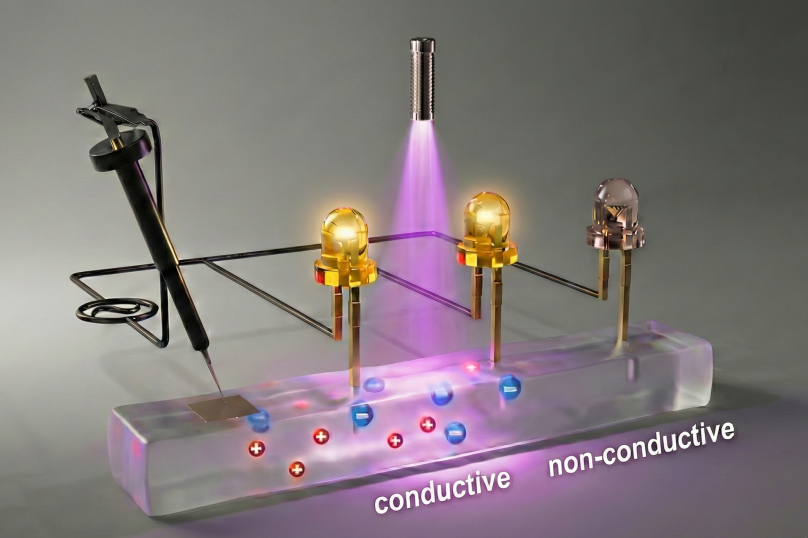
MIT engineers and colleagues have developed a soft, flexible gel that dramatically changes its conductivity upon the application of light. This figure shows a soft, stretchable circuit created with a rectangular bar of the gel. A copper electrode is attached to the left. A stylus and associated metal network connects the electrode to three “stations” on the bar. Light has been shone on the first two stations, creating conductivity that turns on each station’s lightbulb. Because the third station has not been exposed to light it is nonconductive and the bulb is off. Credits: Image courtesy of the Wallin lab.
Bridging the Biological-Electronic Divide
The fundamental friction in modern hardware design lies in the disparity between the rigid architecture of silicon-based electronics and the pliable, organic nature of living systems. While traditional circuitry relies on the movement of electrons through hard substrates, biological communication is governed by the movement of ions – charged molecules like sodium and potassium – across soft cellular membranes.
To resolve this structural mismatch, researchers are advancing ionotronics. This emerging field focuses on the transport of ions to transmit data, creating a functional bridge between synthetic devices and biological tissues. The development of materials that can mimic these biological properties is critical for the next generation of neural interfaces, prosthetic integration, and implantable medical devices that must operate safely over years inside the human body.
“We’ve found a mechanism to dynamically control local ion population in a soft material,” says Thomas J. Wallin, the John F. Elliott Career Development Professor in MIT’s Department of Materials Science and Engineering and leader of the work. “That could allow a system that is self-adaptive to environmental stimuli, in this case light.”
The Mechanics of Soft Photo-Ionotronics
The breakthrough involves a specialized gel capable of shifting its electrical state based on light exposure. By utilizing photo-ion generators (PIGs), the team has developed a material that can transition from an insulating state to a highly conductive one. This process allows for the dynamic “printing” of conductive pathways within a soft medium using light as the trigger, effectively turning illumination patterns into circuit layouts.
“What we’re doing is using light to switch a soft material from insulating to something that is 400 times more conductive,” says Xu Liu, first author of the paper and former MIT postdoc in materials science and engineering who is now an incoming assistant professor at King’s College London.
The technical divergence between traditional electronics and this new ionotronic approach is summarized below:
| Feature | Traditional Electronics | Soft Photo-Ionotronics |
|---|---|---|
| Charge Carrier | Electrons | Ions (charged molecules) |
| Material State | Rigid/crystalline | Soft/polymeric gel |
| Trigger Mechanism | Voltage/current | Light (photo-activation) |
| Conductivity Shift | Binary (on/off) | Continuously tunable (up to 400x increase) |
| Biological Compatibility | Low (requires encapsulation) | High (biomimetic, tissue-like) |
To achieve this, the researchers integrated PIG powder into polyurethane rubber using a solvent-based swelling method. This architecture allows the material to maintain mechanical flexibility while gaining the ability to process and store signals based on light patterns, bringing computing concepts like memory and routing closer to the physical properties of skin and muscle.
Industrial Scalability and Human-Machine Interfacing
The collaboration between MIT and Reality Labs at Meta underscores the commercial interest in “e-skin” and haptic interfaces as companies race to define the next generation of augmented and virtual reality (AR/VR) hardware. For headsets, gloves, and full-body suits, the ability to create soft, conductive interfaces that can be patterned on demand allows for more intuitive human-machine interfaces (HMIs) that conform to the body rather than forcing the body to conform to rigid devices.
In practical terms, these materials could power wearables that don’t just track biometric data but actively respond to the environment or the user’s physiological state – for example, changing stiffness or feedback intensity in response to muscle fatigue, or rerouting signals around inflamed tissue. Because the circuitry is defined by where light has been applied, manufacturers could, in principle, reconfigure designs late in the production process or tailor interfaces to individual patients or workers.
While the current conductivity change is irreversible, the architectural framework allows for future iterations that could be toggled repeatedly. The use of various polymers and solvents suggests a path toward materials that respond to thermal, magnetic, or chemical stimuli, opening the door to context-aware “living” surfaces whose behavior is dictated by their environment rather than only by hardwired chips.
“We’re inspired to do more work in this field by changing the driving force from light to other forms of environmental stimuli,” says Liu.
The broader implications for robotics involve the creation of “soft machines” that possess integrated sensing and processing capabilities without the need for bulky, rigid wiring harnesses. Such systems could enable surgical robots that conform to anatomy instead of pushing against it, or assistive exoskeletons that flex and stretch like clothing while still providing precise feedback and control.
Regulatory Frameworks for Biocompatible Hardware
As these materials move toward biomedical application, they enter a stringent regulatory landscape. Any device interfacing with human tissue must adhere to biocompatibility standards, such as ISO 10993, which governs the biological evaluation of medical devices, from cytotoxicity to long-term implantation risk. For regulators and hospital procurement teams, the use of polyurethane rubber – a material already common in catheters, pacemaker leads, and other implanted components – provides a strategic advantage in meeting these safety and toxicity requirements without redesigning frameworks from scratch.
For policymakers and data protection authorities, the transition to ionotronic systems also introduces new considerations for data integrity and cybersecurity. Soft interfaces that interact directly with the nervous system create new vectors for signal interception or “bio-hacking,” in which malicious actors could in theory attempt to manipulate or read neural-adjacent signals. That risk is sharpening calls inside standards bodies and national regulators to develop encryption and verification requirements tailored to ion-based data transmission, rather than assuming protections designed for conventional, rigid electronics will be sufficient.
“Our work has the potential to lead to the creation of a subfield that we call soft photo-ionotronics,” Liu continues. “We are also very excited about the opportunities from our work to create new soft machines impacting soft wearable technology, human-machine interfaces, robotics, biomedicine, and other fields.”
The full technical analysis of this research is available in the journal Nature Communications.
