

Gerbera growers fight an expensive, perennial battle with powdery mildew. A University of Georgia team, backed by the American Floral Endowment, has now built a CRISPR-based editing platform for gerbera that moves disease resistance from a decade-long breeding project to an engineering problem measured in project cycles. Early results show precise edits are feasible, and work is underway to switch off native susceptibility genes tied to mildew infection-an approach that, if successful, could sharply reduce fungicide use across one of the world’s most popular ornamentals and re-shape pest‑management norms in commercial greenhouses.
© American Floral Endowment
A purpose-built editing pipeline for an ornamental workhorse
Gerbera (Gerbera jamesonii) is a high‑value cut flower grown year‑round in controlled environments, where powdery mildew pressure is consistently high and losses are expensive. The research team established cultivar-agnostic tissue culture and transformation methods for gerbera, then validated CRISPR functionality by targeting phytoene desaturase (PDS). Disrupting PDS is a standard proof-of-concept in plants because edited cells produce albino shoots, a visible indicator that editing machinery is active. Using CRISPR/Cas12, the project recovered albino plants and confirmed targeted sequence changes-evidence that precise editing is now practical in gerbera, not just in major field crops.
This work is presented as the first reported example of CRISPR-based gene editing in Gerbera, positioning the crop to benefit from the same toolchain that has reshaped editing in major field species and opening the door to a broader trait pipeline that could include shelf life, color stability, and post‑harvest performance.
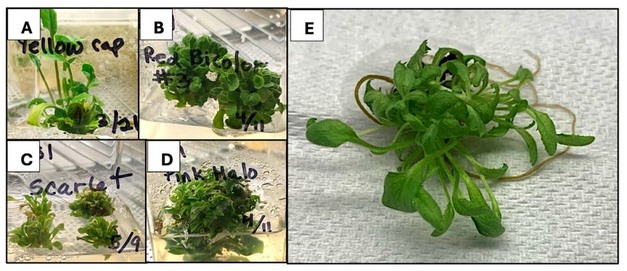
© American Floral Endowment
Optimized shoot tissue cultures of four gerbera cultivars were established, creating an editing platform that is not locked to a single commercial line.
Switching off susceptibility: the MLO playbook
Powdery mildew exploits MLO genes that naturally make plants permissive to infection. Knocking out specific MLO family members has produced durable resistance in multiple crops, including cereals and horticultural species. The Georgia team identified gerbera MLO orthologs and designed CRISPR/Cas9 constructs to disrupt them. Transgenic lines carrying these constructs are moving through recovery and selection, with mutation confirmation and disease-challenge testing next. If the pattern seen in other crops holds, a small edit in a single susceptibility gene could substitute for years of crossing and selection.
Architecture of the gerbera CRISPR workflow
Taken together, the project describes a full bench‑to‑greenhouse workflow that other ornamental programs can adopt or adapt:
| Stage | Method/Tooling | Key Controls | Primary Output |
|---|---|---|---|
| Donor tissue & culture | Optimized shoot regeneration across cultivars | Axenic culture; somaclonal variation monitoring | Highly regenerable explants |
| Editing construct | Cas12 for PDS proof‑of‑concept; Cas9 for MLO targets | gRNA off‑target scoring; multiplex design where needed | Vector or RNP design ready for delivery |
| Delivery & selection | Agrobacterium transformation; antibiotic/herbicide markers | Escape-rate tracking; insertion copy-number checks | Putative edited shoots |
| Genotyping | PCR/amplicon sequencing; zygosity assessment | Indel spectrum; absence of unintended inserts | Confirmed edit profiles |
| Phenotyping | Albino screen (PDS); mildew challenge assays (MLO) | Replicated trials; environmental controls | Resistance phenotype calls |
| Cleanup & line development | Segregation to remove T‑DNA; or DNA‑free RNP approaches | Event identity management; stability over cycles | Non‑transgenic, gene‑edited candidates |
Data and design: why a reference genome changes the pace
A chromosome‑level gerbera genome provides a coordinate system for guide design, specificity modeling, and primer placement. With whole‑genome context, developers can:
- Map MLO family members, select clade‑specific targets, and avoid paralog interference that could blunt resistance or create unintended traits.
- Score gRNAs against off‑target sites, including repetitive elements common in ornamentals, and prioritize designs that minimize editing noise.
- Design assays to track edits through clonal propagation and across production environments, an essential step for variety protection and traceability.
For breeders, that combination turns gerbera from a largely empirical breeding exercise into a data‑rich system where trait hypotheses can be tested and iterated with each cycle of transformation.
Regulatory and compliance path in the United States
Gene‑edited ornamentals that carry small sequence changes and no plant‑pest DNA can fit within existing U.S. biotechnology rules that distinguish targeted edits from transgenic insertions. For a cut‑flower crop like gerbera, the compliance checkpoints concentrate on plant health, interstate movement, and plant‑pest status rather than food safety.
- USDA APHIS (plant health): Many edits that could be achieved through conventional breeding and do not involve plant‑pest components may qualify for a “not regulated” determination under the agency’s biotechnology regulations, avoiding a full permit process.
- EPA (pesticide oversight): Only implicated when the plant produces a pesticidal substance; susceptibility‑gene knockouts typically do not trigger EPA review because the plant is not expressing a new active ingredient.
- FDA (food/feed): Not generally applicable to ornamentals; consultation would be relevant only if an edible derivative were introduced into commerce or if components entered feed channels.
- State plant-health and quarantine: Standard nursery movement, certification, and noxious‑weed checks continue to apply and can influence which edited lines are deployable in particular regions.
Using ribonucleoprotein delivery to create DNA‑free edits can further streamline regulatory positioning and simplify international movement where rules distinguish between edits and transgenes, a consideration for global cut‑flower supply chains.
Risk management, integrity, and containment
Because gerbera is propagated clonally and shipped worldwide, the integrity of each edited event is a commercial and regulatory concern, not just a lab detail.
- Off‑target risk: Use dual‑guide validation and amplicon sequencing of predicted sites; retire guides with high similarity hits before moving candidates into pre‑commercial trials.
- Event identity: Assign unique identifiers and maintain genotype records through micropropagation cycles to prevent line mix‑ups that could erode grower confidence.
- Trait durability: Confirm resistance across pathogen isolates and environments; monitor for potential fitness penalties from MLO disruption, such as effects on plant vigor or flowering.
- Containment: Maintain greenhouse biosafety practices during transformation and challenge testing; control pollen and volunteer escapes to prevent untracked dissemination of early‑generation events.
Operational upside for growers, breeders, and supply partners
The platform is being framed not just as a research success, but as a set of operational levers for the floriculture industry.
- Growers: Fewer fungicide applications, lower discard rates, and more predictable cycles under high humidity conditions where mildew pressure typically spikes.
- Breeders: Trait‑introgression into elite cultivars without backcross drag; faster refresh of bestselling colors and forms while holding disease resistance constant in the background.
- Distributors and retailers: More consistent shelf life with reduced disease incidence in transit, particularly in mixed bouquets where gerbera can act as an entry point for mildew.
- ESG reporting: Quantifiable reductions in chemical inputs and associated worker exposure, with potential alignment to retailer sustainability scorecards and certification schemes.
Near-term milestones to watch
For decision‑makers in breeding companies and grower cooperatives, four concrete milestones will signal whether the platform is ready to scale beyond the lab.
| Milestone | What indicates progress | Dependencies |
|---|---|---|
| Validated MLO edits | Sequenced indels in target MLO orthologs; stable zygosity across propagation cycles | Reliable multiplex gRNA performance |
| Greenhouse resistance | Consistent, replicated mildew resistance under controlled challenge and standard grower conditions | Assays across isolates and environmental conditions |
| Transgene‑free lines | Absence of vector sequence; or ribonucleoprotein (RNP)‑edited events | Segregation or DNA‑free delivery optimization |
| Commercialization readiness | Propagation stability, DUS/variety protection, brand strategy, and supply agreements | Supply‑chain QC and identity preservation |
Why this matters for sustainable floriculture
Powdery mildew pushes growers toward routine fungicide schedules that carry cost, labor, and compliance burdens, particularly in regions tightening rules on greenhouse emissions and worker exposure. A susceptibility‑gene strategy, once validated in gerbera, offers a durable trait that can be replicated across cultivars without resetting consumer-facing aesthetics. It reframes disease control as a property of the plant itself, not the spray program around it, and gives regulators and buyers a tangible example of gene editing being used to reduce, rather than increase, chemical dependence in intensive horticulture.
Technical detail, preliminary results, and methodology are available in the project’s full technical report.
