
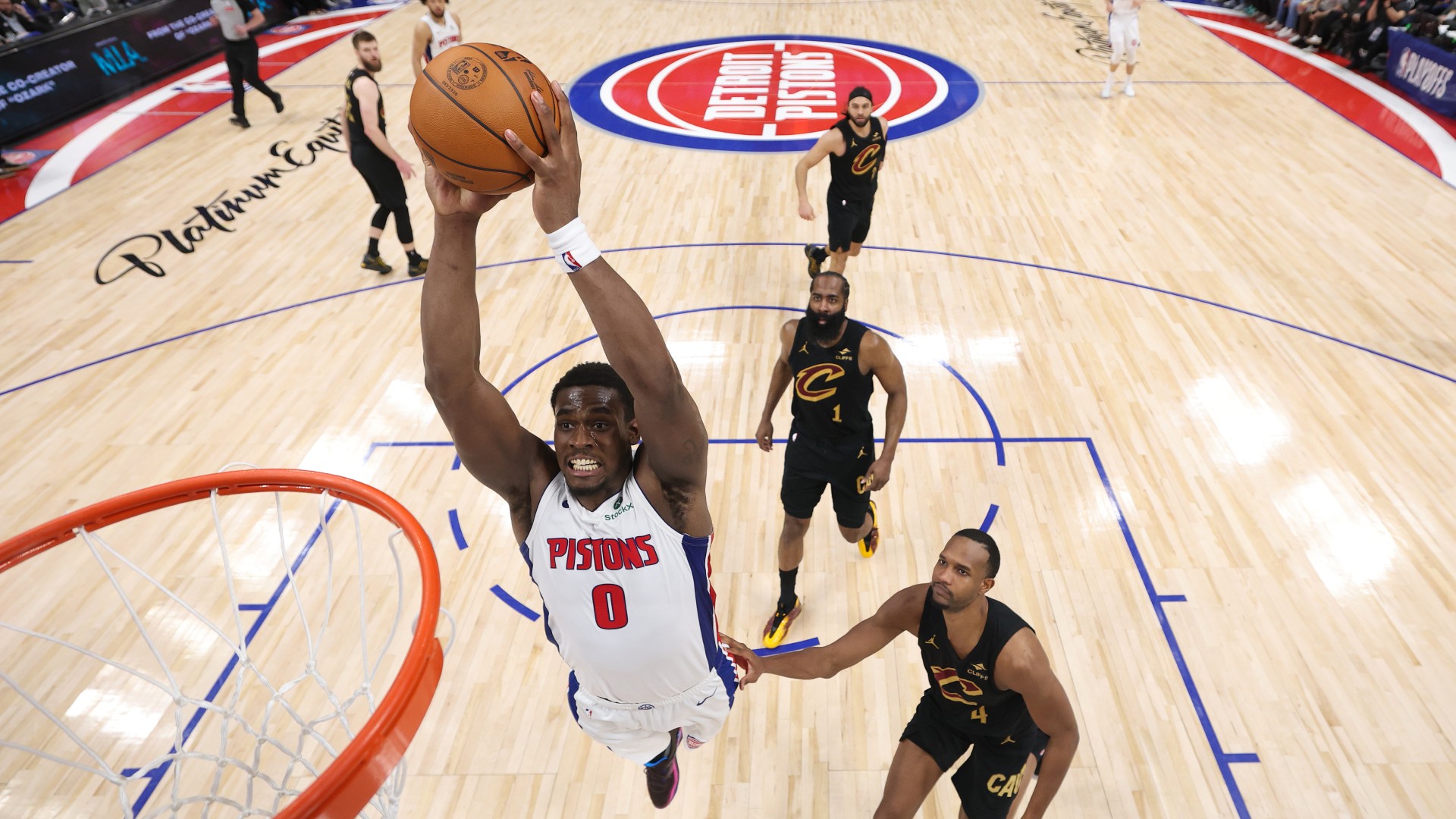
Jalen Duren all but ruled the paint in Game 1, finishing with 12 rebounds to go along with 11 points.
The Detroit Pistons utilized a blend of physical interior dominance and efficient perimeter shooting to secure a 10-point victory over the Cleveland Cavaliers in Game 1 of the NBA Eastern Conference semifinals.
The win provides the Pistons with a 1-0 advantage in the best-of-seven series, serving as an early validation of their top-seed status within the league’s postseason structure, which is governed by the Official Playing Rules of the NBA. While the game featured several competitive stretches, Detroit’s ability to control the tempo in the fourth quarter ultimately neutralized a Cleveland squad that struggled with cohesion and ball security when it mattered most.
Both franchises entered the semifinals following grueling seven-game series in the first round, testing roster depth, injury management, and coaching adjustments. That shared fatigue underscores a broader theme for the series: endurance-physical and tactical-may be as decisive as pure talent.
Interior Dominance and Physicality
Detroit’s game plan was defined by an aggressive interior presence that repeatedly disrupted Cleveland’s frontcourt rhythm. The Pistons out-rebounded the Cavaliers, specifically excelling on the offensive glass with 16 offensive rebounds compared with Cleveland’s 11. That five-board margin translated into multiple second-chance opportunities, extending possessions, inflating Detroit’s time of possession, and gradually wearing down the Cavaliers’ defense.
Jalen Duren emerged as the central figure in this interior battle, recording 12 rebounds and 11 points. His influence was most evident during a pivotal fourth-quarter push by Cleveland, when back-to-back dunks from Duren halted the Cavaliers’ momentum and helped Detroit reclaim the lead with just under four minutes remaining. Notably, Duren finished with as many rebounds as Cavaliers bigs Jarrett Allen and Evan Mobley combined, underscoring both his positioning and Detroit’s broader commitment to controlling the paint.
This physical advantage also produced a pronounced gap at the free-throw line: Detroit attempted 35 free throws, more than doubling Cleveland’s 16 trips. For a postseason environment where possession value is elevated and every whistle carries weight, that disparity reinforced how consistently the Pistons put pressure on the rim. Head coach JB Bickerstaff emphasized postgame that Detroit’s intent was to apply cumulative physical pressure over four quarters, betting that steady contact would eventually tilt the game-state in their favor.
Perimeter Execution
Cleveland’s path into the second round was eased by a first-round opponent in Toronto that struggled to punish defensive lapses from beyond the arc. Against Detroit, that calculus changed. The Pistons deployed a more versatile offensive profile, using floor spacing and five-out looks to drag Cleveland’s help defenders away from the paint and open driving and kick-out lanes.
Duncan Robinson was the fulcrum of that spacing. Shooting 7-for-12 from three-point range, he repeatedly punished late closeouts and miscommunications on the perimeter. His shot-making gave Detroit a high-yield scoring option outside of Cade Cunningham, who provided composed late-game creation despite not appearing to be at peak offensive sharpness.
For Cleveland, each Robinson three-pointer had a secondary effect: it blunted potential momentum swings. Whenever the Cavaliers strung together stops or scored on consecutive possessions, Detroit’s ability to respond with timely perimeter shooting prevented those mini-runs from snowballing into a decisive surge. In a series expected to pivot on adjustments, the Game 1 tape will likely prompt Cleveland to revisit how they prioritize Robinson in their scouting and coverage rules.
Cleveland’s Turnover Crisis
James Harden’s box score was, on the surface, robust-22 points, eight rebounds, and seven assists. Yet the value of that production was undercut by seven turnovers, echoing a pattern from the first round in which he averaged six giveaways per game. In the context of playoff basketball, where defensive schemes are calibrated to strip away primary options, those turnovers functioned almost like live-ball policy failures: preventable errors with immediate, costly consequences.
Many of Harden’s mistakes came when Detroit sent late or disguised double-teams, or when he attempted high-risk cross-court passes against set defenders. Cleveland finished with 19 turnovers as a team, which the Pistons converted into 31 points-effectively gifting Detroit more than a quarter’s worth of efficient offense.
After the game, Donovan Mitchell acknowledged that many of those errors were “self-inflicted” and within the team’s control to fix, a pointed admission that speaks to accountability as much as tactics. For Cleveland to remain competitive in the series, tightening their decision-making against pressure-particularly in the half court-will be non-negotiable. Detroit has already demonstrated a disciplined ability to turn even marginal mistakes into transition opportunities, a dynamic that can quickly distort both scoreboard and substitution patterns.
Key Supporting Performances
Beyond the headliners, several role players quietly reshaped the margins of Game 1-margins that often dictate coaching decisions on rotations, matchups, and future minutes allocations.
- Tobias Harris (DET): Logged 39 minutes and finished with 20 points and eight rebounds, maintaining efficiency while shouldering extended defensive assignments on multiple Cavaliers wings. His performance carried over the momentum from a high-impact Game 7 against Orlando, reinforcing his status as Detroit’s stabilizing veteran presence.
- Daniss Jenkins (DET): Provided an effective change of pace when spelling Cunningham, contributing 12 points, seven rebounds, and four steals. Jenkins’ activity at the point of attack allowed Detroit to maintain defensive disruption while keeping their primary ball-handler fresh for late-game situations.
- Max Strus (CLE): Supplied essential supplementary scoring for Mitchell and Harden, finishing with 19 points and sparking a second-half surge that briefly pulled Cleveland within striking distance. His ability to relocate off the ball and hit contested threes offered one of the Cavaliers’ few consistent pressure valves against Detroit’s half-court defense.
Cleveland’s depth, however, remains an open question as the series progresses. With Sam Merrill limited by a hamstring injury, the Cavaliers face a narrower margin for error in their perimeter rotation, increasing the workload on Strus and the core scorers to sustain both usage and efficiency over potentially long minutes. For Detroit, Game 1 reinforced a contrasting structural advantage: a deeper, more flexible rotation that allows the coaching staff to manage fatigue, foul trouble, and matchup-specific lineups without significantly compromising either spacing or physicality.
