
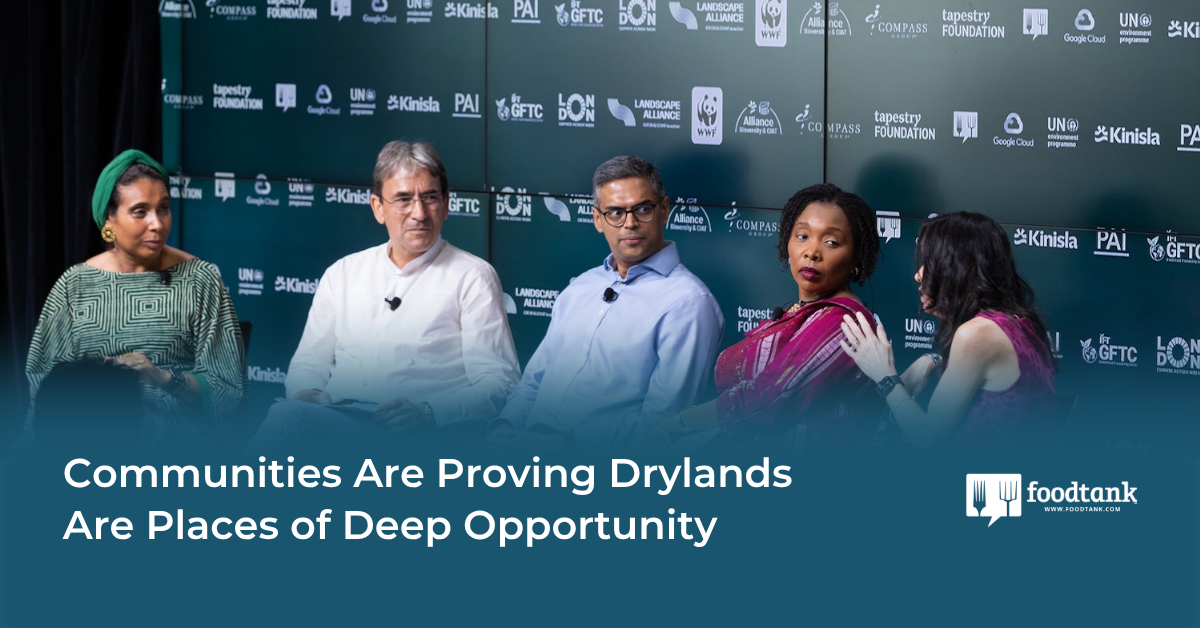
LONDON – More than 250 leaders from the private, investment, philanthropic, and research sectors gathered during London Climate Action Week for the 3rd Annual Chief Sustainability Officer and Food Systems Funders Summit to address the systemic undervaluation of global drylands.
The summit focused on the restoration and sustainable management of these ecosystems, which the Landscape Alliance reports support approximately 44 percent of global food systems and provide homes for more than 2 billion people. These regions include savannas, rangelands, and semi-arid farming zones that sit at the frontline of climate impacts and are increasingly central to national food security strategies.
The event was organized in partnership with a coalition of global entities, including:
- U.N. Environment Programme (UNEP)
- World Wildlife Fund (WWF)
- Google Cloud
- Compass Group
- PAI
- Kinisla
- Tapestry Foundation
- Alliance of Bioversity International and CIAT
- Strong Roots
- Institute of Food Technologists
Organizers framed the gathering as a bridge between boardroom decisions and public mandates, noting that many of the countries hosting drylands have pledged large-scale land restoration under the U.N. Convention to Combat Desertification’s [[UNCCD framework]].
Economic Returns of Dryland Restoration
Dr. Éliane Ubalijoro, CEO of the Landscape Alliance, described drylands as “places of deep opportunity,” noting that these regions are currently degrading rapidly due to unsustainable land use, rising temperatures, and erratic rainfall. Ubalijoro stated that for every dollar invested in drylands, the economic return is 30 times that amount, pointing to gains in agricultural productivity, avoided disaster losses, and rural employment.
To capitalize on this potential, the Landscape Alliance has launched the Thrivelands Project. This global initiative aims to restore these ecosystems to improve food security and build climate resilience, while helping governments meet their nationally determined contributions under the Paris Agreement and their land degradation neutrality targets.
Speakers stressed that financing remains a critical bottleneck. Myriam Sidibé, Chief Mission Officer and Founder for Brands on a Mission, argued that while many global brands rely on products sourced from drylands – from staple grains to high-value spices and botanicals – the value is rarely reinvested into the producing communities or landscapes that sustain those supply chains.
“Are they priced the right way?” Sidibé asked. “Do they give us the kind of value addition that we want to give back to the landscape where they are grown and where we are learning to thrive?”
Panelists called for clearer standards on how companies account for land use, water, and biodiversity in their risk disclosures, suggesting that voluntary sustainability commitments are beginning to intersect with emerging due-diligence regulations in major markets.
Regional Climate-Smart Applications
The summit highlighted specific operational models in India and Egypt that aim to decouple agricultural productivity from environmental degradation, illustrating how national policies, private investment, and farmer innovation can align on the ground.
In India, where approximately 100 million farmers operate in dryland conditions, Kheyti is implementing low-cost, climate-smart agricultural solutions. Kaushik Kappagantulu, Co-Founder and CEO of Kheyti, reported that these interventions – including protected cultivation structures, efficient irrigation, and tailored agronomy support – have allowed farmers to:
- Double their incomes
- Reduce water usage by 90 percent
- Decrease crop loss by 60 percent
According to Kappagantulu, these results are drawing attention from local authorities and financial institutions looking to de-risk rural livelihoods as heatwaves and droughts intensify. “The question is no longer whether smallholders can adopt climate-smart tools,” he said, “but whether capital and policy can move quickly enough to reach them at scale.”
In Egypt, the SEKEM Group is utilizing carbon credits to incentivize sustainable farming. Helmy Abouleish, CEO and Founder of SEKEM, argued that organic and biodynamic farming is inherently cheaper over the long term, asserting that “it’s only by hiding and externalizing costs that it seems to be more expensive.”
While Abouleish noted that carbon credits may not serve as a permanent solution, they provide the necessary economic incentive for farmers to adopt climate-smart practices while maintaining low operational costs. He added that the model could inform how finance ministries and regulators integrate soil health and carbon sequestration into national climate and agricultural plans.
Systemic Resilience and Policy
The discussions emphasized the link between ecological health and human stability, particularly in regions where land degradation, food price shocks, and displacement already strain public institutions. Sidibé stated, “You cannot separate resilience of landscape from resilience of humans.”
Throughout the summit, speakers returned to governance questions: how to align land-use regulations with restoration goals, how to design incentives that reach small producers, and how to measure outcomes credibly enough for both investors and public authorities.
Ubalijoro called for a coordinated approach involving enabling policy, targeted investment, and improved value chain integration to transform these regions. Participants pointed to the growing role of national restoration pledges, public-private partnerships, and blended finance as signals that dryland resilience is shifting from a niche environmental concern to a mainstream development and security priority.
“This is an opportunity for all of us…to make these thrivelands not only a source of prosperity but also a source of peace,” Ubalijoro said.
The summit concluded with a call for increased collaboration between philanthropic funders and private sector sustainability officers to scale restoration projects, and for closer coordination with environment and agriculture ministries as they refine climate plans and rural development strategies.
Worth a look
