

LONDON – The United Kingdom is on course to log its warmest year on record, with the national annual mean temperature tracking at 10.05C, edging past the current high of 10.03C set in 2022, according to forecasters. A cold spell could still affect the outcome, and the final figure has not yet been confirmed.
If confirmed for 2025, it would be only the second time in observational records that the UK’s annual mean temperature has exceeded 10C. Records date back to 1884 and show a concentration of the warmest years in recent decades.
The Met Office says 2025 is on track to become one of the UK’s warmest years, possibly surpassing 2022.
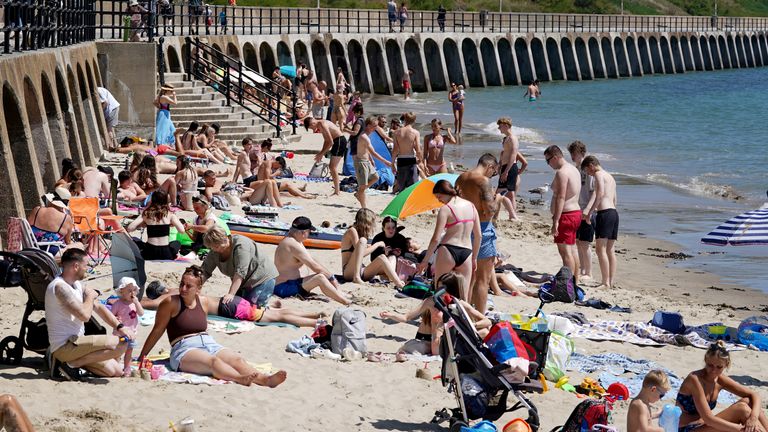
People enjoy the warm weather in Folkestone, Kent, in July. Pic: PA
Key figures in the UK temperature record
Provisional data compiled by the Met Office’s national climate monitoring team suggests a clear, long-term warming trend rather than a single anomalous year. While the headline figure of 10.05C remains subject to revision, climate scientists say it is consistent with the pattern seen across Europe and globally in recent years.
- 2025 annual mean temperature to date: 10.05C (tracking).
- Previous record: 10.03C in 2022.
- If confirmed, 2025 would be only the second year the UK annual mean has topped 10C.
- Observational records date to 1884; all top 10 warmest years have occurred in the last two decades.
- Four of the past five years would feature among the five warmest on record.
- New UK annual mean records were previously set in 2002, 2003, 2006, 2014 and 2022.
Under the UK’s Climate Change Act, ministers are legally bound to meet five-yearly “carbon budgets” on the path to net zero greenhouse gas emissions, using climate indicators such as the national mean temperature to test whether current policies are on track.
Scientists and officials react
Mike Kendon, a senior Met Office scientist, said it was “more likely than not” this year would be confirmed as the UK’s warmest ever, stressing that the apparent marginal increase over 2022 masks a much larger shift in the underlying climate.
“In terms of our climate, we are living in extraordinary times. The changes we are seeing are unprecedented in observational records back to the 19th century,” said Mr Kendon.
Scientists note that a higher annual mean effectively “loads the dice” for more frequent and intense extremes, from sustained summer heat to unseasonal warm spells in autumn and winter that disrupt ecosystems and strain public services.
Professor of climate science Friederike Otto called the findings “devastating and utterly unsurprising”. He added: “10C might not sound very warm, but it is an average and means much higher temperatures in the summer, high temperatures that would have never been possible are now common and that is not good news.”
From record temperatures to policy choices
Climate minister Katie White warned people to “sit up and listen” and said climate change was “reshaping everyday life”. “Four heatwaves in one summer, record wildfires in the Highlands, flash flood warnings from Cornwall to Inverness. This is not normal,” said Ms White. She added: “The good news is we know what works, listening to the science, backing British innovators, and getting on with solutions that cut emissions and build a cleaner, safer future.”
Officials say the latest figures are likely to feed into decisions on energy, transport and land-use planning, including how quickly to scale up home insulation, electric vehicle rollout and investment in climate resilience such as flood defences and heatwave preparedness. The data will also form part of the evidence base ahead of future United Nations climate summits, where governments are under pressure to align national plans with the Paris Agreement goal of limiting global warming to 1.5C above pre-industrial levels.
The final figure is not yet confirmed, and the Met Office will issue an official annual climate statement once full 2025 data have been quality-checked and verified.
Keep reading
