
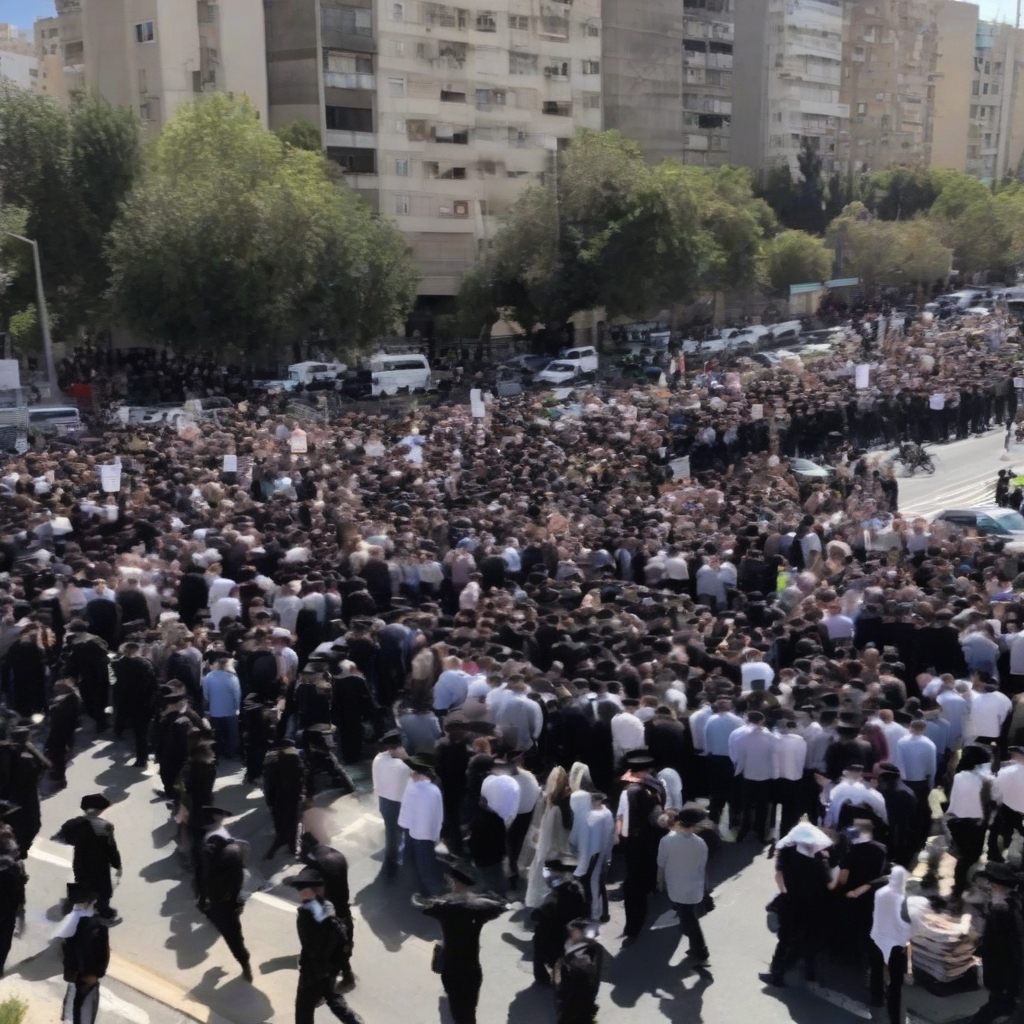
BNEI BRAK – Violence erupted on June 26, 2026, as clashes broke out between ultra-Orthodox residents and pro-conscription demonstrators who blocked the main entrance to the Haredi-majority city.
The confrontation, which centered on the “Coca-Cola Bridge” on Route 4, saw dozens of protesters demanding the mandatory drafting of yeshiva students into the military. The demonstration reflects a deepening societal rift over the distribution of military service burdens during an ongoing multifront war.
The protest was led by Mothers at the Front, an organization composed of women whose children are currently serving in the military or reserve duty. They were joined by active reservists in a coordinated effort to pressure the government to end exemptions for the Haredi community.
Confrontations at the Coca-Cola Bridge
The demonstration caused significant traffic congestion hours before the start of Shabbat, effectively sealing one of the main arteries into central Israel. Local Haredi residents formed counter-protests, leading to physical scuffles and shouting matches. Pro-draft demonstrators chanted, “There are no rights without duties!” while counter-protesters responded with the slogan, “We will die and not enlist!”
Police officers struggled to separate the two groups as the situation escalated into shoving matches and sporadic acts of vandalism. In one instance, a woman reportedly removed her shirt amidst the crowd of ultra-Orthodox men, a direct provocation given the community’s strict adherence to modesty norms and gender segregation in public life.
Ayelet Hashachar Saydof, founder of Mothers at the Front, described the current state of conscription as a global anomaly, arguing that the burden of the country’s defense has been shifted onto a shrinking share of the population.
“Our children didn’t go out to defend a state that protects the right of Haredim to be draft-dodgers,” Saydof said. “It’s unheard of, anywhere in the world, where instead of arresting draft dodgers, they are able to shut down the country. We came here to say: Enough.”
Saydof’s comments tap into a wider resentment among families of soldiers and reservists, who argue that the government has failed to translate battlefield sacrifices into an equitable conscription policy at home.
Reports of Targeted Violence
Following the main protest, some activists reported targeted attacks away from the primary demonstration site, raising questions about police readiness and protection for lawful protesters.
Michal, a member of Mothers at the Front, stated that she and two other women were assaulted while returning to their vehicle.
According to Michal, a pedestrian attacked her, followed by a motorcyclist who blocked their car and encouraged others to join the assault. She reported that an assailant used a helmet to smash the vehicle’s rear window.
Michal alleged that police officers at a nearby checkpoint failed to intervene.
“I cried out to one of them – and he simply didn’t move, didn’t come to us, just photographed us,” she said. She further claimed that attackers continued to pursue them through multiple intersections, smashing the windshield and tearing off the vehicle’s license plate.
Police had not immediately responded to the specific allegations at the time of publication. Law enforcement officials have previously defended their conduct at anti-draft demonstrations, saying they must balance the right to protest with the need to preserve public order.
Escalation of Anti-Draft Protests
The Friday clashes followed a week of increasing volatility regarding the draft issue and signaled that the dispute has moved from courtrooms and coalition talks onto major highways.
In the days leading up to the Bnei Brak protest:
- June 24, 2026: Haredi protesters blocked traffic during the morning rush hour near Bnei Brak. The demonstration turned violent, leading police to deploy batons and stun grenades to disperse the crowd.
- June 24, 2026: Thousands of Haredi demonstrators gathered outside the IDF’s Beit Lid military prison to protest the arrest of an ultra-Orthodox draft evader, portraying him as a symbol of resistance to what they describe as coercive secularization.
המפגינים חוסמים את הכביש וקוראים “אין זכויות בלי חובות”. (ידיעות בני ברק pic.twitter.com/Kp1Zaqre1K)
— לירי בורק שביט (@lirishavit) June 26, 2026
המשטרה החלה להשתמש באלימות כלפי החרדים בבני ברק pic.twitter.com/f9bWn0toCE
— לירי בורק שביט (@lirishavit) June 26, 2026
The dueling street mobilizations – Haredi demonstrators demanding continued exemptions and secular and religious-Zionist protesters insisting on “equal service for all” – have turned the long-running drafting dispute into a rolling test of the state’s capacity to enforce national policy against the wishes of a powerful coalition bloc.
Manpower Shortages and Legislative Conflict
The intensity of the protests comes as the Israel Defense Forces (IDF) face a critical manpower shortage while fighting since the October 7, 2023, invasion. Military officials have repeatedly warned that without a broader conscription base, the current model of extended reserve duty for combat veterans is unsustainable.
The current recruitment gap is defined by the following figures:
- IDF requirement: The military has stated an urgent need for 12,000 additional recruits.
- Eligible Haredi population: Approximately 80,000 ultra-Orthodox men aged 18 to 24 are believed to be eligible for service but have not enlisted.
For decades, blanket deferments for full-time yeshiva students were rooted in political arrangements and interpreted against the backdrop of Israel’s foundational Basic Laws, which function as the country’s quasi-constitutional framework. The Supreme Court, sitting as the High Court of Justice, has repeatedly struck down government conscription arrangements that it deemed discriminatory, most recently ruling that the state may not indefinitely exempt Haredi men while drafting nearly all other Jewish citizens.
In response to these pressures – judicial, military, and political – ultra-Orthodox parties in the governing coalition have moved to protect students of Torah. Earlier this month, the Knesset voted 56-43 to advance a quasi-constitutional Basic Law that would declare Torah study a foundational value of the State of Israel and enshrine sweeping exemptions for full‑time scholars. The legislation is designed to shield draft evaders from legal sanctions and prosecution, and to narrow the court’s ability to intervene.
The bill faces significant legal hurdles. Legal analysts indicate that the High Court of Justice is likely to strike down the law, or at least any interpretation that equates the study of Torah with mandatory military service, setting up a direct confrontation between the judiciary and the governing coalition. The outcome will shape not only the future of IDF conscription but also the balance of power between Israel’s elected branches and its courts.
For protesters on the Coca-Cola Bridge – both for and against the draft – that abstract constitutional struggle has already become personal, playing out in traffic jams, police lines, and the nightly calculus of which families send children to the front and which do not.
- Urban Infrastructure Resilience: How European and Asian Megacities Are Adapting to Extreme Climate Oscillations in 2026
- UN General Assembly 2026 Framework on Autonomous Systems: International Diplomacy Faces Algorithmic Governance
- Spanish election: Pedro Sanchez calls snap election for 29 November after housing protests (globallypulse.com)
