

MALAHIDE – James Patrice, the roving reporter on Dancing with the Stars, says tensions and emotions are peaking off-camera as the series moves into its semi-final stage, describing eliminations as a moment of “pure, raw emotion” once the broadcast ends and backstage interviews begin.
Patrice, who has returned for his ninth series in the role, operates with an access-all-areas backstage pass and files short-form updates from the training room and the dancefloor across Instagram, Facebook and TikTok. While the live show delivers a polished prime-time spectacle, Patrice said the most candid moments tend to arrive immediately after the credits roll, when departing contestants process the finality of their exit.
The comments offer a rare operational window into how entertainment formats now extend beyond linear transmission: production teams increasingly treat “the show” as a combined broadcast-and-social product, with additional interviews and content capture designed for platform-native distribution moments after on-air outcomes are locked.
Backstage content capture begins as soon as the broadcast ends
Patrice said his work with the programme’s social team places him on the floor directly after eliminations, a timing that changes the tenor of the interviews compared with post-show press obligations on other formats and puts him in the middle of what he calls “the most human part” of the franchise.
“Yeah, it’s very emotional, particularly on the floor after they’ve been eliminated. The second the credits roll, the social team and I go in for interviews for Instagram and TikTok. It is that pure, raw emotion.
“It is that kind of initial shock and everyone is around them and everyone’s, you know, saying how amazing and fantastic they are. But by the time we get to them, it’s very much ‘okay, calm down, that’s it, you’re not in the competition anymore’. It’s very emotional.”
The sequence he describes is structurally significant for modern entertainment production: the programme’s elimination is not only a narrative beat for television, but also a trigger for immediate digital publishing, with interviews packaged for short-form circulation. That workflow can compress the time between high-stakes results and public-facing contestant messaging, creating additional performance pressure on both celebrities and professional partners in the minutes after elimination.
It also reflects how traditional broadcasters are retooling for online audiences. Under Ireland’s statutory public service broadcasting mandate, overseen by the regulator [[Broadcasting Act 2009]], linear TV shows such as Dancing with the Stars are increasingly expected to reach viewers on digital platforms as well as on air, pushing production teams to design content that can move seamlessly from studio floor to social feed.
A longer production runway than viewers see
Patrice argued that the emotional intensity is partly explained by the length of the commitment, saying the audience-visible weeks do not reflect the full span of rehearsals and pre-series preparation.
“It’s not just the five or six weeks we see them on the show. It’s the two months before that as well where they are shooting and rehearsing. They’re getting to know their fellow castmates and their partners, so it’s much more than the few weeks that we see on the show,” he said.
That timeline matters in practical terms. A long lead-in shifts the programme from a short booking to an extended production obligation, affecting availability for other screen work, brand campaigns, and live appearances-particularly for contestants with parallel professional schedules. It also deepens interpersonal and creative dependencies between celebrities and their professional dance partners, increasing the emotional cost when the competition ends for a pairing.
The extended run-up is mirrored behind the scenes at broadcaster RTÉ, where reality-entertainment formats are planned months in advance as set-piece elements of the winter schedule. In that context, Patrice’s role as a roving reporter is part of a broader strategy to keep contestants visible between live shows and to maintain audience engagement in a crowded Sunday-night slot.
Eliminations reflect a combined-score system
The latest departure cited by Patrice was Olympic rower Philip Doyle, who became the seventh celebrity to leave the competition after Orchestra Night on RTÉ One.
Doyle and his professional partner Daniela Roze landed in the bottom two after judges’ scores were combined with the public vote, before facing singer-songwriter Tolü Makay in the season’s fourth dance-off.
The mechanics matter for audiences and producers alike: hybrid scoring systems are designed to balance adjudication (judges’ scoring) with engagement (public voting), while dance-offs create an additional performance checkpoint that can reframe the narrative of the elimination episode. The result is a structure that can reward consistency across weeks, but can also shift quickly when combined scores place contestants in the bottom two.
For broadcasters, that same structure helps justify premium weekend scheduling by keeping outcomes visibly dependent on viewer participation. Voting mechanisms, while tightly regulated by internal compliance teams, also sit within wider consumer-protection rules on premium-rate services, shaping everything from the wording of on-air calls-to-vote to the timing of when lines close.
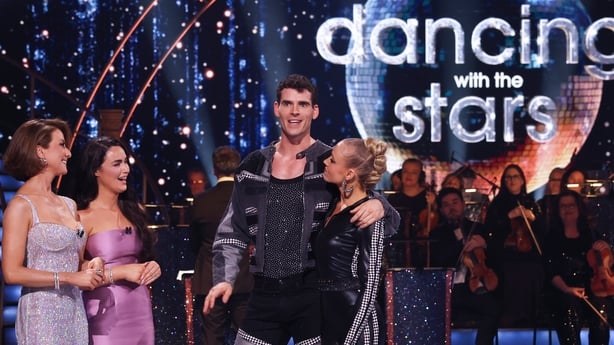
Professional dancers carry the same emotional downside risk
Patrice emphasised that eliminations land heavily on the professional dancers as well as the celebrity contestants, pointing to Roze’s reaction after Doyle’s exit and the intensity of the workload in the closing stages of the series.
“I think for the pros as well, like Daniela and Philip who were eliminated on Sunday, Daniela was particularly upset because she had worked so hard and Philip was so amazing. It’s at that stage now where they do see the Glitterball and think ‘I could get there and this is attainable’. To go home at that stage, it’s heartbreaking, it really is,” Patrice said.
“They are so immersed in it. I mean, you know, myself and the others, we’re only there at the weekends. But they are there seven days a week. They eat, sleep and breathe it,” he added.
His remarks underline a persistent structural feature of celebrity dance competitions: professional dancers are not only performers on broadcast nights, but also the core labour that sustains rehearsal schedules, choreography development, and week-to-week adaptation to judges’ feedback and audience response. In later rounds, where contestants and partners can begin to view the trophy as attainable, the emotional swing associated with an elimination can intensify.
The same professionals have also become central to the programme’s digital storytelling, often fronting rehearsal-room clips and explainers that populate RTÉ’s and the BBC Studios format team’s online channels between Sunday episodes. That dual on-air and online presence raises the stakes when a couple’s journey ends abruptly in the semi-final run-in.
On-camera polish, off-camera vulnerability
Patrice said he expects the emotional register to rise further as the competition reaches its decisive rounds, arguing that visible vulnerability is part of what the format captures when celebrities attempt a new skill under public scrutiny.
“Obviously I don’t want to make people cry, but I do love a few tears because it just shows how real it is and how human it is – trying a new skill and putting themselves out there. It’s daunting to say the least,” he said.
Laughing, he added: “We’ve two weeks left – I want to see tears on the dance floor. Better yet, I’ll just cry.”
In production terms, the quote points to an editorial balancing act: maintaining an upbeat, family-friendly prime-time tone while also leveraging authentic reaction shots and immediate post-result interviews for social clips. The “glitz and glamour” of the live broadcast can coexist with a backstage environment built around fast-turnaround content capture, where heightened emotions can become part of the programme’s digital output.
That tension is now common across global reality franchises. As streamers and social platforms compete for attention, publicly funded broadcasters such as RTÉ face pressure to demonstrate reach beyond linear ratings, building multiplatform brands around flagship shows like Dancing with the Stars. Patrice’s all-access vantage point is one of the tools used to bridge those worlds, translating studio emotion into short-form content that can travel on Instagram and TikTok within minutes of the result being announced.

Dancing with the Stars airs Sundays on RTÉ One and RTÉ Player at 6:30pm, with extended clips and backstage interviews released across the broadcaster’s social channels and digital platforms shortly after transmission.
Keep reading
