
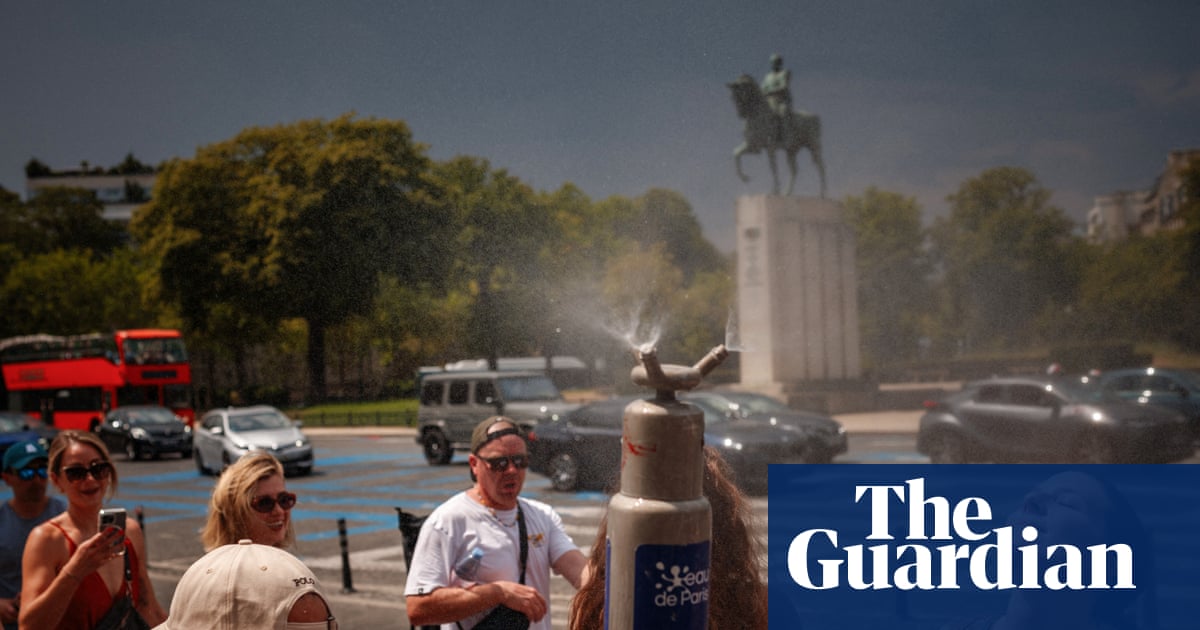
PARIS – A severe heatwave sweeping across Europe has left four toddlers dead in France and more than 55 people drowned, as record-breaking temperatures shift east toward Central Europe.
Scientists have identified this as the most severe and widespread heat event on record, with nearly half of the region’s 850 largest cities experiencing unprecedented heat stress. The World Meteorological Organization (WMO) and other climate scientists attribute the extreme conditions to the climate crisis driven by fossil fuel burning.
The current weather system is forecast to move further east, potentially subjecting 150 million people to temperatures exceeding 35C (95F), with health agencies warning that night-time temperatures in particular are no longer falling to levels that allow the human body to recover.
Fatalities and Emergency Saturation in France
French authorities are reporting a series of toddler deaths linked to hyperthermia. In Marseille, an 18-month-old child died in emergency care after being found in a vehicle; police sources indicate the child may have been forgotten in the car by his father.
Other fatalities include a three-year-old boy in a Paris suburb who became trapped in a car after a child lock was activated, and two children, aged two and four, who were found dead in a residential car park.
Marina Ferrari, France’s sports minister, confirmed that the number of drownings has risen to at least 55, up from 40 reported earlier in the week. “By yesterday night we were at 55, but we fear that the situation may worsen,” Ferrari stated, noting that many of the deaths occurred in unsupervised swimming areas as people sought relief from the heat.
Medical facilities in the capital are struggling to manage the surge of patients. Paris police chief Patrice Faure announced a ban on drinking takeaway alcohol in the streets to reduce pressure on emergency services, noting, “We are reaching a saturation point in hospital facilities.” The measure supplements France’s national heat action plan, which requires local authorities to activate cooling centres, check on vulnerable residents and adapt working conditions during officially declared heatwaves.
Patrick Pelloux, head of the Association of French Emergency Doctors, reported 55 deaths within the care of emergency health services in Paris over a 24-hour period. “Fifty-five is enormous,” Pelloux said. “Normally it’s three or four over 24 hours.” He warned that the real toll from heat stress is likely to emerge only after mortality data are consolidated in the coming weeks.
Due to these risks, organizers postponed Paris Pride and the Pride march in Lyon, as well as the Solidays music festival, after consultations with city officials and public health authorities over crowd safety and emergency access.
Record Temperatures and Infrastructure Failure in the UK
In the United Kingdom, the Met Office recorded the hottest June day on record for three consecutive days. Provisional figures show a peak temperature of 37.3C in Santon Downham, Suffolk, with forecasters warning that some locations could edge higher as the episode continues.
The Met Office warned, “And temperatures are still rising.”
A red heat-health alert-indicating a significant risk to life even for healthy individuals-remained in place for London and south-east England. The UK Health Security Agency extended this alert across southern and central England, triggering formal guidance to the National Health Service, care providers and employers to adapt working hours, provide access to shade and water, and proactively contact at-risk patients.
The extreme heat has caused widespread systemic disruptions:
- Education: Over 1,000 schools closed or partially shut due to overheating in poorly insulated buildings, renewing questions over the pace of investment in climate-resilient public infrastructure.
- Transport: Railway operators reduced services and urged passengers to avoid non-essential travel, citing speed restrictions and the risk of rails buckling in direct sun.
- Environment: Firefighters are battling a 200-hectare wildfire in Derbyshire, with local authorities warning of heightened fire risk across parched moorland.
- Utilities: South East Water implemented a hosepipe ban in Kent, while energy operators warned of power supply strain due to air conditioning demand and increased use of fans.
The London ambulance service reported its highest number of life-threatening emergencies on record. Chief operating officer Craig Harman stated he expected demand to grow daily and urged the public to reserve emergency calls for genuinely critical situations as crews face long response times.
Heat Shift Toward Central and Eastern Europe
As conditions peak in the west, extreme heat is intensifying across Central and Eastern Europe, with national meteorological services from Germany to the Balkans issuing their highest-level alerts.
In Germany, the A2 motorway suffered structural failure as the surface buckled and ruptured over several lanes. Highs of 40C are expected. In Austria, the national rail company issued warnings that train tracks could buckle as temperatures climb toward 39C, and encouraged passengers to carry water and avoid peak afternoon travel where possible.
Other regional impacts include:
- Netherlands: Issued its first-ever red heat alert; the Defqon 1 techno festival was cancelled following consultation with public safety officials.
- Belgium: A large-scale re-enactment of the 1815 Battle of Waterloo was cancelled as local authorities cited heat risks for participants in historical uniforms.
- Balkans: Temperatures are forecast to reach 39C, with health ministries in several countries warning of increased wildfire danger and urging limits on outdoor work.
- Hungary: Budapest Pride will proceed, though organizers have urged vulnerable people to stay home and pledged additional shade, water points and medical support along the route.
Conversely, Greece and Cyprus have seen relief provided by early Etesian winds. While temperatures remain in the upper 30s, the absence of high humidity has allowed tourists to remain active in Athens. Heavy rainfall and hail are predicted for parts of central Greece, prompting flash-flood watches even as the wider region battles drought and heat.
Climate Drivers, Policy Frameworks and Regional Trends
The WMO indicates that Europe has warmed by approximately 2C in the 50 years since the heatwave of 1976, making it the fastest-warming continent over recent decades. The Mediterranean region is warming about 20% faster than the global average, amplifying the risk of compound events in which heatwaves coincide with drought, wildfire and water scarcity.
John Kennedy, the WMO’s climate information chief, linked the current event to long-term warming trends.
“Heatwaves like this are what we expect to see in a changing climate,” Kennedy said. “Extreme heat will occur more frequently, for longer duration and with greater intensity as global warming continues.”
Across the European Union, governments are under pressure to translate such warnings into faster adaptation. The bloc’s cornerstone water law, the EU Water Framework Directive, already obliges member states to manage rivers, groundwater and coastal waters in ways that mitigate the effects of floods and droughts, but heat-health experts say current national plans often underestimate the speed and intensity of recent extremes.
Forecasters predict that temperatures in Mediterranean countries will exceed 40C starting in mid-July, marking the beginning of a two-month period of extreme day and night heat. Urban planners say this will test whether measures such as early-warning systems, tree planting, reflective surfaces and legally mandated “cool rooms” in care homes are being deployed at the scale needed to protect Europe’s rapidly ageing population.
