
WASHINGTON –
The US Department of Defense has awarded Kongsberg Defence & Aerospace a $45.5 million firm-fixed-price contract to supply the Republic of Latvia with a Naval Strike Missile (NSM) coastal defense system under the US Foreign Military Sales program. The award includes options that could lift the total value to $56.3 million. Work will be carried out across multiple sites, with the bulk of production in Kongsberg, Norway, and additional contributions from Finland, Italy, Denmark, the United Kingdom and other locations. Under the current schedule, work is due to conclude by July 2030, and could extend to November 2031 if all options are exercised.
“This acquisition strengthens Latvia’s coastal defense posture and reflects ongoing cooperation between NATO allies,”
NAVSEA said.
Why the deal resonates across the Baltic
Latvia’s purchase arrives as NATO has consolidated control of nearly the entire Baltic Sea coastline following Finland’s accession on April 4, 2023, and Sweden’s accession on March 7, 2024-leaving Russia as the only non‑NATO littoral power. That strategic shift, coupled with recent incidents affecting subsea energy and data infrastructure, has elevated allied priorities for coastal defense, sea denial, and maritime domain awareness from the Gulf of Riga to the Danish straits.
For Latvia, which regained independence in 1991 and joined NATO in 2004, the contract is part of a long-term effort to ensure that its 498‑kilometer shoreline cannot be used as a seam in the alliance’s northern defenses, but instead contributes to a more integrated Baltic Sea deterrence posture.
What Latvia is buying
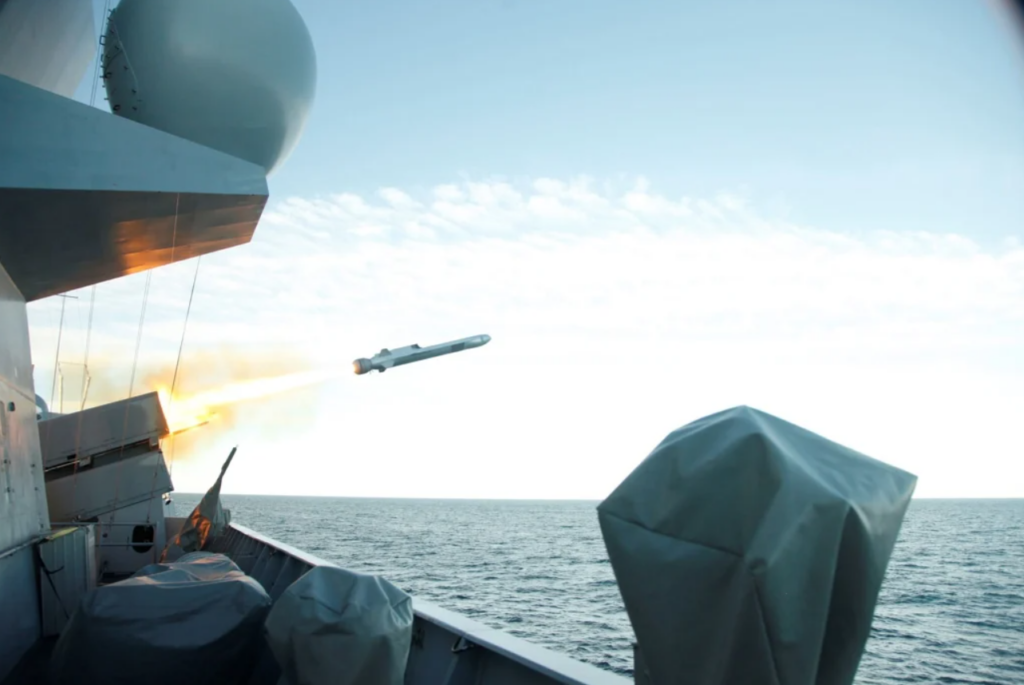
The NSM coastal defense system combines mobile launchers, command-and-control units and supporting sensors to deliver precise, over‑the‑horizon strikes against naval targets, with the missile’s sea‑skimming flight profile and imaging infrared seeker designed to penetrate modern ship defenses and guide to specific aim points. The same missile is in frontline service with the US Navy and US Marine Corps, enabling common training, tactics and logistics with allied forces in Europe.
Kongsberg’s NSM family has become a de facto NATO standard for anti‑ship missions, fielded or on order with multiple European and Indo‑Pacific partners. Poland operates coastal squadrons built around NSM and is expanding the force, while Romania is procuring an NSM coastal defense system via the US FMS channel-both precedents that anchor the missile’s growing role in European littoral deterrence. For Latvian planners, that interoperability reduces technical risk and simplifies integration into combined NATO maritime operations and exercises.
How the US FMS framework underpins the sale
FMS is a government‑to‑government channel authorized by the Arms Export Control Act and administered by the Defense Security Cooperation Agency (DSCA). It allows the US government to contract with industry on behalf of eligible foreign partners, aligning procurement with US oversight, export controls and sustainment planning. Latvia’s NSM case follows DSCA’s May 3, 2023 congressional notification for an NSM coastal defense package valued at up to $110 million, and complements an October 24, 2023 notification for six M142 HIMARS launchers-both milestones in Riga’s broader modernization drive.
Firm‑fixed‑price contracting for this award places cost risk primarily on the contractor and offers partners greater predictability on program outlays-a feature NATO defense ministries have increasingly prioritized as rearmament schedules compress across Europe. For Latvia’s Parliament and Ministry of Defence, that structure also makes it easier to sequence large, multi-year capabilities like coastal batteries alongside parallel investments in ground forces, air defense and munitions stockpiles.
A tighter allied posture on NATO’s eastern flank
Latvia’s 498‑kilometer coastline on the Baltic Sea and Gulf of Riga is a critical stretch of NATO’s northern maritime frontier. Since 2022, allied operations have focused more heavily on protecting undersea energy and data links, an urgency underscored by the 2022 Nord Stream pipeline explosions and the 2023 damage to the Balticconnector gas pipeline between Finland and Estonia. NSM-equipped coastal batteries give Riga a more credible ability to contest hostile naval movements close to those routes, complementing maritime patrol aircraft, allied naval presence and undersea surveillance assets.
Riga’s investment also meshes with the alliance’s ground posture in Latvia, where a Canadian‑led multinational formation is being scaled toward brigade level and, more recently, Swedish troops have joined operations as Stockholm transitions from long‑standing neutrality to full NATO integration. Together, the land and coastal strike elements feed into NATO’s regional defense plans for the Baltic area, which aim to move from tripwire deterrence toward forward, pre-planned defense along the eastern flank.
Latvia’s accelerating defense buildup
Latvia has moved sharply to expand defense spending and rebuild magazine depth, air defenses and coastal strike since Russia’s full‑scale invasion of Ukraine. According to official budget data, Latvia’s defense outlays rose to roughly 3.3% of GDP in 2024 and are projected to reach approximately 4.9% in 2026, with plans indicating a path to about 5% by 2027 under NATO accounting. Those commitments frame long‑lead procurements-such as NSM coastal batteries-within a multi‑year financing plan, and signal to allies and domestic audiences that elevated spending levels are intended to be sustained rather than episodic.
- May 3, 2023: DSCA notifies Congress of a proposed NSM coastal defense sale to Latvia (est. $110 million).
- Dec. 8, 2023: Latvia signs a $105 million NSM agreement with the United States; US support covers a significant share.
- Mar. 7, 2024: Sweden joins NATO, further consolidating allied control of the Baltic Sea littoral.
As of today, NAVSEA lists the Latvia NSM coastal defense contract as a firm‑fixed‑price award with a base value of $45.5 million, multi‑site production centered in Kongsberg, Norway, and an expected completion by July 2030-extendable to November 2031 if options are exercised. For both Washington and Riga, the timeline underscores that hardening NATO’s eastern flank is now planned on a decade-long horizon, with industrial capacity, alliance planning and national budgets all being aligned to support a more permanent deterrence posture.
Worth a look
