
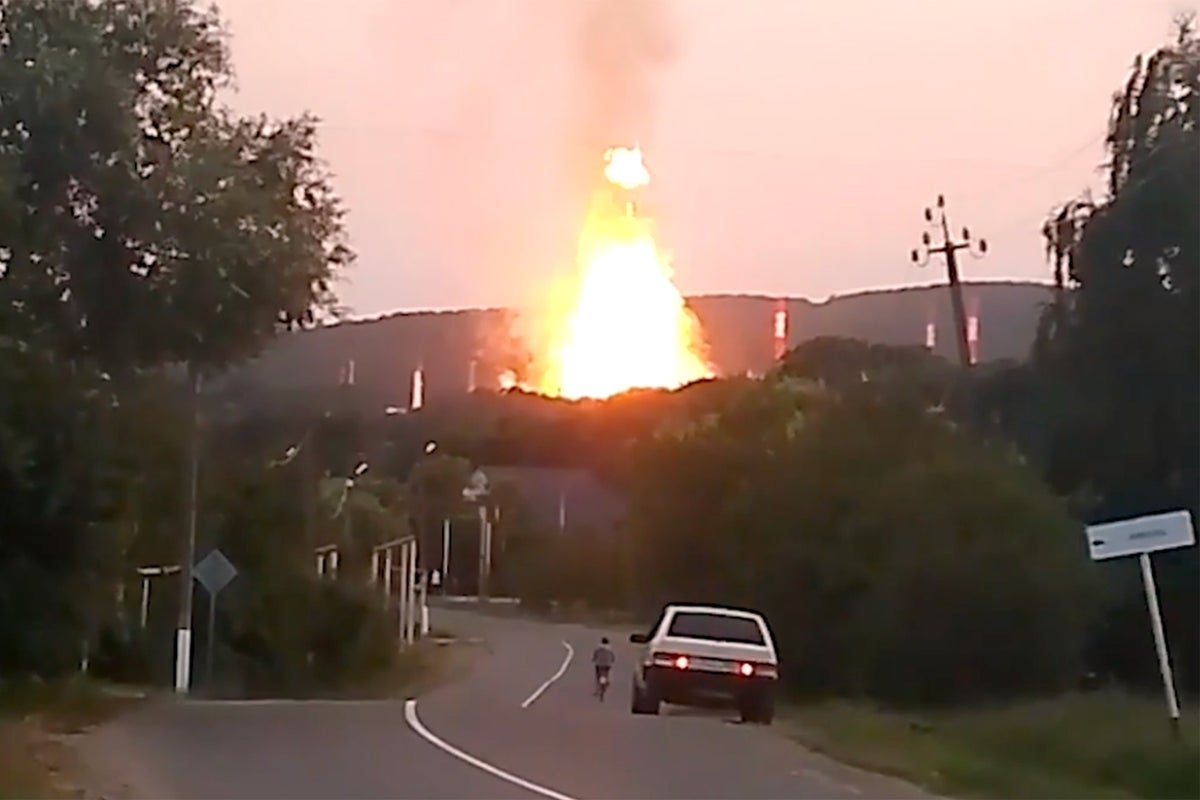
ANKARA – Ukraine has intensified its strategic campaign against Russian energy infrastructure, striking 12 tankers in the Sea of Azov and triggering a domestic fuel crisis that has forced the Kremlin to ban diesel exports.
The escalation coincides with a pivotal shift in Western military support, as U.S. President Donald Trump announced during a NATO summit in Ankara that Washington will grant Ukraine a license to manufacture Patriot missile interceptors domestically.
These dual developments signal a transition in the conflict toward long-term industrial attrition, where Ukraine is simultaneously attempting to bankrupt the Russian war machine through economic sabotage while building a sustainable, sovereign defense industry.
The Energy War and Domestic Instability
The General Staff of the Armed Forces of Ukraine confirmed the destruction of 12 Russian tankers in the Sea of Azov, alongside one tugboat and one dry loader. The Sea of Azov serves as a critical maritime artery for the Russian military, facilitating the movement of fuel and supplies to occupying forces in southern Ukraine and connecting inland Russian ports to the Black Sea.
“The affected vessels were used, among other, to supply fuel and oil materials to the grouping of troops of the Russian Federation, as well as to transport oil and petroleum products in the absence of international sanctions,” the Ukrainian military stated via Telegram. “They provide the export of energy carriers, which is one of the key sources of financing the war against Ukraine.”
The maritime strikes are part of a broader systematic campaign of drone attacks targeting Russian oil refineries and logistics nodes, aimed at degrading Moscow’s fiscal capacity to sustain the war. The resulting volatility in the fuel market has forced the Russian government to introduce an emergency ban on diesel exports, effective until July 31, under its domestic fuel-market regulation powers to prevent a total collapse of internal supply.
The impact of these strikes is most acute in Russian-occupied Crimea and various mainland regions:
- Price Surges: Data from Rosstat indicates that average fuel prices in Crimea have risen by 78.4 percent, nearly doubling previous levels and putting additional pressure on household budgets and local businesses.
- Supply Shortages: Sergey Aksyonov, the Russian-appointed governor of Crimea, warned that shortages are likely to persist, noting that on certain days “there will be no fuel available to be freely sold.”
- Civilian Disruption: Drivers across multiple Russian regions report hours-long queues at filling stations as gasoline and diesel supplies dwindle, prompting local authorities to consider rationing and priority fueling for emergency services.
The crisis has forced Russia, a global energy superpower, into the paradoxical position of importing fuel to maintain internal stability. Industry sources confirm that Moscow has already begun seaborne imports of gasoline from India to mitigate the shortfall, underscoring the degree to which wartime disruption is colliding with the Kremlin’s domestic social contract built on cheap, reliable fuel.
The export ban also has implications for international energy markets, as Russia’s diesel flows are a significant component of global supply. While the measure is framed as temporary, it highlights how the war has entangled Russian domestic policy decisions with broader concerns about energy security in Europe and beyond.
Strategic Shift in Defense Production
While targeting Russia’s economic vulnerabilities, Ukraine is moving toward strategic autonomy in air defense. At the NATO summit in Ankara, President Donald Trump confirmed that the United States would allow Ukraine to produce Patriot missile interceptors on its own soil, marking a shift from ad hoc emergency resupply to a more durable industrial partnership.
“We’re going to give a license to you to make Patriots. That’s pretty cool. This way, you can’t complain that we’re not giving ’em enough,” Trump told Ukrainian President Volodymyr Zelensky.
The Patriot system is among the most sophisticated air-defense networks in the world. By granting a manufacturing license, the U.S. is moving beyond the model of direct equipment transfers toward a model of co-production that embeds Ukraine more deeply into the alliance’s defense-industrial base. In practical terms, it reduces Ukraine’s total reliance on the fluctuating political will of foreign capitals for interceptor stockpiles, while binding Kyiv more tightly to the regulatory and export-control framework that governs advanced U.S. weapons technology under the International Traffic in Arms Regulations.
The announcement was accompanied by a massive financial commitment from the alliance:
- Military Assistance: NATO members pledged €70bn (£59.7bn) in military aid to Ukraine for 2026, moving the war effort further onto a multi-year budgetary footing rather than short-term emergency packages.
- Arms Procurement: The alliance unveiled arms deals valued at a minimum of $50bn, signalling a long-horizon expansion of European and transatlantic defense production capacity.
- Collective Defense: Member states reaffirmed their “ironclad commitment” to the Article 5 pact in a formal summit declaration, reiterating that an attack on one is an attack on all under the North Atlantic Treaty.
For Kyiv, domestic production of Patriot interceptors could, over time, help close the gap between the scale of Russian missile and drone barrages and the limited number of high-end air-defense missiles available at any given moment. It also aligns with broader Ukrainian efforts to grow a homegrown defense sector capable of sustaining a protracted conflict and eventually exporting to friendly states.
Moscow’s Response and Regional Escalation
The Kremlin has reacted with sharp condemnation, viewing the NATO summit’s outcomes as a direct provocation and an institutionalization of Western military support for Ukraine. Russian Foreign Ministry spokesperson Maria Zakharova warned that the decisions made in Turkey could lead to “catastrophic consequences.”
Zakharova characterized the current trajectory as the “militarisation of the European continent,” asserting that NATO is focused on “preparation for an armed conflict with Russia.” She further suggested that the alliance is fragile, citing “cracks” between the United States and its partners, specifically mentioning unresolved tensions regarding Greenland and perceived lack of support for Washington’s interests. The rhetoric is in line with Moscow’s longstanding effort to frame NATO as both expansionist and internally divided, even as member governments seek to project unity.
As the diplomatic and economic war intensifies, the kinetic conflict continues to impact civilian populations. On July 8, Russian drone and missile strikes targeted residential buildings in Kharkiv and Kyiv, leaving apartment complexes heavily damaged and killing at least 21 civilians in a recent 11-hour assault on the capital, according to Ukrainian authorities. Emergency services reported hours-long rescue operations as they searched for survivors under the rubble.
The Russian Ministry of Defense claimed that air defense units downed 73 Ukrainian drones overnight, while reporting a fire at an oil depot in the Tver region following a drone strike. Neither side’s battlefield claims could be independently verified in full.
The Russian government continues to maintain the diesel export ban through the end of July as it attempts to stabilize domestic prices and secure fuel logistics for its military operations. Combined with stepped-up NATO coordination on Ukrainian air defenses and industrial capacity, the latest moves on both sides underscore that the war is increasingly being fought not only on the front lines, but also through supply chains, regulatory levers, and long-term institutional commitments.
Worth a look
- Global Food Security Alliances: How Climate-Resilient Agricultural Corridors Are Stabilizing Wheat and Rice Supplies
- Cross-Border Renewable Energy Grids: North Sea and Mediterranean Subsea Cable Networks Enter Phase Two
- Russian lab worker's suspected plague death leaves experts puzzled (globallypulse.com)
