
WASHINGTON – The Ocean Conservancy has announced the winners of its 2026 Photo Contest, a global exhibition that leverages high-resolution visual journalism to document the biodiversity and precarious state of the world’s marine ecosystems.
The annual competition serves as more than an artistic showcase; it functions as a visual census of the planetary health of the High Seas and coastal waters. At a time when international bodies are struggling to implement the “30×30” goal-the global commitment to protect 30 percent of the world’s oceans by 2030, anchored in the new high-seas protections under the U.N. High Seas Treaty-these images provide critical evidence of the habitats and species that remain at risk from climate volatility and anthropogenic degradation.
Arctic Fragility and the Walrus Habitat
The 2026 Judges’ Choice Winner, Walrus Nursing by Richard Rothstein, captures a rare moment of intimacy between two female walruses and their calves in the Arctic. The image underscores the symbiotic relationship between marine mammals and the sea ice, which serves as essential platforms for resting, nursing, and molting.
“Our group was in a small skiff slowly moving among the icebergs when we came upon the scene in the image. Two female walruses were in what appeared to be a protective posture as one of the females was nursing a small calf,” says winning photographer Richard Rothstein. “We remained a very respectable distance and did not approach. The walruses seemed to completely tolerate our presence as there appeared to be no alteration of their natural behavior. This was my first encounter with walruses, and it was truly an experience of a lifetime!”
“There’s such tenderness in this Arctic moment-two adult walruses framing the calf nursing between them, all mirrored in the glassy meltwater below. That reflection doubles the impact and gives the composition a beautiful symmetry, and the soft, even light shows off every wrinkle and whisker. A quiet, intimate family portrait set against the fragile backdrop of the sea ice these animals depend on,” says 2026 Ocean Conservancy Photo Contest Judge and two-time winner, Angela J. Farmer.
The mention of “glassy meltwater” echoes broader scientific concerns regarding the acceleration of Arctic ice loss. As the polar regions warm at nearly four times the global average, the loss of stable ice platforms forces walruses to haul out on land in massive numbers, often leading to fatal stampedes and increased distance from primary feeding grounds. For policymakers weighing Arctic shipping routes, offshore drilling, and fisheries access, such images foreground the trade-offs between economic activity and the survival of ice-dependent species.
Biodiversity in the Indo-Pacific
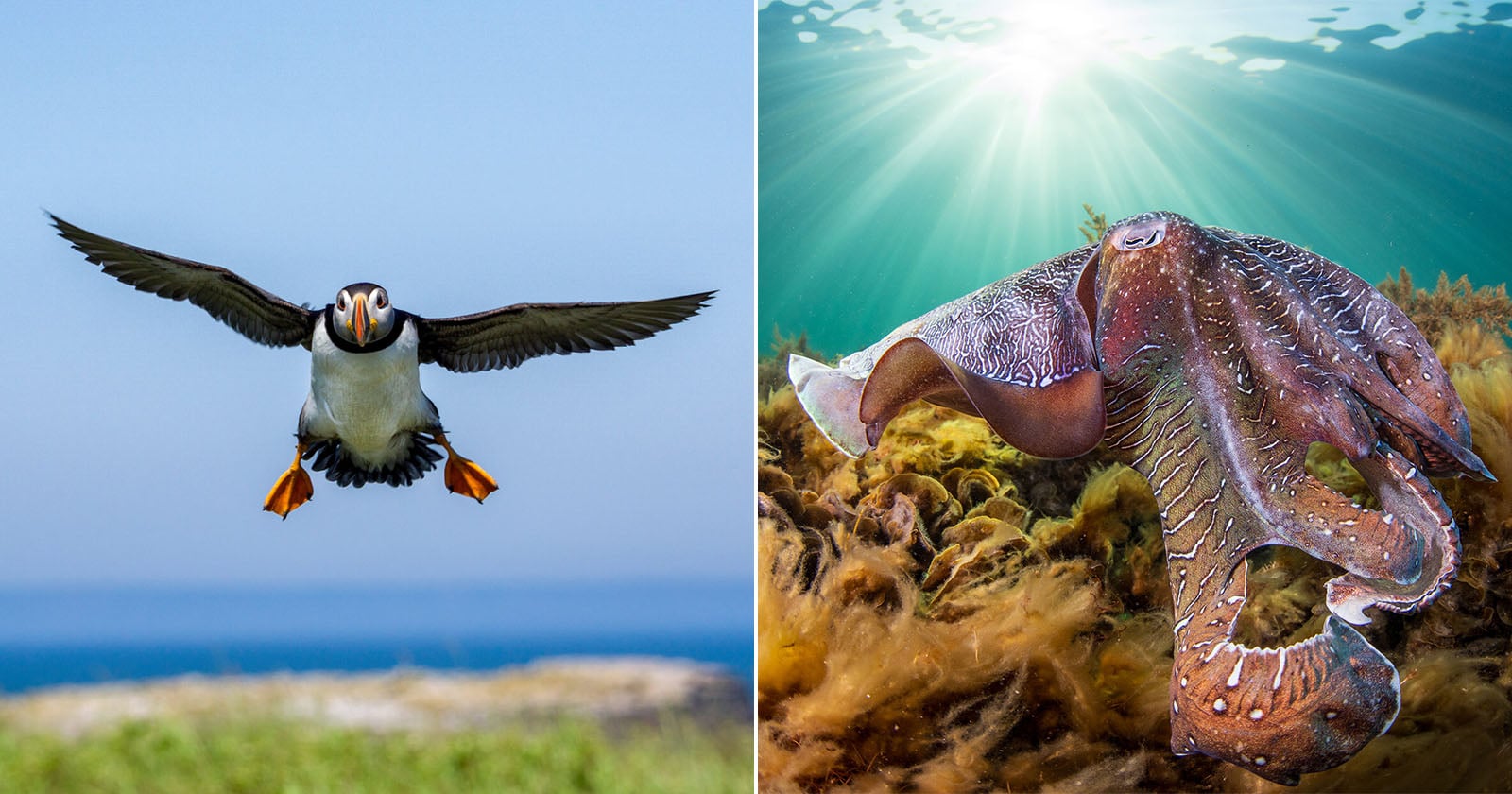
Shifting from the poles to the temperate waters of the Southern Hemisphere, the Staff Choice award was granted to Rowan Dear for The Lone Ranger. The photograph documents a male Giant Cuttlefish off the coast of Australia, a species renowned for its advanced camouflage and complex social hierarchies within one of the planet’s most species-rich marine regions.
“Most of the Cuttlefish here are smaller and similar size to the females, however you will see some very large males who are three to four times the size of some males who will swim around and bully and dominate the other males and sometimes guard up to three females. The larger males are probably two years old and have been eating their way through summer waiting for the mating season in winter,” says Dear.
Judge Angela J. Farmer described the work as an “absolute showstopper,” noting that “the sunburst breaking through the surface turns an ordinary dive into something almost cinematic. The cuttlefish’s intricate textures and shifting purple-to-copper tones are stunning, and the way the light rays guide your eye right down to it shows real mastery of natural underwater lighting. A rich, immersive image that makes you feel like you’re in the water with him.”
The Indo-Pacific has become a focal point for regional fisheries management and tourism-driven coastal development. By drawing viewers into the life of a single cuttlefish, the contest also spotlights the cumulative pressure that warming waters, overfishing, and habitat loss place on entire reef systems that underpin food security and local economies from Australia to Southeast Asia.
Global Reach and Public Engagement
The competition’s People’s Choice winner, Nicole Pellegrino, highlighted the intersection of urban development and wildlife with her photo Sweet Seal, depicting a seal pup on the shores of Long Island, New York. This inclusion emphasizes the presence of endangered or protected species within highly populated coastal corridors, reminding the public of the invisible boundaries between human infrastructure and marine life.
Along the U.S. Atlantic seaboard, where coastal zoning, offshore wind build-out, and port expansions are under active review, images like Sweet Seal bring an immediate, local face to decisions often debated in technical hearings and regulatory filings.
Beyond the primary winners, the Ocean Conservancy identified eight Honorable Mentions that illustrate the global scale of marine conservation efforts across diverse jurisdictions:
- Antarctica: Abbey Road by Mathilde Chevallay, depicting Emperor penguins along ice corridors governed by the Antarctic Treaty System.
- Japan: The Silver Ocean Within the Ocean by Akira Asahina, capturing human interaction with massive fish schools in heavily managed coastal fisheries.
- Argentina: Voice of the Forgotten Coast by Aldo Gustavo Galante, featuring a rockhopper penguin on a windswept shoreline.
- Dominica: Nature Reclaimed by Bingqian Gao, documenting a seahorse clinging to an algae-covered rope, a quiet commentary on marine debris.
- French Polynesia: Curiosity by Laura Murchie, showcasing underwater dolphin behavior in one of the world’s largest exclusive economic zones.
- USA (Hawaii): Existing Together by Bill Ehman, showing a kayak alongside a whale and calf, echoing debates over vessel speed limits and approach distances.
- USA (Maine): Puffin Landing by Michelle Hare, capturing a puffin in flight above restored nesting islands.
- USA (Florida): Manatee by David Fleetham, highlighting Florida’s sirenia populations in waters shaped by boating rules, freshwater management, and state protections under the U.S. Endangered Species Act framework.
Together, the winning and shortlisted photographs trace a visual map of ocean governance-from the polar commons to densely populated coastlines-at a moment when governments are under pressure to translate high-level commitments into enforceable marine protected areas, fisheries quotas, and pollution controls.
The Ocean Conservancy continues to use these annual contests to brief lawmakers, engage multilateral forums, and build public backing for stronger international maritime law and the reduction of plastic pollution in the global commons. The 2026 winning gallery remains available through the organization’s official digital archives, positioning the images not just as art, but as evidence in an ongoing debate over how quickly the world can – or will – protect the ocean that regulates the planet’s climate and sustains most of its life.
Related reading
