
Image by Author
Google’s real‑time music generator reaches the DJ booth
Text-to-music systems spent years in labs producing short clips. Now MusicFX DJ moves the format into a live, consumer-facing instrument that reacts as you play. The web app blends multiple prompt layers, streams 48 kHz stereo audio, and lets users steer output with mixer-style controls-turning generative models into a performance surface rather than a render button.
It is also one of the first mainstream tests of how real-time AI music will coexist with copyright rules, platform policies, and new regulatory demands that treat synthetic audio less as an experiment and more as a product category with duties attached.
What changes for creators and developers
The shift is interactivity. Instead of waiting for offline inference, users ride a continuous stream that evolves with each tweak. Example prompts such as “funky bassline,” “ethereal synth pads,” and “driving hip-hop beat” can run simultaneously. Track controls include “chaos” and “density,” giving immediate influence over texture and dynamics. The “magic” of the layering comes from conditional generation that weights prompts in real time, so one idea can dominate or recede without stopping the music.
For working DJs and producers, that reframes the model from a file-export tool into an instrument that can follow a set, a crowd, or a creative hunch. For developers, it reframes integration from a background asset pipeline to a live service whose behavior, latency, and compliance profile change second by second.
Under the hood: a streaming stack built for latency
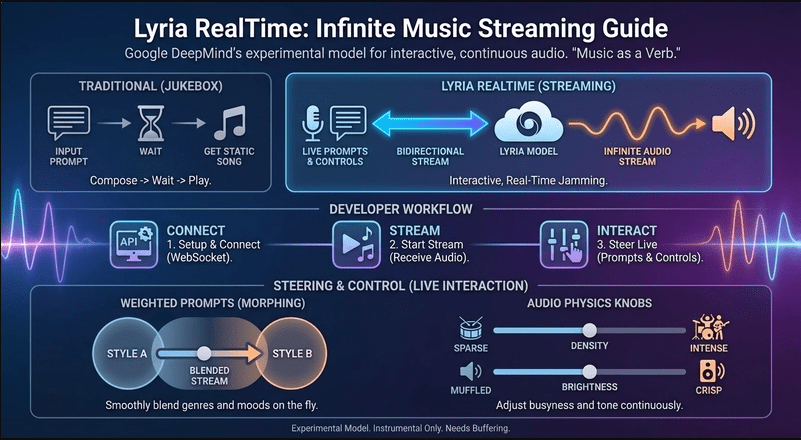
Lyria and Real-Time Diffusion
The engine behind the deck is the Lyria family-specifically a real-time variant that adapts diffusion for streaming. While implementation details aren’t fully public, the deployment pattern follows modern low-latency media systems.
- Client layer
- Web interface with mixer-like controls and prompt lanes
- WebAudio for playback; transport/clocking to keep layers aligned
- Lightweight state synced to the backend for deterministic changes
- Inference layer
- Diffusion-based generator that emits short overlapping segments
- Prompt-conditioning weights updated per frame to reflect faders
- Server-side lookahead to smooth transitions and avoid artifacts
- Streaming layer
- Bidirectional signaling for prompt/parameter updates
- Adaptive buffering to ride network jitter without audible gaps
- GPU/TPU autoscaling to match bursty, session-driven demand
For teams building on the same foundation, the model family is documented as Lyria, with a real-time mode also exposed through Google’s developer stack for prototyping and integration.
Where it sits in the AI‑music landscape
MusicFX DJ arrives into a crowded text-to-music field, but its design pushes decisively toward live performance and interactive media rather than static soundtrack generation.
| Capability | MusicFX DJ (Lyria RealTime) | Typical text‑to‑music (batch) |
|---|---|---|
| Generation mode | Continuous stream; evolves during playback | Fixed‑length clip; regenerates on edit |
| Prompt handling | Multi‑prompt with live reweighting | Single prompt or static multi‑tag |
| User control | Faders for intensity, “chaos,” “density” per layer | Global parameters set pre‑render |
| Output | High‑fidelity 48 kHz stereo stream | Downloadable file after processing |
| Developer path | Real‑time API surface suitable for apps and games | Clip generator suited to libraries and one‑shot assets |
That positioning matters: a system that behaves like an instrument will be evaluated not only on sound quality, but also on safety under pressure, auditability when something goes wrong, and its ability to meet the disclosure and labeling rules that now follow synthetic audio into clubs, streams, and consumer apps.
Data, licensing, and the copyright line
As generative music goes mainstream, three issues now define the operational boundary for consumer apps and APIs.
- Training data governance
- Clear documentation of audio sources and licenses where applicable
- Policies for handling takedowns and dataset refreshes
- Separation of evaluation sets from training material
- Copyright and similarity risk
- Controls that lower the chance of memorized passages surfacing
- Musicological similarity checks before publishing or export
- Guardrails around vocal likeness and artist style impersonation
- Attribution, labeling, and provenance
- Visible indicators that music is AI‑generated when required
- Provenance signals (metadata or watermarking) where supported
- Audit trails for enterprise use and dispute handling
For labels, collecting societies, and venues, these questions are no longer abstract. They determine whether AI‑generated sets can be cleared, how royalty reporting should treat synthetic stems blended with human performance, and which contracts need updated language on training data and output rights.
Regulatory pressure is reshaping feature roadmaps
- EU rulemaking places transparency and safety expectations on general‑purpose and generative systems, with staged obligations that encompass documentation, risk management, and user disclosure for synthetic content. The EU’s new Artificial Intelligence Act hardens many of these expectations into law for systems that generate or manipulate audio, including labeling duties when synthetic content is shown to the public.
- In the United States, federal consumer protection enforcement against deceptive AI outputs intersects with state deepfake and impersonation statutes, pushing platforms to deploy labeling controls and provenance tooling. Even without AI‑specific legislation, the Federal Trade Commission can treat misleading claims about AI capabilities, undisclosed synthetic content, or harmful “deepfake” uses as unfair or deceptive practices under its existing authority.
- Industry standards bodies are advancing content authenticity frameworks and safety testing practices, which are becoming procurement requirements for public‑ and private‑sector buyers.
For developers integrating real‑time generation into consumer apps, building with these expectations at design time-rather than as a post‑launch patch-reduces compliance risk and shortens approval cycles with distribution platforms. For public institutions commissioning training content or civic events that use AI music, it also simplifies due diligence: systems that can export logs, labels, and provenance signals by default are easier to buy.
Security and reliability in a live model
Once AI music is in the signal chain for a live set, failure modes look less like a bad export and more like silence, glitches, or reputational harm in front of an audience. That shifts the risk model for both providers and venues.
- Abuse resistance
- Prompt filtering and rate limits to mitigate targeted style copying
- Session‑level anomaly detection for automated scraping or cloning
- Infrastructure robustness
- Graceful degradation paths (quality reduction before dropout)
- Fallback to cached transitional loops during brief inference stalls
- Data integrity
- Strict separation between user prompts/outputs and model training pipelines
- Logging that supports reproducibility without storing raw user audio longer than necessary
Music platforms, labels, and event organizers will increasingly ask for these guarantees in contracts, not blog posts-from service level expectations on latency to assurances that crowd recordings, user prompts, or artist stems won’t quietly feed back into future training runs.
Product fit: where real‑time generation is immediately useful
- Interactive media and games: adaptive scores that respond to player state without asset baking
- Creator tools: rapid ideation, stems for later arrangement, and mood beds for video drafts
- Live formats: performances, streams, and events where generative accompaniment must follow the room
- Enterprise content ops: internal podcasts, training modules, and background scores produced within policy guardrails
In each of these settings, buyers are not just selecting a sound engine; they are choosing a governance model-how content is labeled, how disputes are handled, and how confidently they can tell regulators, artists, or employees what role AI played in the finished audio.
Why this matters now
Real‑time generation changes the economics of AI music from file exports to sessions, introducing new metrics-latency budgets, session concurrency, safety hit‑rates-that will define competitive advantage. With a consumer‑ready interface on top of a streaming diffusion backbone, MusicFX DJ shows how a research model can be packaged for everyday creativity while meeting the durability demands of the web.
It also previews the policy conversation to come. As more stages, streams, and studios lean on live AI audio, institutions-from competition regulators to cultural ministries and collecting societies-will be forced to decide where generative accompaniment fits in the rules that govern who gets paid, who is responsible when things go wrong, and how audiences are told what they are hearing.
Keep reading
