
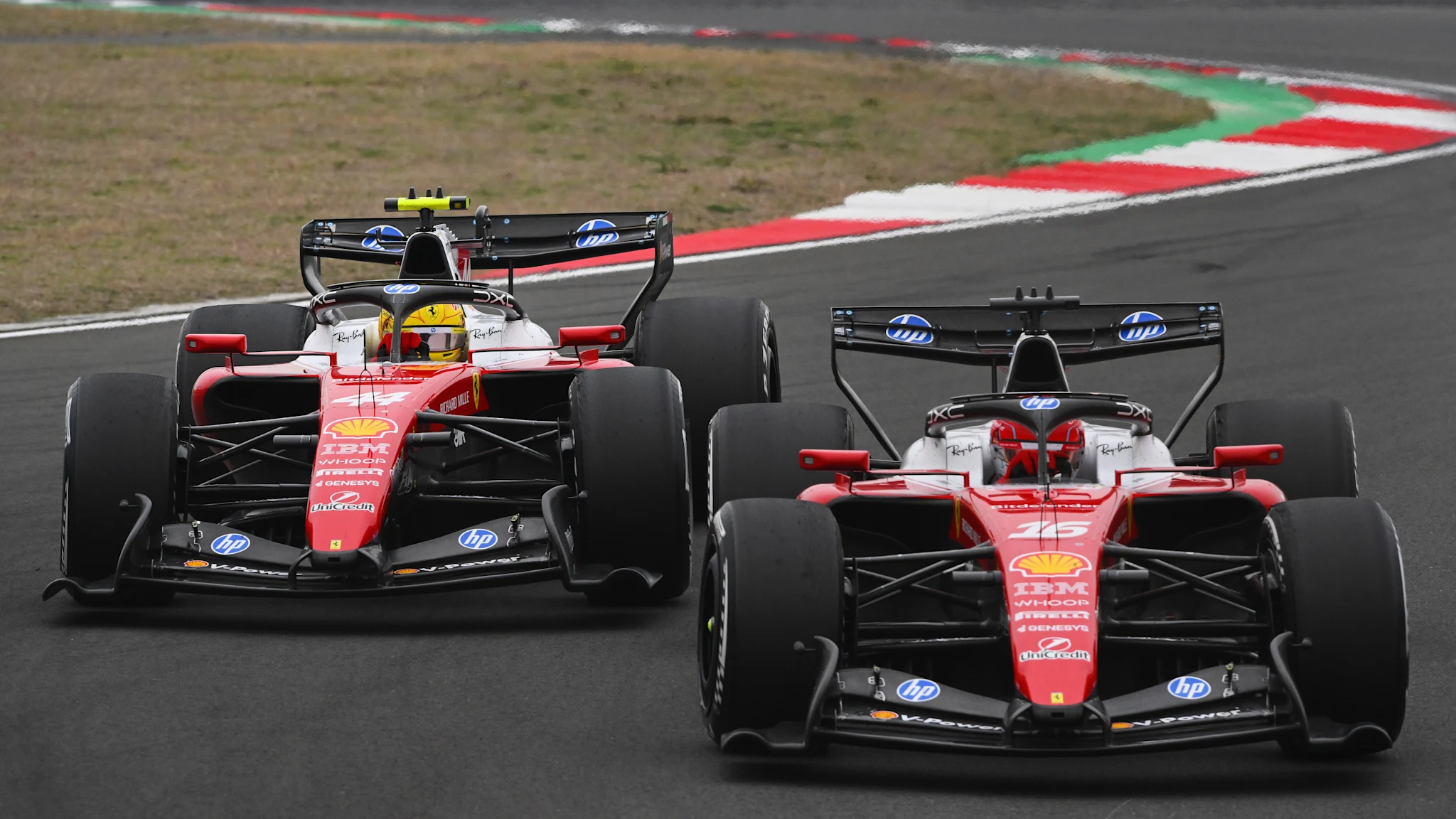
Hamilton-Leclerc duel earns Vasseur’s backing as Ferrari balances freedom and development in Shanghai
Clean intra-team fight, podium for Hamilton, and a measured message from the pit wall
Ferrari Team Principal Fred Vasseur praised Lewis Hamilton and Charles Leclerc after the pair raced each other hard and clean during the Chinese Grand Prix at the Shanghai International Circuit. In their first sustained wheel‑to‑wheel duel as team‑mates, Hamilton ultimately prevailed in the on‑track battle, securing his first Grand Prix podium with Ferrari, with Leclerc finishing fourth. Both drivers described the contest positively, with Hamilton calling it “one of the most enjoyable races I’ve had” and Leclerc saying he “enjoyed” the fight and trusted the space being left on track.
Vasseur characterized the scrap as “professional,” adding that allowing drivers to race is “the best way to build up a team.” He emphasized he did not want to “freeze the position” provided the fight remained respectful and under control on track and on the radio. The tone from the Ferrari pit wall was notably calm, with only light management on tyre and power‑unit settings, underscoring that the team was prepared to let the result be decided between the drivers rather than via coded team orders.
Mercedes still the benchmark as Ferrari gauges the gap
While Ferrari’s pace was strong enough at times to challenge the front, both Hamilton and Leclerc fell away from race winner Kimi Antonelli and George Russell in the decisive phases. Vasseur acknowledged that Mercedes remain out of reach for now and pointed to a straight‑line speed deficit as a key limiter at Shanghai’s long‑back‑straight layout, where Ferrari’s SF‑26 was particularly exposed in DRS trains.
Crucially, he outlined a weekend‑by‑weekend and session‑by‑session improvement curve, noting Ferrari had been roughly eight‑tenths adrift in Melbourne, then trimmed the margin across the Chinese Grand Prix weekend from practice to qualifying and into the race. He stressed that the lag is not only about the power unit, highlighting the need to work “everywhere”-chassis, tyres, drag level and the overall operating window-on the SF‑26. That framing matters for Maranello’s internal decision‑making: it justifies continued investment in incremental aero and mechanical updates rather than a disruptive concept reset.
Why Ferrari’s stance on team orders matters
Ferrari’s choice to let Hamilton and Leclerc race-and to say so publicly-signals confidence in garage harmony and driver judgment at the start of a long season. In a championship where teams accrue points through both cars, intra‑team battles can be sensitive; yet they can also accelerate learning by pushing drivers to explore limits in real race conditions and to report more precise feedback on how the car behaves at those limits. Vasseur’s approach suggests Ferrari believes controlled competition between its drivers will help extract more performance from the SF‑26 as development parts arrive and setups evolve.
Team orders remain permitted in Formula 1 under the FIA Formula One Sporting Regulations, but the threshold for intervention typically weighs risk (time loss, tyre wear, contact and potential penalties) against reward (maximizing the combined result and protecting a title campaign). In recent years, stewards have shown little tolerance for collisions between team‑mates that appear avoidable, adding a regulatory incentive for teams to define clear internal guidelines even when formal orders are not issued. By highlighting the professionalism of his drivers, Vasseur effectively framed Shanghai as a net gain: an additional podium, intact cars, and useful race data under pressure, with no need to test those boundaries with race control.
Circuit profile underscores Ferrari’s trade-offs
Shanghai is a revealing test for car efficiency and organizational judgement on setup. The combination of medium‑speed complexes and the extended back straight demands a strong aerodynamic platform and low‑drag efficiency, while also punishing cars that overheat their tyres through the first sector. Vasseur’s reference to straight‑line performance is particularly relevant here: even small deficits in top speed can compound across lap distance and in wheel‑to‑wheel exchanges when DRS trains form.
That Hamilton and Leclerc could still contest positions robustly indicates Ferrari’s cornering performance and tyre management were competitive enough to keep them in the fight before ultimate pace told. Strategically, Ferrari’s decision to run a downforce level that preserved tyre life, even at the cost of some top speed, underlined the broader trade‑off the team is trying to solve in its development programme.
What the result tells us about Ferrari’s trajectory
– The podium validates operational progress: a clean execution day and a strong return from Hamilton, with Leclerc close behind, suggest Ferrari is converting opportunities even without outright race‑winning pace. Pit stops and strategy calls were tidy rather than spectacular-precisely the kind of consistency the team has lacked in previous campaigns.
– Development priorities are aligned with track demands: the focus on straight‑line speed and global car efficiency fits the profile of upcoming circuits where drag sensitivity and traction will again be central. Internal resource decisions-on wind‑tunnel time, CFD runs and power‑unit mapping-are now being made against a clear performance map rather than headline lap‑time alone.
– Driver dynamics look stable: an open‑racing policy, reinforced by mutual respect and explicit backing from the pit wall, reduces the need for hard team orders and supports consistent points scoring across both cars. It also lowers the risk of the kind of intra‑team flashpoints that can distract leadership and trigger reactive policy shifts mid‑season.
Key facts from Shanghai
– Venue: Shanghai International Circuit (Chinese Grand Prix)
– Intra‑team battle: Lewis Hamilton vs Charles Leclerc, with multiple side‑by‑side moments through the first and second sectors
– Outcome: Hamilton finished on the podium; Leclerc finished fourth
– Front of the race: Ferrari’s challenge faded relative to race winner Kimi Antonelli and George Russell as Mercedes’ superior straight‑line efficiency and late‑race pace told
– Technical takeaways (per Vasseur): straight‑line speed deficit; improvements noted from the previous event and across the weekend; development required on power unit, chassis and tyres for the SF‑26, with a particular emphasis on drag reduction without sacrificing stability
As Ferrari refines the SF‑26, Shanghai offered a clear snapshot: a team capable of racing near the front, a driver pairing trusted to manage their own fight, and a principal prepared to trade short‑term control for long‑term competitive growth. How consistently Ferrari applies that philosophy-at tighter street circuits, under title pressure, and in the glare of future controversies-will help determine whether Shanghai is remembered as an entertaining outlier or an early marker of a more mature competitive culture at Maranello.
Related reading
- New Zealand Kiwis Unveil Strong Rugby League World Cup Squad Featuring Ponga, Gagai, and Key Debutants
- Aidan Forker Retires: Armagh’s All-Ireland Winning Captain Ends 15-Year Inter-County Career
- How to Win “El Buen Fin” on Facebook & Instagram: The October Strategy (archyde.com)
- Bahrain GP in Malaysia 2026: Verstappen on pole ahead of Hamilton (globallypulse.com)
