
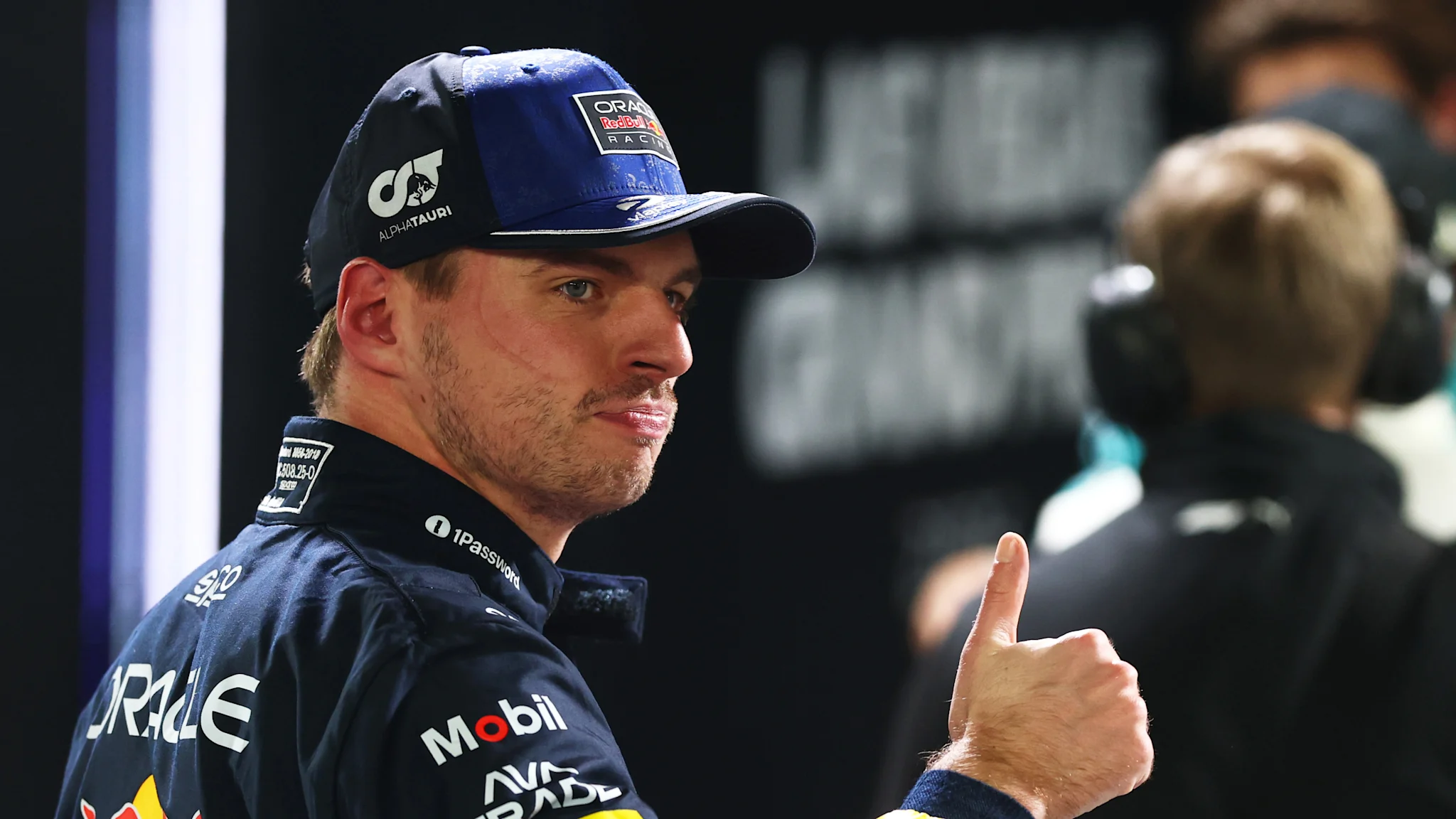
Verstappen inherits Las Vegas pole after turbulent build‑up as Red Bull lock in strong grid positions
Max Verstappen will start the Las Vegas Grand Prix from pole position after inheriting top spot on the grid, with the Dutch driver describing his qualifying performance as “solid” following a difficult final practice session marked by on‑track incidents and car concerns.
From practice frustration to pole promotion
Verstappen had initially secured provisional pole in Q3 but was edged out in the final runs by Mercedes driver Kimi Antonelli. A five-place grid penalty for Antonelli, who had set the fastest time, moved the newly crowned World Champion down the order and promoted Verstappen from P2 to pole.
The reshuffle gives Red Bull crucial track position for the night race on the Strip, despite Verstappen’s own admission that the build‑up had been far from straightforward.
The 29-year-old’s qualifying upturn came after an eventful Free Practice 3. During that session, the Red Bull driver was given a warning for erratic driving following an incident involving George Russell. A separate investigation into alleged erratic driving near Alpine’s Franco Colapinto resulted in no further action.
Compounding the disruption, Verstappen also reported steering issues across the session, leaving the team with a compressed window to refine the car before qualifying.
Verstappen: ‘Solid qualifying’ after set‑up struggles
Speaking after qualifying, Verstappen conceded that he had been wrestling with recurring set‑up concerns, referencing problems that had also appeared at the previous race in Brazil.
“Yeah, [I was] just struggling with some things that also were in the car in Brazil, and just trying to get my head around it to try and, let’s say, make the best out of it this weekend again,” he said.
Despite those issues, he felt the decisive phase of qualifying came together when it mattered most.
“But I think we had a solid Qualifying. We executed well. My first lap in Q3 was pretty much as good as it can be, I think, just with the tow effect as well around the lap. I think to be on the front row is very good for us.”
On a street layout dominated by long straights, drivers spent much of the evening attempting to balance tyre preparation with slipstream advantage. Verstappen underlined how complex that equation had become in the cool desert conditions.
Asked about the biggest challenge of the session – with track temperature, tyre behaviour and positioning on circuit all in play – the four‑time World Champion replied: “I guess all of that!
“Track temp, being in the right position… It’s incredibly hard when you have so many straights around here, but I think we executed well, so we can be very happy with that.”
Strategic importance of pole in Las Vegas
On a street circuit where safety cars, low grip and traffic management are recurring themes, inheriting pole carries significant competitive weight. The Las Vegas Grand Prix forms part of the FIA Formula One World Championship regulations framework, in which grid penalties are routinely used to enforce technical and sporting rules across the season.
Starting from the front gives Verstappen the cleanest line into Turn 1 and the best platform to control race pace and tyre strategy in a field where tow dynamics down the long Strip section could create pronounced slipstream trains. His comments about making the most of the car after earlier difficulties also point to a broader theme of adaptation at this stage of the campaign: banking results even when outright comfort with the set‑up is not guaranteed.
The warning for erratic driving in practice, with no further penalty applied, means Verstappen retains his grid advantage, but the incident itself illustrates how tightly stewarding and driving standards are policed over a weekend that pairs high speeds with close walls and limited runoff.
Hadjar capitalises on Red Bull pace from P4
It was also a productive day on the other side of the Red Bull garage, with Isack Hadjar qualifying fourth. Like Verstappen, the Frenchman highlighted the influence of the tow on lap time around the Las Vegas layout, while acknowledging that he had not maximised those aerodynamic gains.
“Tomorrow with the penalty that’s ahead for Kimi, we start fourth, so it’s a great starting position,” Hadjar said. “It’s just that… I mean, we were quick. I was just not playing the tow games.
“[If] you look at the data, it’s a bit sad how much I’m losing down the straight, but that’s part of this track. I didn’t expect the tow to be that powerful. We only got it quite late, so that’s on me. But anyway, from fourth anything is possible tomorrow.”
Given how powerful the slipstream appears to be over a full race distance, Hadjar’s position on the second row keeps him firmly in contention to influence the early running and potentially support Red Bull’s strategic options against rivals starting behind.
Looking ahead to Saturday’s race, he set his target clearly: “Podium, and below that is my starting position, so not very far.”
Key qualifying and disciplinary notes
- Max Verstappen inherits pole position after Kimi Antonelli’s five‑place grid drop.
- Verstappen had earlier received a warning for erratic driving following an FP3 incident with George Russell; a separate investigation linked to Franco Colapinto resulted in no further action.
- Both Verstappen and Isack Hadjar highlighted the importance of the tow on Las Vegas’ long straights and the difficulty of tyre and track temperature management.
- Antonelli’s penalty elevates Hadjar to fourth on the grid, strengthening Red Bull’s starting hand for the race.
For a race staged on a layout that amplifies both risk and opportunity, Red Bull head into Saturday with front‑loaded grid positions and a driver pairing that, by their own admission, is still working around imperfections. In championship terms, that combination – a less‑than‑ideal build‑up married to prime starting slots – underlines why this qualifying hour in Las Vegas could carry consequences well beyond a single night on the Strip.
Related reading
