
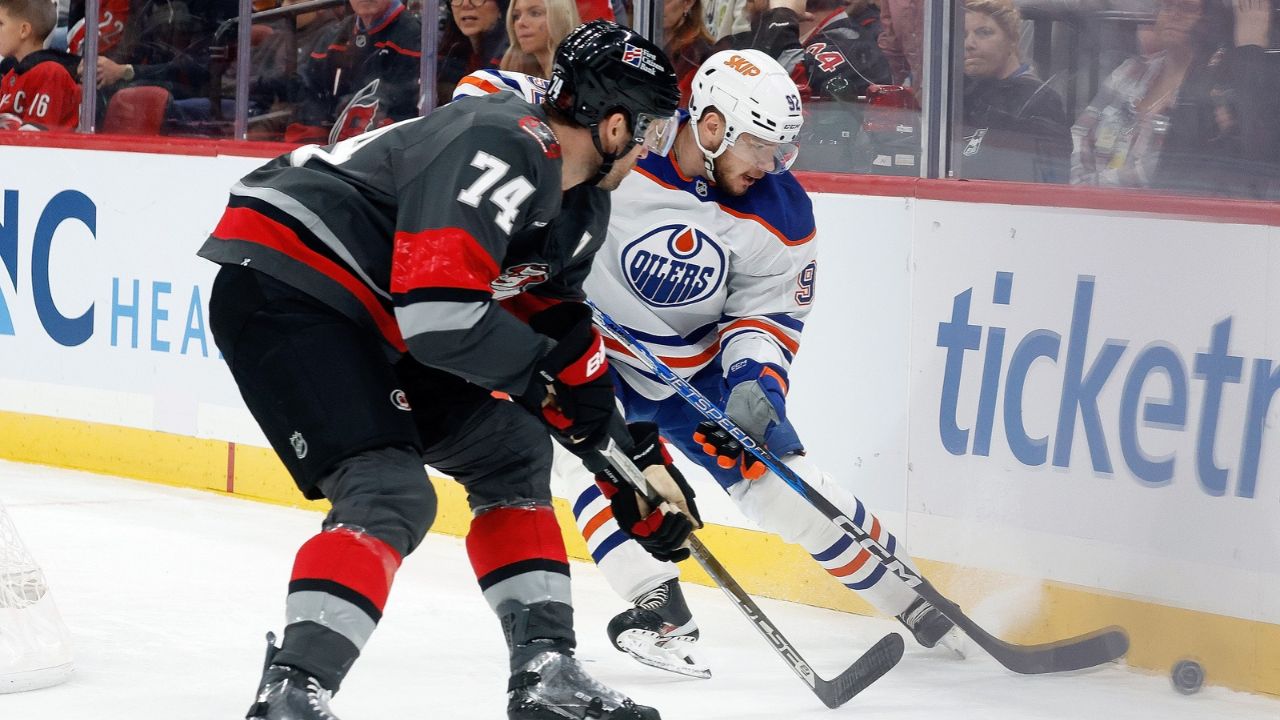
Svechnikov, Aho Power Hurricanes Past Oilers in Seven-Goal Surge
RALEIGH, N.C. – Andrei Svechnikov scored twice and Sebastian Aho added a goal and two assists as the Carolina Hurricanes rode a dominant second period to a 7-4 home win over the Edmonton Oilers on Saturday in a matchup of two of this season’s leading National Hockey League teams.
Sean Walker, Jalen Chatfield, Taylor Hall and Alexander Nikishin also scored for Carolina, which extended its points streak to six games (5-0-1). Pyotr Kochetkov made 11 saves to register his 13th win of the season and backstop a comeback that underlined the Hurricanes’ ability to control high-event games against top-tier opposition.
High-Tempo Meeting Between Contenders
This was the second and final regular-season meeting between the sides, with each club taking one game in a two-part series that underscored their offensive depth. Edmonton had claimed the first matchup 6-5 in a shootout at home on Oct. 22, and Saturday’s rematch again produced a combined double-digit goal total.
For international audiences, the result carries weight beyond a single night. In the NHL’s conference-based structure, interconference games like this do not directly decide divisional races but often serve as key barometers for Stanley Cup contenders gauging their level against elite opposition from the other half of the league.
Oilers Start Fast, Hurricanes Take Over
Edmonton opened with the sharper start, building a 2-0 lead after the first period through goals by Owen Michaels and Leon Draisaitl. The Oilers’ early advantage suggested control on a long road swing, but the complexion of the game shifted sharply after the first intermission.
Carolina responded with a five-goal outburst in the second period, transforming a two-goal deficit into a lead and turning the contest into a test of depth and endurance more than set-play structure. The second frame alone featured seven goals by seven different players, a reflection of how both benches relied on multiple lines rather than a single dominant unit.
The Hurricanes trailed 3-1 in the middle frame before erupting for three goals in just 3:05, a rapid run that swung momentum decisively. Svechnikov’s first goal, scored on the power play at 12:34 of the second period, gave Carolina its first lead at 4-3 and highlighted the impact of special teams in a game where the standard of five-on-five play was high but penalties proved pivotal.
Svechnikov and Aho Decide It on Special Teams
Vasily Podkolzin briefly pulled Edmonton level at 4-4 with 3:05 remaining in the second period, scoring the Oilers’ second power-play goal of the game and restoring some balance in a chaotic stretch.
Carolina’s top forwards answered again before the period ended. With 26 seconds left in the second, Aho struck on the power play to restore a 5-4 Hurricanes lead heading into the third. The timing of that goal – in the closing seconds of a period that had already seen wild swings – created a psychological edge that carried into the final 20 minutes.
Svechnikov then added his second of the night at 8:20 of the third period, extending Carolina’s advantage to 6-4 and effectively settling the contest. His performance lifted his season total to 13 goals, reinforcing his role as a primary finisher within a Carolina attack that relies on pace and repeated offensive-zone pressure rather than a single scoring star.
Oilers’ Road Trip Momentum Stalls
For Edmonton, the defeat marked a second straight loss after the Oilers had opened their six-game road trip with three consecutive victories. Goals from Michaels, Draisaitl, Mathieu Joseph and Podkolzin reflected the breadth of their offensive options, supported by 29 saves from goaltender Devon Levi and two assists by Connor McDavid.
However, the inability to hold multiple leads and close out a game that featured two power-play goals will be a concern as the Oilers look to refine their game management against high-tempo opponents. On extended road swings, performances like this one can influence how coaching staffs adjust line deployment, special-teams balance and rest patterns ahead of the season’s decisive months.
Match Facts
- Final score: Carolina Hurricanes 7, Edmonton Oilers 4
- Venue: Raleigh, N.C.
- Carolina goal scorers: Andrei Svechnikov (2), Sebastian Aho, Sean Walker, Jalen Chatfield, Taylor Hall, Alexander Nikishin
- Edmonton goal scorers: Owen Michaels, Leon Draisaitl, Mathieu Joseph, Vasily Podkolzin
- Goaltenders: Pyotr Kochetkov (Carolina) – 11 saves; Devon Levi (Edmonton) – 29 saves
- Key special-teams moments: Podkolzin’s power-play goal for 4-4; Aho’s late second-period power-play goal for 5-4; Svechnikov’s power-play strike for Carolina’s first lead at 4-3
- Series: Season series split 1-1 (Edmonton 6-5 SO win at home on Oct. 22; Carolina 7-4 home win on Saturday)
- Hurricanes form: Six-game points streak (5-0-1)
Implications in a Tight NHL Field
Within the NHL’s salary-cap and draft framework, results between top teams, even across conferences, are significant in shaping playoff seeding and home-ice advantage. Carolina’s victory, combined with its active points streak, strengthens its position in a tightly contested league table where small runs of form can determine whether a club secures a favorable postseason route.
For Edmonton, the loss extends a mini-slide that interrupts what had been a productive road trip. In a league that awards two points for a win and one for an overtime or shootout loss, dropping regulation points in games where the team had multiple leads places additional pressure on the remaining fixtures of the trip and on home games to come.
Quick Turnarounds Ahead
Both clubs face immediate schedule demands under the NHL’s compact, travel-heavy calendar:
- Oilers: Conclude a six-game road trip with a visit to St. Louis on Sunday.
- Hurricanes: Travel to face the New York Rangers on Sunday.
Back-to-back games of this nature test roster depth and the internal load-management decisions overseen by coaching and performance staffs. With both Carolina and Edmonton aspiring to play deep into the postseason, how they rotate players and manage minutes in such stretches is crucial within the competitive and regulatory framework that governs NHL scheduling and player workload.
Related reading
