

A GMT built to ride a wave of aviation nostalgia-without losing sight of modern usage
Christopher Ward’s C60 Clipper GMT arrives as the brand leans into the United States market and as Pan American World Airways re-enters the public conversation as a revived commercial airline brand rather than a currently operating carrier. The limited run of 707 pieces is an overt nod to the Boeing 707 era, but the watch itself is very much contemporary: a 42mm steel tool watch with 300m water resistance, a bi‑directional 24‑position world‑time bezel, and a Swiss automatic GMT movement built for frequent travel and everyday durability.
This collaboration also lands at a time when regulators are tightening scrutiny of how defunct airline brands are reused and marketed to consumers, making the clarity of the Pan Am licensing story part of the watch’s broader commercial context rather than mere aesthetic garnish.
Case, bezel, legibility: travel‑first hardware
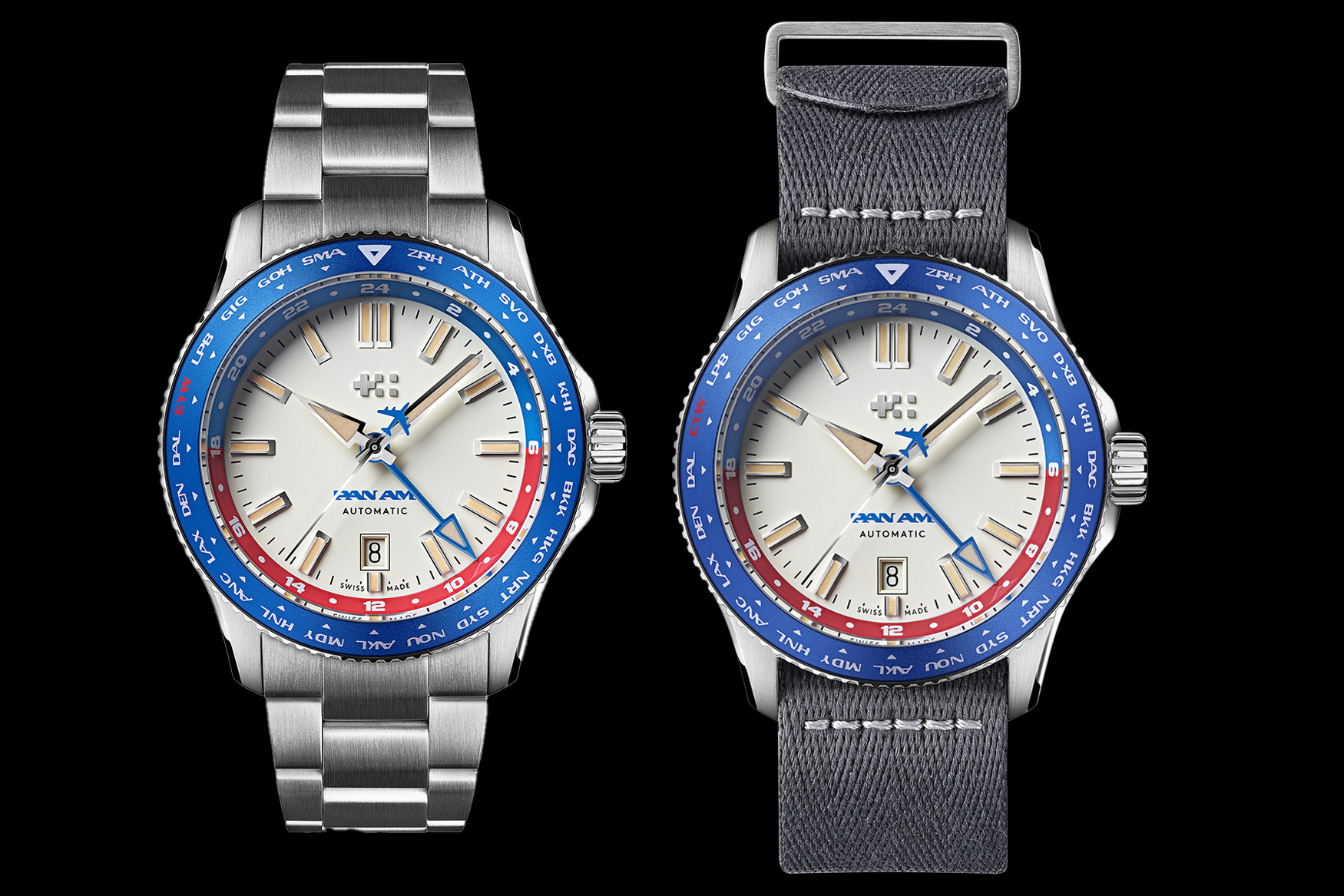
The mid‑size C60 steel case prioritizes comfort and readability, pairing generous polished bevels with a bright, high‑contrast dial. The rotating bezel, anodised in blue and marked with 24 IATA airport codes in a Pan Am‑style typeface, doubles as a quick world‑time reference. Each detent aligns to a city and its UTC offset; Key West (EYW −5) appears in red to mark Pan Am’s first flight in 1927, and Dallas (DAL −6) nods both to a historic Pan Am route network touchpoint and to Christopher Ward’s first U.S. showroom, underscoring the model’s role as a bridge between historic aviation hubs and the brand’s current retail expansion.
- Dimensions: 42mm diameter, 12.45mm thickness, 49.3mm lug‑to‑lug
- Water resistance: 300 meters with screw‑down crown
- Bezel: bi‑directional, 24‑click world‑time scale with IATA city codes
- Crystal: sapphire
- Lume: Super‑LumiNova Grade X1 BL “old radium” on hands and markers
- Dial: eggshell white with blue detailing and Pan Am logo at six
Movement architecture: caller vs. traveler, and what the SW330‑2 delivers
The C60 Clipper GMT uses the Sellita SW330‑2, a reliable, serviceable GMT calibre from the SW300 family. The movement offers a 56‑hour power reserve and a 28,800 vph beat rate, with a quoted tolerance of ±20 seconds per day. The caseback is solid, stamped with the Pan Am “Blue Meatball” emblem and the individual edition number out of 707, reinforcing the watch’s status as a finite collectible rather than a permanent catalogue piece.
For buyers comparing GMT systems, it helps to separate marketing language from user experience. Many enthusiasts distinguish two operating logics:
- Traveler (jump‑hour) GMT
- Local hour hand jumps in one‑hour increments without stopping the movement.
- Date advances with the local hour hand; 24‑hour hand typically remains synced to “home.”
- Fastest when crossing time zones frequently.
- Caller (office) GMT
- 24‑hour hand sets independently; local hour is set conventionally.
- Ideal if you mostly track a second time zone from a fixed home base.
- SW330‑2 implementations generally follow this logic.
Operationally, this means the C60 Clipper GMT is optimized for people who regularly monitor a second time zone and occasionally travel, rather than for constant time‑zone hopping. The bezel’s city ring provides a fast world‑time read at a glance, complementing the 24‑hour rehaut in red and blue-colors that some enthusiasts colloquially associate with “Pepsi,” though here they double as Pan Am’s corporate palette and clearly distinguish day and night hours in use.
Design signals from the jet age, executed for contemporary durability
The aesthetic cues pull from both pilot’s watches and mid‑century airline graphic design. High‑polish indices and hands sit against the matte eggshell ground for contrast, and the overall layout remains clean enough that critical information is legible at a glance from the wrist or across an aircraft cabin. The seconds hand’s counterbalance replaces Christopher Ward’s trident with a blue Pan Am Clipper plane silhouette, and the dial carries a bright blue Pan Am logo at six. The bracelet is the brand’s three‑link steel Bader design with quick‑release spring bars, and the kit includes a woven strap made from aircraft seatbelt material for a more casual, period‑correct feel that leans into the retro brief without compromising modern build quality.
Brand licensing vs. airline operations: a distinction that matters
Pan Am’s logos, typefaces, and calls to jet‑age glamour are central to the C60 Clipper GMT’s appeal. It’s important to separate branding from aviation operations, not least because the latter is tightly regulated by authorities such as the Federal Aviation Administration in the United States.
- Licensing and trademarks
- Logos, wordmarks, and typefaces can be licensed for consumer products, including watches and accessories, provided they comply with intellectual property and consumer‑protection rules.
- IATA city and airport codes are standardized identifiers widely used in travel tools and consumer products, and their presence on a watch bezel is informational, not regulatory.
- Operating an airline
- Running scheduled commercial flights requires federal economic authority and aviation safety certification; a brand revival alone does not confer operating status, route rights, or traffic freedoms.
- A product collaboration does not imply flight operations, route approvals, or safety certifications, which remain the remit of national aviation regulators and, in cross‑border contexts, bilateral air services agreements.
For consumers, that distinction reduces confusion: the C60 Clipper GMT celebrates the iconography of Pan Am; it does not signal any particular aviation regulatory milestone by itself. In an era when dormant airline brands can be revived for anything from marketing to full service relaunch attempts, that transparency is increasingly important to both regulators and travellers.
Specifications at a glance
| Model | C60 Clipper GMT (Christopher Ward × Pan American World Airways) |
| Limited edition | 707 pieces |
| Case | Stainless steel; 42mm × 12.45mm; 49.3mm lug‑to‑lug |
| Bezel | Bi‑directional, blue anodised aluminium, 24‑position world‑time with IATA city codes |
| Crystal | Sapphire |
| Water resistance | 300 meters; screw‑down crown |
| Dial | Eggshell white; blue Pan Am logo at six; red/blue 24‑hour rehaut |
| Lume | Super‑LumiNova Grade X1 BL “old radium” |
| Movement | Sellita SW330‑2 automatic GMT; 28,800 vph; 56‑hour power reserve; ±20 s/d |
| Bracelet/strap | 3‑link stainless steel Bader bracelet with quick‑release; additional woven seatbelt‑material strap |
| Caseback | Solid, embossed with Pan Am “Blue Meatball” logo and individual number |
| Availability | January 29, 2026 |
| Price | US,995 / £1,450 / €1,895 |
Traveler takeaways
- Time‑zone logic
- Use the 24‑hour rehaut for a persistent “home” time reference.
- Rotate the bezel to align local cities for fast world‑time checks, particularly when dealing with multi‑stop itineraries or tight connection windows.
- Daylight saving caveat
- City rings assume standard offsets; locations may shift seasonally. The 24‑hour hand remains the most dependable anchor, especially when airline schedules adjust to differing daylight‑saving rules across jurisdictions.
- Durability for real travel
- 300m water resistance and a screw‑down crown reduce failure risk in wet environments and pressure changes, from airport security lines to unplanned pool dives at the layover hotel.
Positioning in the market
At just under two thousand dollars in the U.S., the C60 Clipper GMT competes in a crowded segment of Swiss automatic GMTs. Its value story leans on robust water resistance, a world‑time bezel that’s actually useful in transit, and a cohesive design language that taps into Pan Am’s visual heritage without compromising on modern specifications. For buyers who prioritize a second‑time‑zone display and world‑time legibility over a jumping local hour, it’s a thoughtful, travel‑ready package with a distinctly American backstory-priced and timed for Christopher Ward’s expanding U.S. footprint and for a travel sector where brand heritage, regulatory clarity, and functional tools increasingly intersect.
Worth a look
