
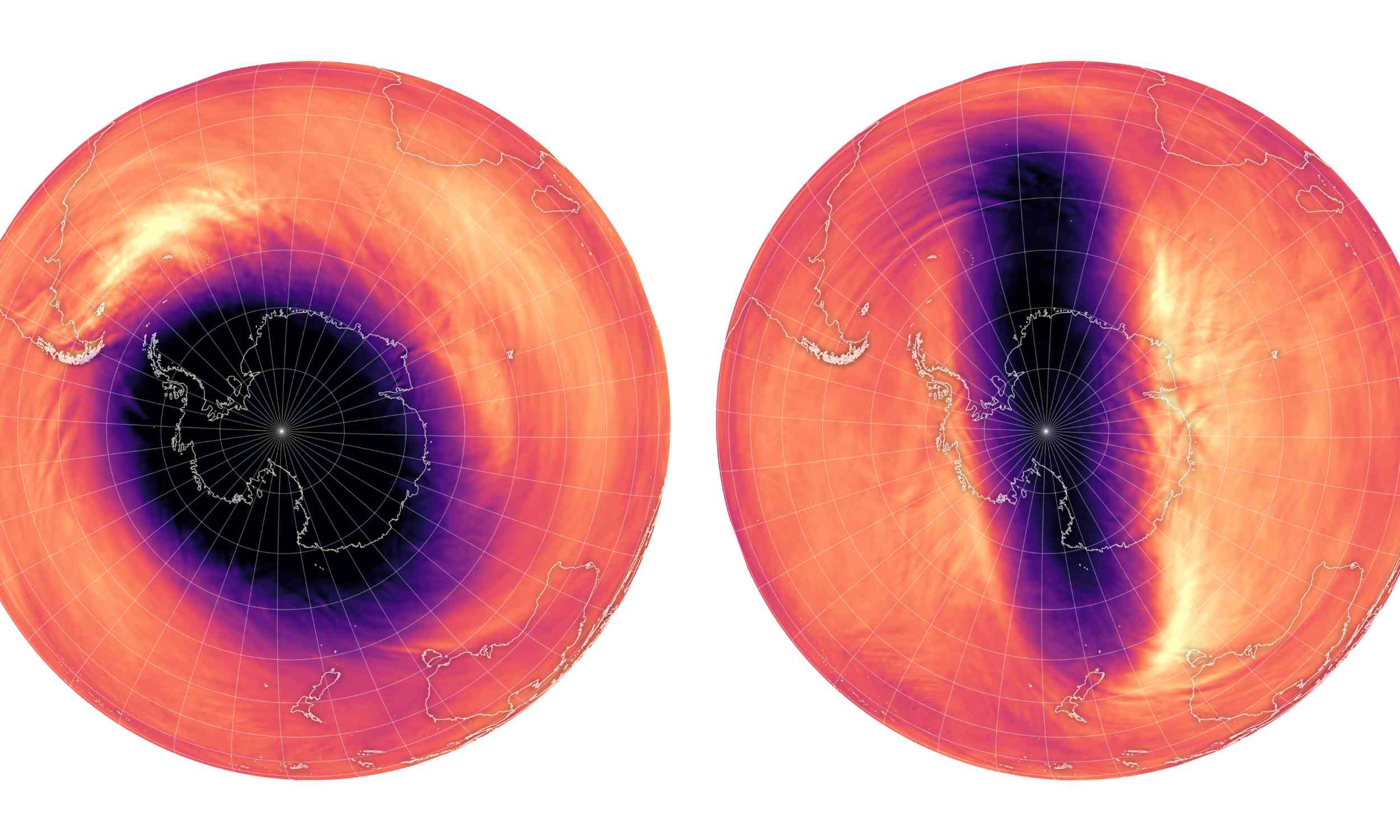
The Antarctic ozone hole closed on December 1, 2025 after one of the briefest seasons in recent decades, marking the smallest extent in six years. The early shutdown aligns with a broader recovery pattern now detectable in long satellite records and ground observations. “The earlier closure and relatively small size of this year’s ozone hole is a reassuring sign and reflects the steady year-on-year progress we are now observing in the recovery of the ozone layer,” said Laurence Rouil, Director of the Copernicus Atmosphere Monitoring Service.
2025 in focus: what the measurements show
- Closure date: December 1, 2025, several weeks earlier than many seasons since the early 2000s.
- Season length: among the shortest of the past several decades, with the hole forming later and collapsing faster than the 21st‑century average.
- South Pole minimum: 147 Dobson Units, a standard total-column ozone metric that, while still below the 220‑DU “hole” threshold, is well above the most depleted years.
- Seasonal ranking: among the smallest since the early 1990s, reinforcing the emerging signal that the worst years of Antarctic depletion are receding into the past.
Why the hole snapped shut early
- Weaker polar vortex: A looser circumpolar wind field let ozone-rich mid‑latitude air mix into Antarctica, reducing the depth and area of depletion.
- Warmer late winter: August temperatures were high enough aloft to suppress polar stratospheric clouds that catalyze chlorine-driven chemistry.
- Faster springtime mixing: As sunlight returned and the vortex weakened, inflow of ozone from surrounding latitudes accelerated the recovery.
These conditions line up with the chemistry at play each austral spring: cold clouds host reactions that convert stable chlorine into ozone‑destroying forms; once air warms and winds relax, the chemistry slows and the hole collapses. In that sense, 2025 looks less like an anomaly and more like the atmosphere’s response to steadily shrinking stocks of man‑made ozone‑depleting substances.
The observation and modeling stack that makes recovery visible
Today’s ozone surveillance is an integrated system that pairs multi-sensor satellites, routine balloon soundings, ground spectrophotometers, and global data assimilation. This stack delivers daily maps, uncertainty bounds, and short‑range forecasts of hole size, depth, and shape that are now routine inputs for meteorological agencies and environmental regulators.
- UV backscatter imagers (e.g., operational sensors on polar‑orbiting satellites) quantify total-column ozone globally.
- Limb and nadir ozone profilers resolve vertical structure, improving assessments of depletion altitude and chemistry layers.
- Balloon-borne ozonesondes over Antarctica provide high‑resolution vertical profiles to anchor satellite retrievals.
- Ground networks of Dobson and Brewer spectrophotometers supply long, consistent time series for trend detection.
- 4D data assimilation and chemical transport models within services such as the Copernicus Atmosphere Monitoring Service fuse these streams into analyses and forecasts used by agencies, researchers, and public‑health planners.
Data integrity is safeguarded through cross‑calibration between instruments, overlap periods during satellite handovers, and routine validation against independent sondes and ground stations. That discipline matters politically as well as scientifically: the same observing system underpins compliance assessments under international ozone agreements and informs national decisions on refrigerant regulation and product standards.
Policy architecture behind the turnaround
The turnaround is the product of a multi‑decade regulatory framework that phased out the industrial chemicals most destructive to stratospheric ozone and is now phasing down climate‑warming substitutes. At its core is the Montreal Protocol on Substances that Deplete the Ozone Layer, the 1987 treaty that has been ratified by every UN member state and is widely viewed as the most successful environmental agreement to date. The same framework delivers climate co‑benefits by avoiding roughly 0.9-1.8°F (0.5-1.0°C) of warming this century.
| Year | Milestone | System impact |
|---|---|---|
| 1987 | Montreal Protocol agreed | Global schedule to phase out ozone‑depleting substances (CFCs, halons) established. |
| 1989-1992 | Entry into force and strengthened amendments | Accelerated controls; compliance, trade, and reporting mechanisms operationalized. |
| 1991 | Multilateral funding mechanism launched | Financed technology conversion and capacity building in developing economies. |
| 1999 | Expanded substance controls | Additional ozone‑depleting chemicals brought under phaseout. |
| 2016 | Kigali Amendment adopted | HFC phasedown initiated, delivering ozone protection continuity and climate benefits. |
“This progress should be celebrated as a timely reminder of what can be achieved when the international community works together to address global environmental challenges,” Rouil said. For policymakers, the 2025 season offers visible proof that long-term treaty discipline, backed by verification and finance, can bend atmospheric trends.
Cooling technology is remaking itself under the same rules
Regulatory timelines ripple through the HVACR market, reshaping refrigerants, equipment design, service practices, and safety standards. In many countries, those rules now sit alongside national energy‑efficiency mandates and building codes, turning the ozone story into a day‑to‑day business constraint for manufacturers, utilities, and property owners.
- Refrigerant transition: From CFCs and HCFCs to HFCs, and now toward low‑GWP options such as HFO blends and natural refrigerants (CO₂, ammonia, hydrocarbons).
- Safety and codes: Updates to equipment and building standards (e.g., provisions addressing mildly flammable A2L refrigerants) enable lower‑GWP adoption while managing risk.
- Controls and leak mitigation: Broader deployment of electronic expansion valves, continuous monitoring, and automated shutoff reduces charge sizes and emissions.
- Lifecycle tracking: Digital record‑keeping for refrigerant handling and recovery tightens compliance and curbs illegal trade.
For regulators, the challenge is sequencing these changes in a way that keeps cooling affordable and reliable while delivering the emission cuts promised under international law.
Explaining the 2020-2023 spike in hole size
Large, persistent holes from 2020 through 2023 did not signal policy failure. A major underwater volcanic eruption in 2022 lofted extraordinary amounts of water vapor into the stratosphere, enhancing the surfaces and cooling that accelerate ozone loss. Those dynamics temporarily pushed the system in the opposite direction, even as industrial chlorine and bromine levels continued to fall.
Scientists and treaty bodies were watching closely: had the spike been driven by renewed production of banned chemicals, it would have triggered a very different diplomatic and enforcement conversation. Instead, the episode has become a case study in distinguishing natural variability from non‑compliance.
Risks and safeguards that will shape the recovery curve
- Very short‑lived substances: Rising use of chlorinated solvents with brief lifetimes can still deliver reactive chlorine to the lower stratosphere.
- Stratospheric water vapor: Volcanic injections and high‑altitude aviation are active research fronts because added moisture can favor ozone‑depleting chemistry.
- Rocket launch growth: Emissions from solid‑fuel motors and alumina particles are being assessed for regional ozone impacts.
- Illegal production and banks: Legacy stocks (“banks”) of controlled chemicals and episodic illicit emissions demand sustained monitoring and enforcement.
- Satellite continuity: Aging sensors create coverage risk; planned replacements and overlapping missions limit data gaps.
Each of these factors has implications for governance. Very short‑lived substances test the edges of current regulations. Growing launch activity raises questions for space and environmental regulators. And the persistence of chemical “banks” keeps customs agencies and environmental ministries engaged long after factory production has officially ceased.
The statistical signal of recovery is now clear
By early 2025, researchers reported a robust recovery fingerprint in Antarctic ozone that matches the expected decline in ozone‑destroying gases, with 95 percent confidence that the downward trend in those gases is the primary driver. The 2025 season’s brisk closure is consistent with that signal, while still allowing for year‑to‑year swings driven by temperature, winds, and episodic aerosol or water‑vapor injections.
That level of confidence matters for ministers and negotiators defending continued investment in monitoring, enforcement, and technology transition. It underpins the argument that staying the course on existing controls is more important than over‑reacting to any single unusual season.
What to track as the 2026 season approaches
- Polar vortex strength and stability through late winter, a key control on mixing and hole geometry.
- Frequency and altitude of polar stratospheric clouds, which set the stage for chlorine activation.
- Lower‑stratospheric water‑vapor anomalies that can amplify chemical loss.
- Hole diagnostics from multi‑sensor analyses: total‑column minima, profile depth, and day‑to‑day shape evolution.
- Implementation progress on refrigerant transitions and leak‑reduction practices across cooling supply chains.
The technology, policy, and market pieces are moving in the same direction-toward a thinner season of depletion and, over decades, a return to conditions resembling 1980 across Antarctica-provided enforcement remains tight and new pressures are kept in check. For governments preparing the next round of ozone and climate negotiations, the 2025 Antarctic season offers both a scientific milestone and a reminder: with sustained rules, data, and diplomacy, even slow-moving atmospheric crises can be steered back toward stability.
Keep reading
- Quantum Networking Milestones: How Quantum Key Distribution (QKD) Testbeds Are Moving to Financial Hubs in 2026
- The Rise of Specialized Small Language Models (SLMs) in Enterprise On-Premise Deployments
- Judge Pauline Newman Misconduct Case Transferred to Eleventh Circuit After Three Years (archyde.com)
- PM Modi Marks 25 Years in Public Office with Delhi Temple Visit (globallypulse.com)
