
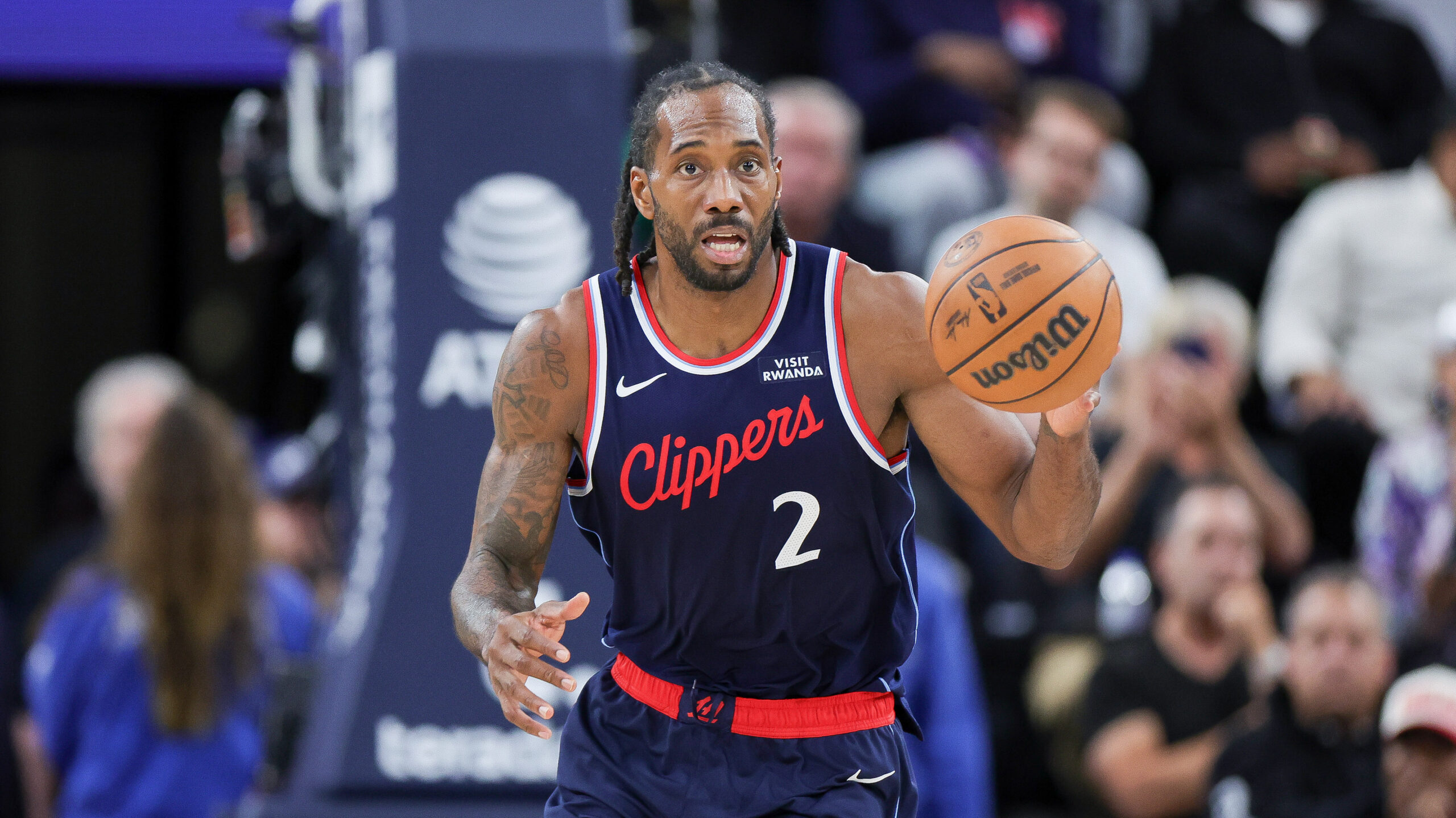
Kawhi Leonard (left) and Scottie Barnes (right) could provide the Raptors with a dynamic 1-2 punch next season.
Seven years after guiding the Toronto Raptors to their first NBA championship and departing shortly after in free agency, Kawhi Leonard is returning to the franchise.
In a deal reported Tuesday, the Raptors have re-acquired their former Finals MVP from the LA Clippers. To secure the veteran forward, Toronto has sent the following assets to Los Angeles:
- Brandon Ingram and Gradey Dick
- Two unprotected first-round draft picks
The move signals a shift in strategy for Toronto, which entered the offseason as one of the league’s most improved teams. The Raptors won 16 more games than they did in the 2024-25 season and recorded their best statistical performance in six years, posting a plus-2.9 points per 100 possessions. By integrating Leonard, the Raptors are positioning themselves to move from a developmental phase to a direct challenge for the top tier of the Eastern Conference and, by extension, greater relevance in Canada’s broader sports economy.
For the LA Clippers, the trade completes a five-month roster overhaul. Despite maintaining the fourth-best regular-season record during Leonard’s seven-year tenure, the Clippers failed to secure a championship in that span. The organization is now pivoting toward a younger core, a reset made possible by the flexibility teams enjoy under the league’s collective bargaining agreement, which governs salary-cap limits, player movement and long-term roster building.
Defensive recalibration
Toronto ranked fifth defensively last season, allowing 112.1 points per 100 possessions. However, a deeper analysis reveals specific vulnerabilities that Leonard is expected to address. While their overall ranking was high, the Raptors fell to 12th defensively (117.3 allowed per 100) when facing the league’s top 10 offenses, and their defensive efficiency dipped to 12th during the first round of the playoffs.
A significant liability for Toronto has been foul discipline. The team ranked 23rd in opponent free throw rate (27.9 attempts per 100 shots), a figure that worsened to 31.8 per 100 in the postseason. Leonard provides a high-impact alternative who excels at disrupting plays without committing fouls. His ability to defend without sending opponents to the line is particularly valuable in a league where marginal differences in free-throw attempts can swing playoff series and, ultimately, franchise trajectories.
Last season, Leonard recorded 122 steals and 27 blocks against only 78 personal fouls. Among 378 players with at least 500 minutes played, Leonard held the highest ratio of stocks (steals + blocks) per foul.
| Player | MIN | STL | BLK | PF | (STL+BLK)/PF |
|---|---|---|---|---|---|
| Kawhi Leonard | 2,085 | 122 | 27 | 78 | 1.91 |
| Victor Wembanyama | 1,866 | 66 | 197 | 156 | 1.69 |
| Robert Williams III | 1,008 | 35 | 87 | 74 | 1.65 |
| Al Horford | 969 | 30 | 51 | 51 | 1.59 |
| Derrick White | 2,625 | 88 | 98 | 119 | 1.56 |
This addition allows the Raptors to transition toward a more versatile frontline featuring Leonard, Scottie Barnes, and rookie Collin Murray-Boyles. This switchable lineup addresses the struggles of Jakob Poeltl, who recorded a career-worst rim-protection mark last season, with opponents shooting 63.9% at the rim. Murray-Boyles already showed promise in the playoffs, logging 191 minutes compared to Poeltl’s 134, and Leonard’s arrival gives the coaching staff greater freedom to lean into those smaller, more mobile combinations.
Solving the late-clock offensive struggle
While Toronto’s aggressive defense fuels a strong transition game-ranking third in the league with 28.6 transition points per game-the team has lacked a reliable option in half-court sets. The Raptors struggled significantly in the final six seconds of the shot clock, posting an effective field goal percentage of 43.3%, the second-lowest mark in the NBA.
Leonard is statistically one of the most efficient “closers” in the league and, crucially, one with deep experience in pressure possessions. Over the last three seasons, he has maintained a 53.0% effective field-goal percentage in the final six seconds of the clock, ranking ninth among 131 qualifying players.
The trade also upgrades Toronto’s isolation scoring. Among 28 players with at least 1,000 isolation attempts over three years, Leonard ranks sixth in efficiency at 1.07 points per chance. In contrast, Brandon Ingram ranked 24th in the same group, producing 0.99 points per chance for the Raptors and Pelicans. For a franchise owned by Maple Leaf Sports & Entertainment and operating in one of North America’s largest media markets, reliably generating late-clock offense is not just a basketball concern but a performance metric with direct implications for ratings, playoff revenues and local sponsorships.
Postseason pedigree
The acquisition is a strategic move to improve Toronto’s ceiling in the playoffs. Leonard remains one of the most efficient high-volume scorers in postseason history. Across 146 playoff games, he has averaged 21.5 points with a 62.1% true shooting percentage-the second-highest among 89 players who averaged at least 20 points over 10+ games.
On May 12, 2019, Kawhi Leonard gets an incredible bounce to knock down a game-winning shot in Game 7 sending the Raptors to the Eastern Conference Finals.
Since 2017, Leonard has averaged 28.6 points on 63.2% true shooting over 71 playoff games. He is one of only five players in history to record three separate postseasons (2017, 2019, 2021) with at least 25 points per game and a true shooting percentage of 60% or higher in 10 or more games. That profile, combined with his familiarity with the Toronto market and its expectations after the 2019 title run, gives the Raptors a proven postseason fulcrum at a time when several Eastern Conference rivals are recalibrating their own cores.
Clippers’ roster transition
The trade marks a definitive end to the Clippers’ recent veteran-heavy era. Just one year ago, Los Angeles added Bradley Beal, John Collins, Brook Lopez, and Chris Paul to a core featuring Leonard, James Harden, and Ivica Zubac. Following this trade and previous deadline moves, Brook Lopez is the only remaining member of that group.
The Clippers now possess the lowest continuity rate in the league. Currently, players under contract for 2026-27 (including those with new agreements) account for only 42% of the 2025-26 minutes. This figure would rise to 52% if restricted free agents Jordan Miller and Bennedict Mathurin are re-signed, which would still be the second-lowest rate in the league.
Having shifted from a veteran-centric model-where only 12% of minutes were played by rookies or second-year players in 2025-26-the Clippers are now rebuilding their identity around rookie guard Keaton Wagler and Darius Garland. It is a dramatic strategic turn for a franchise that plays in a publicly financed arena and operates within the governance structures of both the NBA’s Board of Governors and the city of Los Angeles, underscoring how star-player trades can ripple beyond the court into local economics, arena usage and long-term civic partnerships.
Keep reading
