
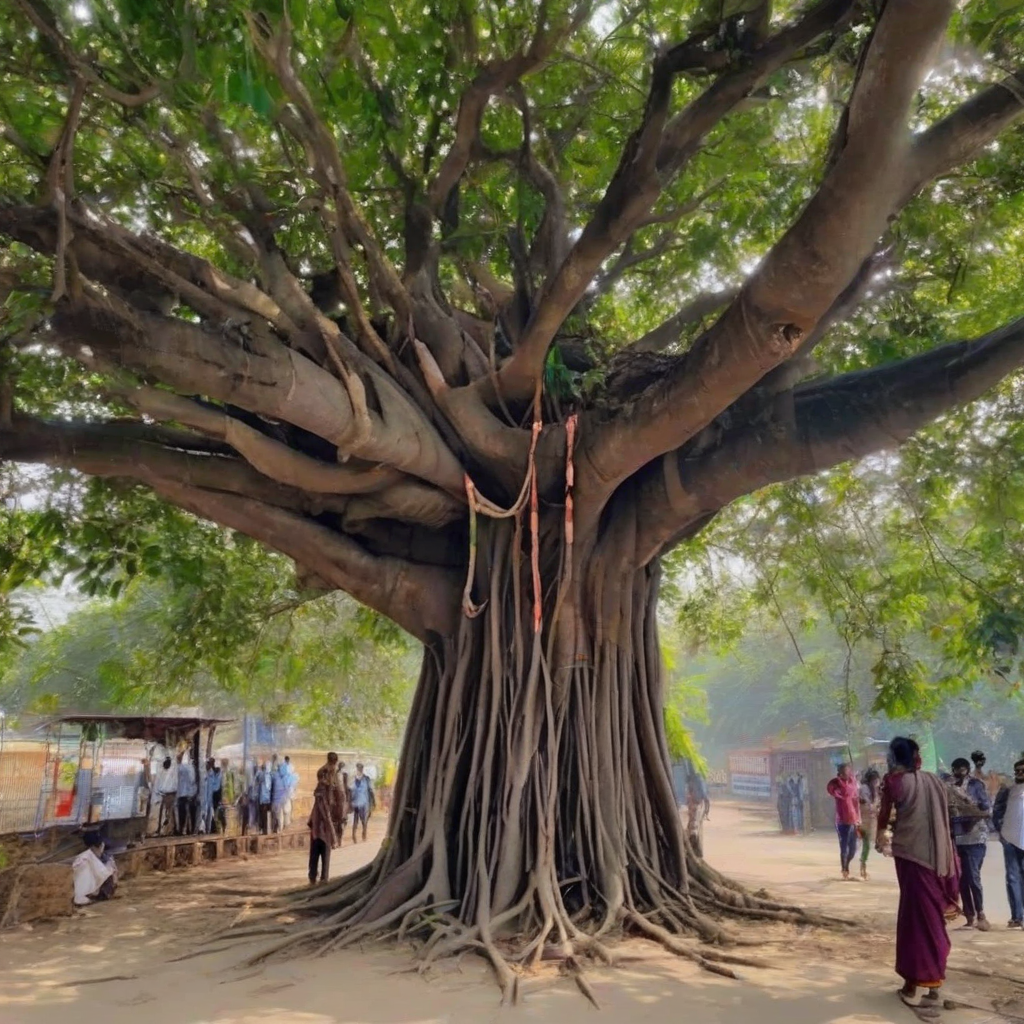
MUNGER – Researchers have identified a banyan tree (Ficus benghalensis) in Munger, Bihar, as the oldest accurately dated banyan tree using radiocarbon analysis, estimating its age at approximately 700 years.
The finding, published in the journal Quaternary Research, replaces centuries of reliance on folklore and oral tradition with scientific evidence. The study establishes a new framework for dating tropical broadleaf species, which have historically resisted conventional aging methods.
Challenges in Tropical Dendrochronology
Determining the age of banyan trees has remained a long-standing challenge for botanists and historians. Unlike temperate tree species, tropical broadleaf trees lack distinct annual growth rings.
This biological characteristic renders conventional dendrochronological methods-which rely on counting rings-ineffective. Consequently, age estimates for these trees have historically depended on local narratives or historical documentation, often resulting in significant uncertainty.
The challenge is particularly acute in regions like Munger, a historically significant district on the Ganges floodplain in eastern India, where ancient trees often sit at the intersection of ecology, religion, and local identity. In such settings, the difference between legend and verifiable age can influence how authorities prioritize protection, tourism planning, and land use decisions.
The Radiocarbon Methodology
The breakthrough was led by Dr. Trina Bose of the Birbal Sahni Institute of Palaeosciences (BSIP) in Lucknow, an autonomous institute under the Department of Science and Technology (DST).
Invited by the Bihar Forest Department to analyze the Munger banyan, Dr. Bose worked alongside Dr. Mayank Shekhar and Dr. Akhilesh K. Yadava to develop a specialized scientific approach.
The team utilized the following process to determine the tree’s age:
- Sample extraction: Researchers extracted alpha-cellulose, the most stable primary component of plant cell walls, from carefully selected wood samples to minimize harm to the living tree.
- Sampling sites: Samples were taken from an ancient primary branch and near the pith of a secondary trunk, representing the tree’s juvenile stage of secondary growth and allowing the team to bracket its earliest development.
- Analysis: The cellulose samples underwent high-precision radiocarbon dating via Accelerator Mass Spectrometry (AMS), enabling detection of extremely low levels of radioactive carbon.
- Calibration: Results were calibrated using OxCal software and the IntCal20 calibration curve to convert radiocarbon years into calendar dates with quantified uncertainty ranges.
By demonstrating that minimally invasive sampling can yield robust age estimates for a species long considered “undatable,” the researchers argue that similar protocols can now be standardized for heritage trees elsewhere in tropical South Asia.
Revision of Local History
The scientific data has overturned previous assumptions regarding the site’s historical timeline.
Local records previously suggested the banyan had been planted roughly 300 to 350 years ago in front of the historic Burra Bunglow. The building dates to the late Mughal-early British period and served as a hub for village assemblies, religious ceremonies, and cultural exchanges.
The study concludes that the tree predates the Burra Bunglow by several centuries. The 700-year-old specimen is likely a remnant of a natural forest that originally covered the region, meaning the tree existed long before the construction of the bungalow.
For local authorities, this reordering of timelines effectively upgrades the site from a colonial-era landmark framed by a mature tree to a much older cultural landscape in which the bungalow is only the most recent layer. That shift has potential implications for how the area is interpreted for visitors, mapped in district planning documents, and prioritized within state-level heritage and tourism schemes.
Implications for Heritage Conservation
The methodology developed by the BSIP team provides a scientific framework that can be applied to other ancient tropical trees globally.
Researchers state that replacing uncertain age estimates with verifiable evidence will assist governments, forest departments, and conservation agencies in identifying and protecting ecologically significant trees.
In India, such data can feed directly into statutory mechanisms created under the Biological Diversity Act, 2002, which empowers national and state biodiversity authorities to conserve unique biological resources and designate biodiversity heritage sites. Reliable age profiles for iconic trees strengthen the case for special status, targeted funding, and stricter safeguards in urban expansion or infrastructure projects.
The application of this framework extends to several fields:
- Biodiversity conservation, by identifying keystone trees and relict forest stands that anchor local ecosystems
- Heritage management, by informing how living natural monuments are catalogued alongside archaeological and architectural sites
- Environmental education, by giving schools and museums verifiable timelines that connect contemporary communities to centuries-old landscapes
- Studies of historical landscapes and past climates, by using dated trees as reference points in reconstructing land-use change and monsoon variability
The research provides a mechanism to strengthen the preservation of natural and cultural heritage across South Asia and other tropical regions. For districts such as Munger, where ancient trees share space with historic buildings and religious sites, that combination of scientific dating and legal protection could become a practical tool for balancing development pressures with long-term stewardship of living landmarks.
- Urban Infrastructure Resilience: How European and Asian Megacities Are Adapting to Extreme Climate Oscillations in 2026
- UN General Assembly 2026 Framework on Autonomous Systems: International Diplomacy Faces Algorithmic Governance
- PM Modi Marks 25 Years in Public Office with Delhi Temple Visit (globallypulse.com)
