
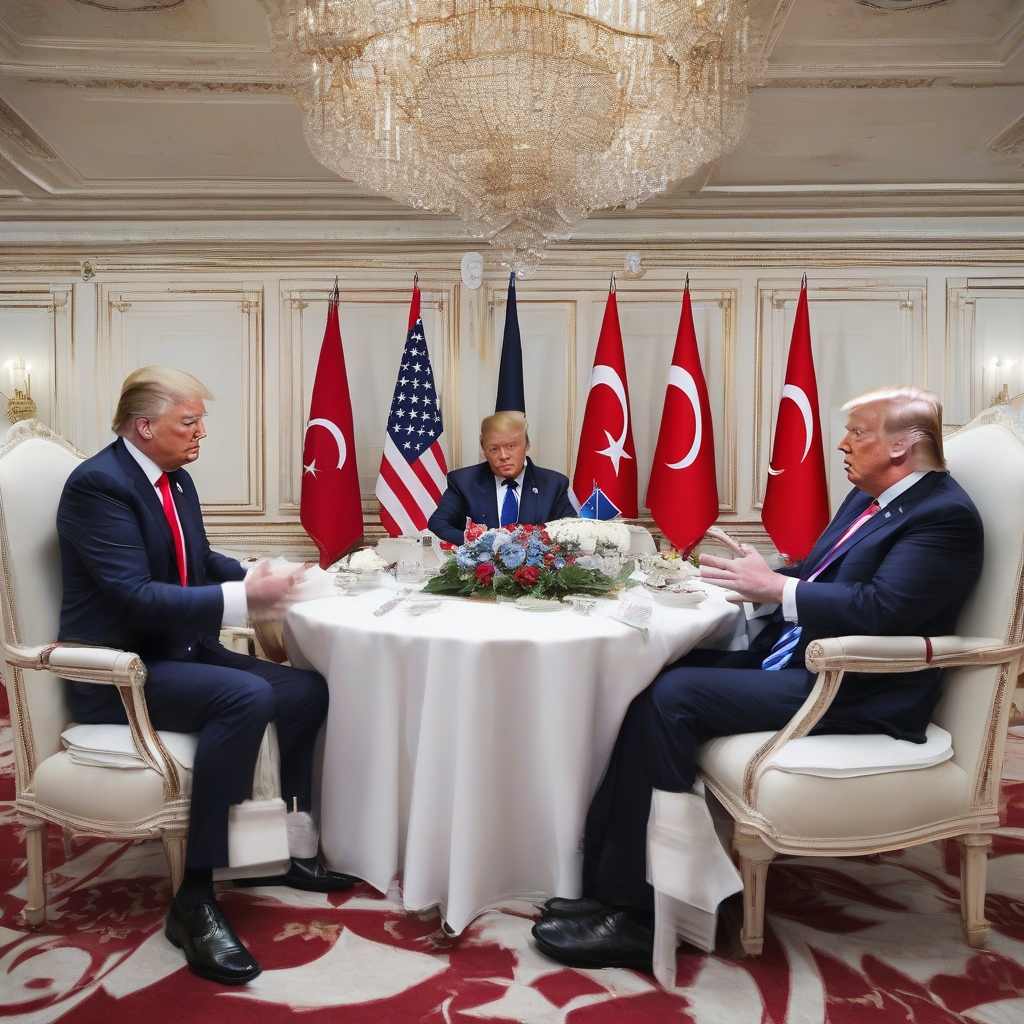
WASHINGTON – NATO Secretary General Mark Rutte conducted a high-stakes diplomatic push in Washington in late June to ensure U.S. President Donald Trump remains committed to the security alliance ahead of a critical summit in Ankara on July 7.
The effort comes as the U.S. reviews its military posture in Europe and tensions escalate in the Middle East and Ukraine, leaving European allies concerned about the stability of the trans-Atlantic security umbrella. The Ankara meeting will bring together leaders of all 32 NATO allies, the largest number in the alliance’s history, at a moment when Washington’s long-standing role as security guarantor is under renewed scrutiny.
During the visit, Rutte utilized large display boards with gold-colored headlines, including one titled “The Trump Trillion,” to frame European defense increases as a direct result of Trump’s influence and demands for higher allied spending. The framing was aimed as much at the U.S. domestic audience as at European partners, underscoring how alliance politics have become entangled with American election-year debates over burden-sharing and overseas commitments.
“I want to show you what this president was able to achieve,” Rutte told the press, citing a significant increase in defense expenditures by Canada and European allies since Trump first took office.
Defense Spending Increases Since 2017
- Total additional spending: $1.2 trillion (€1 trillion)
- Contributing parties: European NATO allies and Canada
- Timeframe: From 2017 to present
Those figures are measured against the alliance’s longstanding political pledge that each member should move toward spending at least 2% of gross domestic product on defense, a benchmark formally embedded in NATO summit communiqués and derived from the North Atlantic Treaty’s collective-defense framework under Article 3 and Article 5.
Economic Incentives and the Defense Industrial Revolution
Rutte is attempting to secure U.S. support by emphasizing the economic benefits NATO provides to American industry, specifically regarding the procurement of F-35 fighter jets and associated systems, maintenance and supply chains. By highlighting U.S. export and jobs data, he is seeking to recast NATO not only as a security instrument but as a generator of industrial demand in key U.S. states.
As part of this strategy, Rutte is expected to unveil a “defense industrial revolution” at the Ankara summit. This initiative will involve tens of billions of dollars in new contracts and procurement deals intended to boost weapons production, expand shared stockpiles and shorten delivery timelines for critical munitions. Allies say the effort is designed to move NATO from ad hoc crisis responses toward a more predictable, multi-year industrial planning model.
Claudia Major, a trans-Atlantic security expert at the German Marshall Fund think tank, stated that the goal is “to show that there is a market for the US industry and also to make an economic case in favor of NATO that Trump hopefully will find attractive.”
Major noted that European leaders are attempting to “please Trump and to make a case for NATO” to signal that the alliance remains strong. Diplomats describe the approach as an attempt to align NATO’s strategic narrative with the transactional language that has often defined Trump’s view of alliances.
U.S. Military Review and Deployment Concerns
The diplomatic optimism follows a period of friction. During a NATO defense ministers’ meeting in Brussels on June 18, U.S. Defense Secretary Pete Hegseth announced a comprehensive review of American troop deployments and military posture in Europe, including long-standing basing arrangements and rotational deployments on NATO’s eastern flank.
Hegseth issued a blunt warning regarding the expectations for allied contributions:
“Our national defense strategy states clearly that we’re going to incentivize and enable our allies to step up and do their part. So we’re going to keep a close eye on allies who are not doing that, and who say no, or maybe, or wait and see when it matters most. It’s a review that some countries will fail, and others will pass with flying colors.”
The tone of the announcement caused irritation among European ministers, who privately complained that the language risked portraying treaty allies as transactional clients. While a reduction in the U.S. role in Europe had been anticipated as Washington shifts focus toward the Indo-Pacific, the speed and scale of any transition remain primary concerns for governments that still depend on U.S. enablers such as air defense, logistics and intelligence.
German Defense Minister Boris Pistorius emphasized the need for a synchronized transition to avoid “dangerous capability gaps,” warning that abrupt changes to U.S. force posture could outpace Europe’s ability to field and coordinate replacement capabilities.
Following sustained pressure from the U.S., European allies and Canada increased defense spending by 20% in 2025 compared to the previous year in real terms. Officials argue that this surge shows NATO is already responding to calls for greater burden-sharing, even as Washington signals it may reassess the size and configuration of its own deployments.
Military Aid Pledges for Ukraine
A central pillar of the Ankara summit will be the formalization of new funding for Ukraine’s defense and security, turning what have often been yearly or ad hoc pledges into a more predictable, multi-year support framework. The package is intended both to sustain Kyiv on the battlefield and to lock in allied commitments against rapid policy shifts in individual capitals.
European NATO members and Canada are expected to make the following commitments:
- Total military aid pledge: 70 billion euros ($80 billion)
- Distribution period: Current year and next year
Despite these pledges, internal tensions remain regarding burden-sharing, with some allies contributing significantly more as a share of GDP than others. Rutte has repeatedly called for Ukraine aid to be distributed more equitably among all NATO partners, arguing that uneven contributions are politically difficult to defend in front-line states and risk undermining public support for long-term engagement.
Tests of Political Cohesion in Ankara
The upcoming summit serves as a test of political unity at both the NATO and domestic levels. Major argued that open disputes or public criticism from the U.S. president regarding ally spending or the war against Iran could weaken political cohesion and the alliance’s military deterrence message, particularly toward Russia and other adversaries watching for signs of division.
However, some officials point to the recent G7 summit in France as a positive indicator. During that meeting, Trump adopted a cooperative tone and supported increased pressure on Russia and President Vladimir Putin through sanctions on the banking sector and oil exports, moves that aligned closely with European positions.
German Chancellor Friedrich Merz described the G7 outcome as a “new tone in trans-Atlantic unity and determination,” suggesting it could create a “chance for peace.” Officials caution, however, that summit atmospherics can change quickly and that Ankara will test whether that tone can be translated into concrete alliance decisions on spending, deployments and long-term commitments to Ukraine.
The final summit declaration in Ankara is expected to reaffirm Article 5, the alliance’s mutual-defense clause, and maintain language identifying Russia as a long-term threat to Euro-Atlantic security. Draft language, according to diplomats, also underscores that NATO remains a defensive alliance, operating strictly within the mandate of the North Atlantic Treaty and in line with broader international law.
The NATO summit involving the leaders of 32 allied countries begins in Ankara on July 7. Alongside formal decisions, allies will closely watch Trump’s public statements for signals about how firmly the United States intends to remain anchored in the alliance’s collective-defense system – a question that now carries significant implications not only for European security, but for defense budgets, industrial policy and domestic politics on both sides of the Atlantic.
Keep reading
- Urban Infrastructure Resilience: How European and Asian Megacities Are Adapting to Extreme Climate Oscillations in 2026
- UN General Assembly 2026 Framework on Autonomous Systems: International Diplomacy Faces Algorithmic Governance
- Bahrain GP in Malaysia 2026: Verstappen on pole ahead of Hamilton (globallypulse.com)
- Pope Leo XIV Sends Personal Letter to Chicago White Sox Ahead of Playoffs (archysport.com)
