
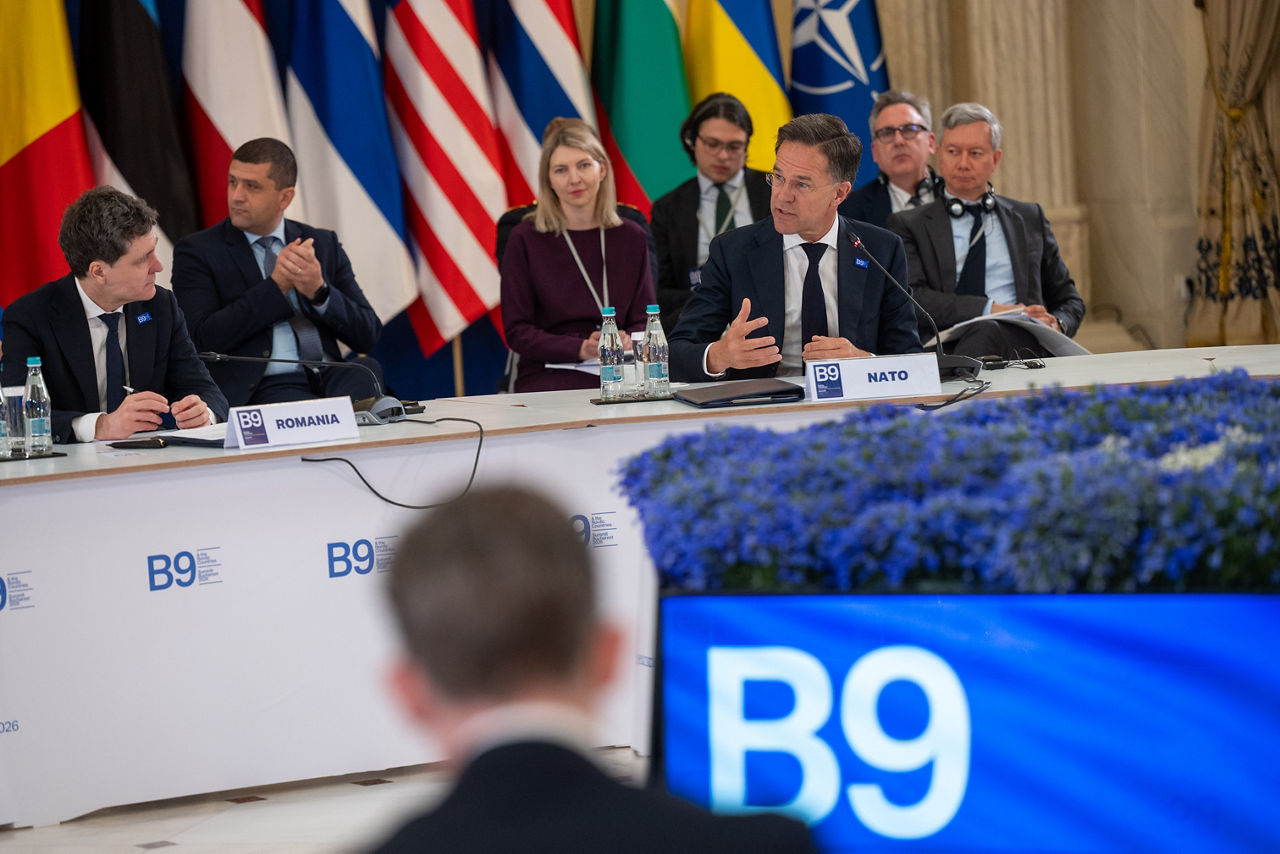
BUCHAREST – NATO Secretary General Mark Rutte convened with leaders of the Bucharest Nine (B9) and Nordic Allies on Wednesday, May 13, 2026, to synchronize defensive postures across Europe’s eastern and northern flanks.
The summit, co-hosted by Romanian President Nicușor Dan and Polish President Karol Nawrocki, serves as a critical strategic alignment before the broader NATO Summit scheduled for July in Ankara. By bringing together the B9-a group of eastern-flank member states-and the Nordic Allies, the gathering aimed to bridge the security architectures of the Black Sea and the Arctic Circle.
The meeting occurs amidst a shifting geopolitical landscape where NATO is increasingly focused on “burden sharing,” urging European members to reduce their reliance on United States logistical and military primacy while maintaining the overarching American security guarantee. It also reflects the alliance’s effort to turn the 2022 Madrid and 2023 Vilnius summit pledges on deterrence and defence into concrete posture and procurement decisions under the current [[NATO Strategic Concept]].
Strategic Integration from the Arctic to the Black Sea
The convergence of the B9 and Nordic members represents a conscious effort to create a seamless defensive perimeter against Russian territorial ambitions and hybrid pressure. The B9, originally formed in 2015 to enhance cooperation among eastern-flank allies, now operates in closer coordination with Finland and Sweden, whose recent integration into the alliance has fundamentally altered the security dynamics of Northern Europe by eliminating what officials once described as a “grey zone” along NATO’s northern border.
During the session, Secretary General Rutte emphasized the symbolic and operational importance of this coalition, presenting the Bucharest gathering as a bridge between regional consultations and formal decision-making in Brussels.
“The gathering of NATO Allies, from the Black Sea to the Arctic, demonstrates our unity and determination to stand together, and to defend against any threat, from any direction,” Rutte stated.
Military analysts note that this geographic alignment is designed to prevent “security gaps” that could be exploited by adversarial forces, particularly in the Baltic states and the Suwalki Gap, the narrow corridor of land along the Polish-Lithuanian border that links the Baltic allies to the rest of NATO and sits between Belarus and Russia’s Kaliningrad exclave.
Officials said discussions in Bucharest also touched on how national defence plans, regional contingency plans and NATO’s integrated air and missile defence can be better synchronized so that reinforcement routes-from Nordic ports to Black Sea airfields-are protected in the opening hours of any crisis.
Defense Production and the Ankara Mandate
With the July summit in Ankara approaching, the Bucharest meeting focused heavily on the industrialization of defense. The alliance is currently grappling with depleted stockpiles and a need for rapid scaling of munitions production to match the attrition rates seen in modern high-intensity conflict, particularly in Ukraine.
Rutte used the summit to signal a pivot toward greater European self-reliance in conventional warfare. He emphasized the need for “a stronger Europe in a stronger NATO, through increased defence spending and defence production, and with European Allies taking more responsibility for their own conventional defence, backed by American power.”
This directive aligns with ongoing discussions within the North Atlantic Council regarding the “2% of GDP” spending target set out in NATO’s defence investment pledge, with Rutte suggesting that spending figures may soon be viewed as a floor rather than a ceiling for members on the eastern periphery. Diplomats said Ankara is expected to formalize language that frames 2% as a minimum benchmark and adds qualitative metrics on ammunition output, interoperability and resilience of supply chains.
Beyond the headline numbers, several governments used the Bucharest meeting to press for more predictable multi-year contracts for European defence industries, arguing that such commitments are necessary for factories to expand capacity and for parliaments to justify higher medium‑term budget lines.
The PURL Initiative and Ukrainian Support
President Volodymyr Zelenskyy joined the Bucharest proceedings to secure continued military commitments for Ukraine. The discussions centered on the sustainability of long-term aid and the transition from emergency shipments to a structured supply chain that can be planned, budgeted and overseen by national parliaments.
Central to this effort is the PURL initiative. Under this framework, the United States provides essential military equipment to Ukraine, while the financial costs of the procurement are covered by NATO Allies and international partners. This mechanism is intended to maintain the flow of high-end American hardware without placing the entire fiscal burden on the U.S. Treasury, while giving European governments clearer visibility on their forward commitments.
The Secretary General urged member states to expand their contributions to the PURL initiative, arguing that the stability of the European continent is directly tied to Ukraine’s ability to repel Russian aggression. Officials stressed that commitments made under PURL would be reported alongside existing bilateral and EU support to allow for public and legislative scrutiny of burden sharing.
The Bucharest Nine consists of Albania, Bulgaria, Estonia, Latvia, Lithuania, Poland, Romania, Slovakia, and Slovenia. The Nordic Allies include Denmark, Finland, Iceland, Norway, and Sweden. Together, these states form the core of NATO’s northern and eastern front-line, hosting many of the alliance’s battlegroups, air-policing missions and pre-positioned stocks.
NATO representatives have confirmed that the outcomes of the Bucharest and Nordic coordination meetings will be integrated into the official agenda for the July summit in Ankara. Draft conclusions circulating among diplomats point to possible new taskings for the North Atlantic Council and the Military Committee on readiness, mobility and industrial policy, anchoring Wednesday’s political messages in the alliance’s standing governance structures and day‑to‑day defence planning. A separate explanatory note on how regional formats like the B9 feed into NATO decision-making is expected to be published on the alliance’s official [[NATO portal]] ahead of the Ankara summit.
Keep reading
