
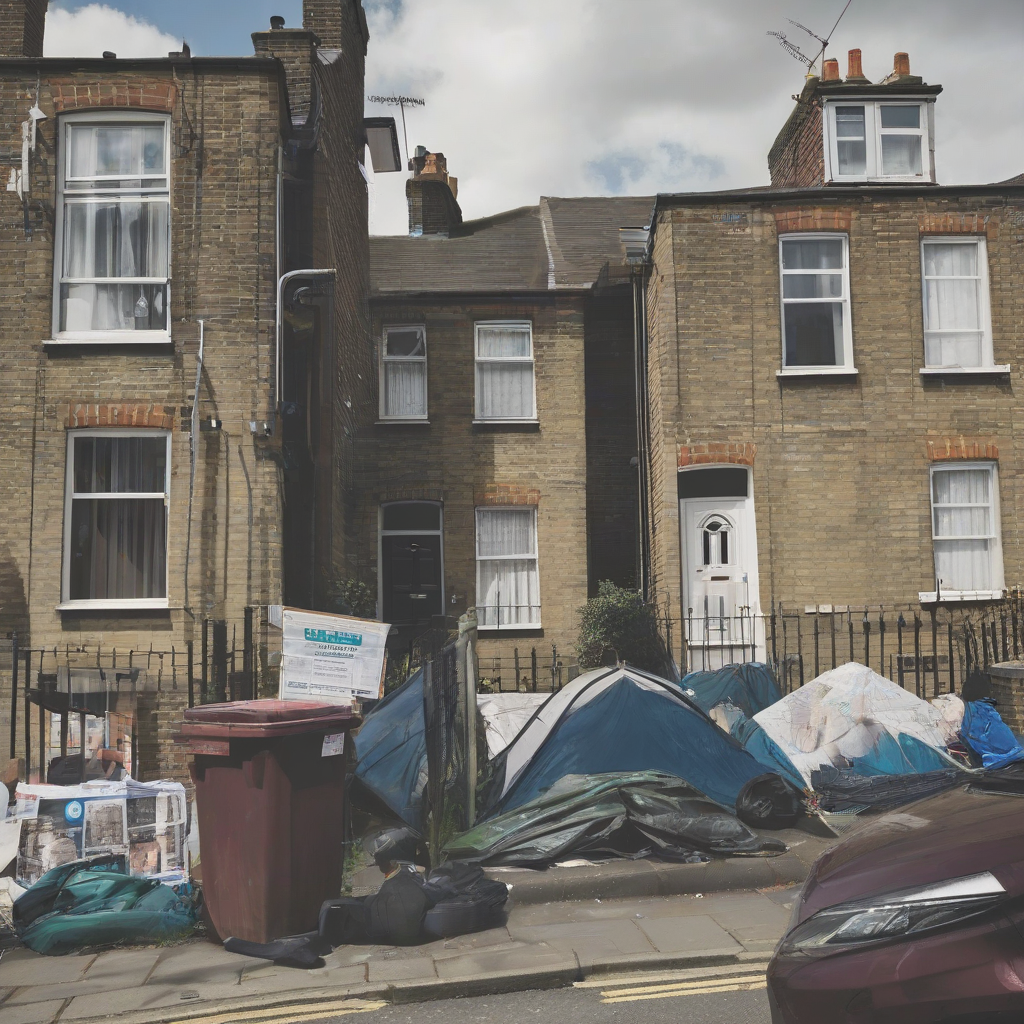
LONDON – London councils are relocating homeless families, including women fleeing abuse and vulnerable refugees, to properties hundreds of miles away in northern England in a practice that critics say is bypassing legal protections and straining deprived communities.
The number of homeless people forced out of the capital has doubled over the last two years. According to freedom of information requests, scores of families with children have been moved into cheap, sparsely furnished properties in some of the poorest regions of England, including Bolton, Blackpool and Hartlepool.
The trend is driven by a severe shortage of social housing and temporary accommodation in London, where more than half of England’s homeless population is concentrated. A 2023 report indicated that only 2% of private properties in the capital were affordable to individuals receiving housing benefit.
The Scale of Out-of-Area Placements
Official data highlights a sharp increase in the displacement of households from London, a practice formally known in government guidance as “out-of-area placements” under local authorities’ statutory homelessness duties:
- Year to March 2023: 670 homeless households moved out of London.
- Year to March 2025: Approximately 1,300 homeless households moved out of London.
Housing charities argue these figures are undercounts, as families moved into private rented accommodation under informal or short‑term arrangements often do not appear in official statistics and can be harder to track by oversight bodies and MPs.
Private Contracts and ‘Reloc8’
Several boroughs are utilizing private intermediary companies to manage these relocations, outsourcing what was once a core public housing function. Reloc8, a Derbyshire-based firm, specializes in moving homeless families out of London and sourcing landlords in cheaper housing markets in the north of England.
Financial records and contracts reveal the scale of this partnership and the fiscal pressures shaping council decisions:
- Croydon Council: Signed a £1 million contract with Reloc8 last summer, planning to move approximately 110 homeless households. The council estimates a saving of £5,000 per placement, money it says can be redirected into other stretched services.
- Enfield Council: Paid more than £894,000 to Reloc8 since August 2023. In that period, 94% of Enfield’s offers to homeless families were outside London, with 59% located in north-east England.
On its website, Reloc8 claims to have moved more than 400 homeless households out of the capital and markets itself as providing “modern and tailored house removals and clearance solutions” for residential and commercial clients.[2] The company states that it only requires landlords to provide a minimum of a cooker and fridge freezer, adding that beds may be requested in certain cases. In a statement, Reloc8 said all its properties are inspected to comply with regulations and noted it has “many success stories over the years.”
Legal Obligations and High Court Rulings
Under Part 7 of the Housing Act 1996 and the statutory homelessness code of guidance, local authorities are mandated to find accommodation within their own borough “so far as reasonably practicable” and to consider factors such as a family’s support networks, schooling and medical needs when deciding if a placement is suitable. Where accommodation is secured outside the area, the council is also legally required to notify the receiving local authority and must be able to justify why no closer option was available.
Despite these mandates, several London councils have been found by the high court to have acted unlawfully in individual cases, including failures to properly assess vulnerability, to consider children’s best interests and to give families adequate notice to challenge a move. Housing lawyers and charities allege that some authorities are now routinely flouting the law or stretching its interpretation to clear their homelessness registers and reduce long-term liabilities.
Sophie Earnshaw, a solicitor at the housing charity Shelter, said: “The law is clear: councils have a responsibility to accommodate families who become homeless in their local area – when this is not feasible, they must secure accommodation as close by as possible. Instead, some councils are paying private companies, like Reloc8, to move families up to hundreds of miles away from their local area.”
Impact on Vulnerable Populations
The practice has led to cases of extreme hardship, particularly for those with limited English proficiency, survivors of abuse and people with complex mental health or disability-related needs who rely on services in London.
In one instance, an Albanian woman who had fled a sex trafficking gang in Manchester was ordered by Ealing Council to move from west London to a property 260 miles away in County Durham. Despite her vulnerability and having two young children, the council provided her with contact details for support organizations that were actually located in Durham, North Carolina (USA) and Durham, Ontario (Canada).
The woman subsequently won a high court battle against the council, which found that officials had not adequately considered the risk to her safety or the disruption to specialist support she was receiving in London. “I was crying because I was really stressed,” she said. “I felt they didn’t care.”
Further reports indicate families are sometimes transported in one-way taxis in the middle of the night with minimal possessions and little advance information about where they are going. Jonathan Brash, the Labour MP for Hartlepool, said he had heard of families being “bundled into taxis in the middle of the night with little more than the clothes on their backs” and that local councils only became aware of their arrival when the families appeared seeking help.
Tensions in Northern Communities
The sudden influx of displaced families is creating friction in towns already struggling with housing shortages, low wages and strained public services, including schools and GP surgeries. Northern councils complain they are being treated as a “pressure valve” for London’s housing emergency without being resourced to cope.
Jonathan Brash described the practice as a “disgrace,” stating: “It is undoubtedly the case that this kind of behaviour is increasing tension in towns like Hartlepool as local people face massive challenges with housing and other public services. It is ripping at the social fabric of the community I represent.”
Other officials have been equally critical:
- Grahame Morris (Labour MP for Easington): Accused London councils of “coercion” and called for sanctions against those acting unlawfully or failing to consult receiving authorities.
- Mary Kelly Foy (Labour MP for City of Durham): Described the policy as “inhumane” and warned that it risks pitting long-standing residents against newly arrived families who have had no say in where they are sent.
- Liz Wyatt (Housing Action Southwark and Lambeth): Noted that the number of families sent from London to north-east England rose from one in 2017 to at least 38 in 2023, calling it “a systemic export of London’s housing crisis.”
Wyatt further argued that targeting non-English speakers is “totally irresponsible,” specifically noting the risk of placing refugees in areas that experienced racist riots in the summer of 2024 and where specialist legal and trauma services are limited or non-existent.
Council Responses and Policy Debate
London Councils, the representative body for the capital’s 32 boroughs, stated that most placements are in counties bordering London and insisted that out-of-area moves remain a “last resort” used when local accommodation is unavailable or unaffordable. The organization called on the government to address “unsustainable” homelessness levels, reform local housing allowance rates and increase social housing supply, and confirmed it has met with north-east council colleagues to discuss the issues and improve notification procedures.
Enfield and Ealing councils denied breaching the Housing Act, asserting that they always notify receiving local authorities and that individual cases found unlawful have led to changes in internal procedures. Enfield denied targeting non-English speaking individuals, stating it “does not discriminate” against those seeking help, while both boroughs cited a “severe” housing crisis, welfare cuts and years of underinvestment as the primary drivers of their actions.
The dispute now goes to the heart of a wider policy question facing ministers and local leaders: whether England’s homelessness safety net can still be delivered locally, as the law envisages, or whether, in practice, it has become a system that quietly moves the poorest families ever further from the places they call home.
- Urban Infrastructure Resilience: How European and Asian Megacities Are Adapting to Extreme Climate Oscillations in 2026
- UN General Assembly 2026 Framework on Autonomous Systems: International Diplomacy Faces Algorithmic Governance
- England's ADHD Review Found a Risk of Overdiagnosis, Not Overdiagnosis (daybreakwire.com)
- Fez Mayor defends council amid tax waiver and staffing crisis (archyde.com)
