
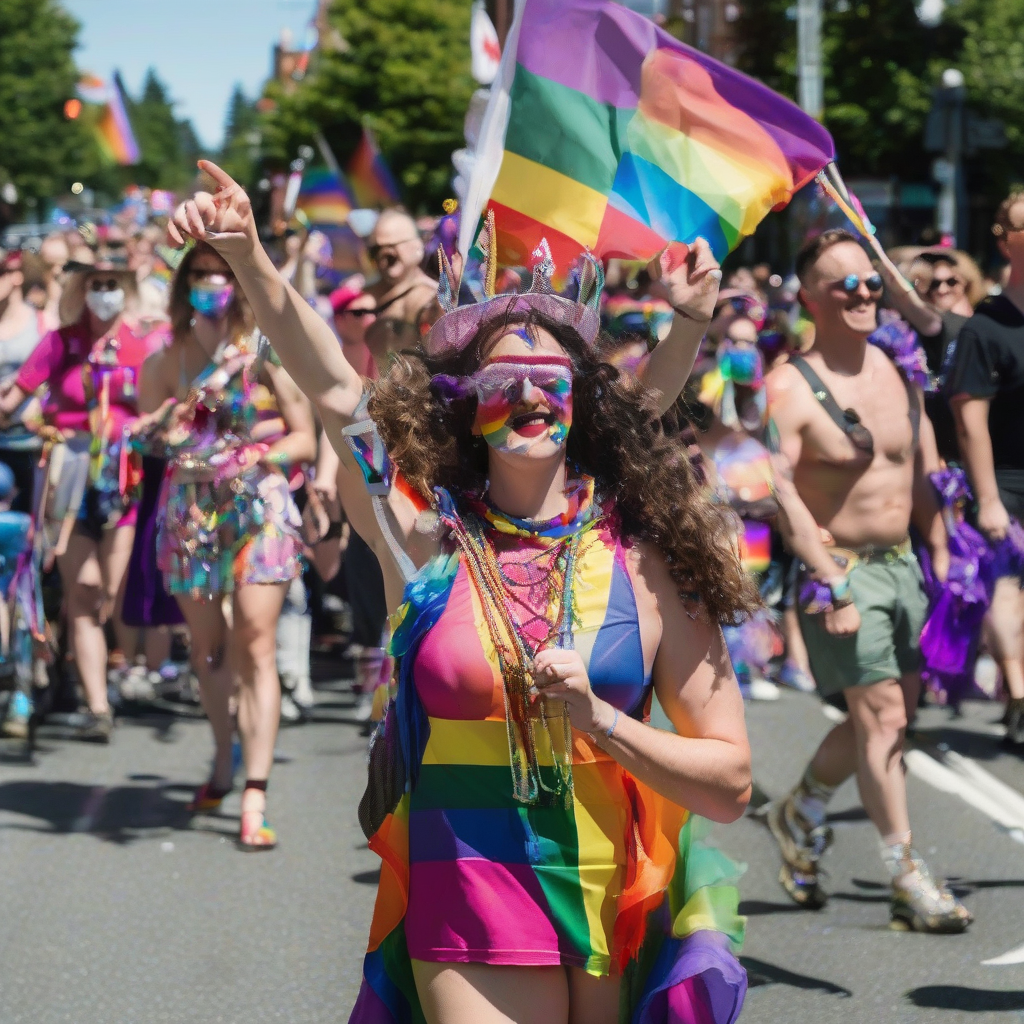
VICTORIA – The city of Victoria marked its 32nd annual Pride Parade with a large-scale celebration of community spirit and visibility.
While the event functioned as a festive gathering, the 2024 celebration carried a distinct message of unity in response to a shifting political environment across Canada. Organizers and attendees pointed to recent legislative developments in other provinces as a catalyst for renewed activism.
Legislative tensions have heightened following the introduction of Bill 9 in Alberta. The bill mandates that schools obtain parental consent before allowing students under the age of 16 to use their preferred pronouns, situating classroom gender expression squarely within a broader national debate over youth rights, parental authority and educational policy. The proposal is one of several recent provincial measures that advocates say are reshaping how schools support queer and trans students.
“It’s important to make sure we keep fighting and ensure that our rights stay today, tomorrow and forever,” said Nick DeGroot, president of the Victoria Pride Society. DeGroot said this year’s parade was framed explicitly as both a celebration and a signal to policymakers that local communities are watching how provincial and territorial governments respond to 2SLGBTQIA+ issues.
Response to Legislative Shifts
Longtime supporters of the 2SLGBTQIA+ community emphasized that current political trends make vocal advocacy more critical than in previous decades. Many referenced the evolution of Canadian legal protections – from the 1969 decriminalization of same-sex relationships to the inclusion of gender identity and expression in the Canadian Human Rights Act – as a reminder that rights gains have historically followed sustained public pressure, not arrived automatically.
Valrie Sullivan, a regular attendee of Pride events, noted that the need for visibility is urgent, “particularly for trans people who are not being given any support,” Sullivan said. She added that policy debates in school boards and provincial legislatures can feel abstract, but have immediate consequences for young people deciding whether it is safe to come out.
Bill Williamson, another longtime supporter, reflected on the slow pace of social acceptance. Williamson stated that widely accepted visibility has only been a reality for roughly the last 20 years, despite several decades of incremental legal change.
“We’re old enough to remember when you weren’t allowed to be gay, so that people would hide away,” Williamson said. “We have been active in the theatre, so we’ve always known 2SLGBTQIA people as part of the arts community.” For Williamson, the size and openness of Sunday’s crowd underlined how quickly public space can be reclaimed – and how easily, he warned, it could be narrowed again if political attention fades.
Origins of the Canadian Pride Movement
The event served as a reminder of the movement’s roots as a political protest rather than a celebration. During the 1970s, Pride began in Canada as a direct response to systemic police raids and mass arrests targeting queer spaces, including nightclubs and bathhouses. Early marches were organized not only to demand changes to criminal law and policing, but also to challenge governments’ reluctance to recognize discrimination on the basis of sexual orientation and gender identity.
These raids triggered mass protests in several major urban centres:
- Vancouver
- Toronto
- Montreal
Max Arignon, a member of the Victoria Pride Society, described the current atmosphere as a return to those foundational goals. Arignon recalled a conversation with an 85-year-old transgender individual who remarked, “sometimes it’s fun, dear, and some years it’s necessary.”
“I think pride for the last two years is really getting back to what it was meant to be, which is a place for the community to gather in times that are fun and also times that are really challenging,” Arignon said. They noted that watching policy shifts in other provinces has reinforced for many in Victoria that local celebrations remain intertwined with national debates over policing, education and health-care access.
Regional Demographic Data
The scale of the Victoria celebration reflects the city’s specific demographic makeup. According to data from Statistics Canada, Victoria has emerged as a bellwether for how municipal services, school districts and health authorities adapt to rapidly diversifying populations.
- Victoria possesses the highest level of gender diversity among all large urban centres in Canada.
- The city contains the largest proportions of transgender and non-binary people in the country.
Local organizers say those numbers translate into practical expectations: that municipal and provincial decision-makers will ensure inclusive policies in areas such as housing, mental health supports and public safety. For many marching this year, the parade route doubled as a visible reminder that the people most affected by shifts in law and regulation are not abstractions, but residents and families embedded in the daily life of the capital region.
Related reading
