
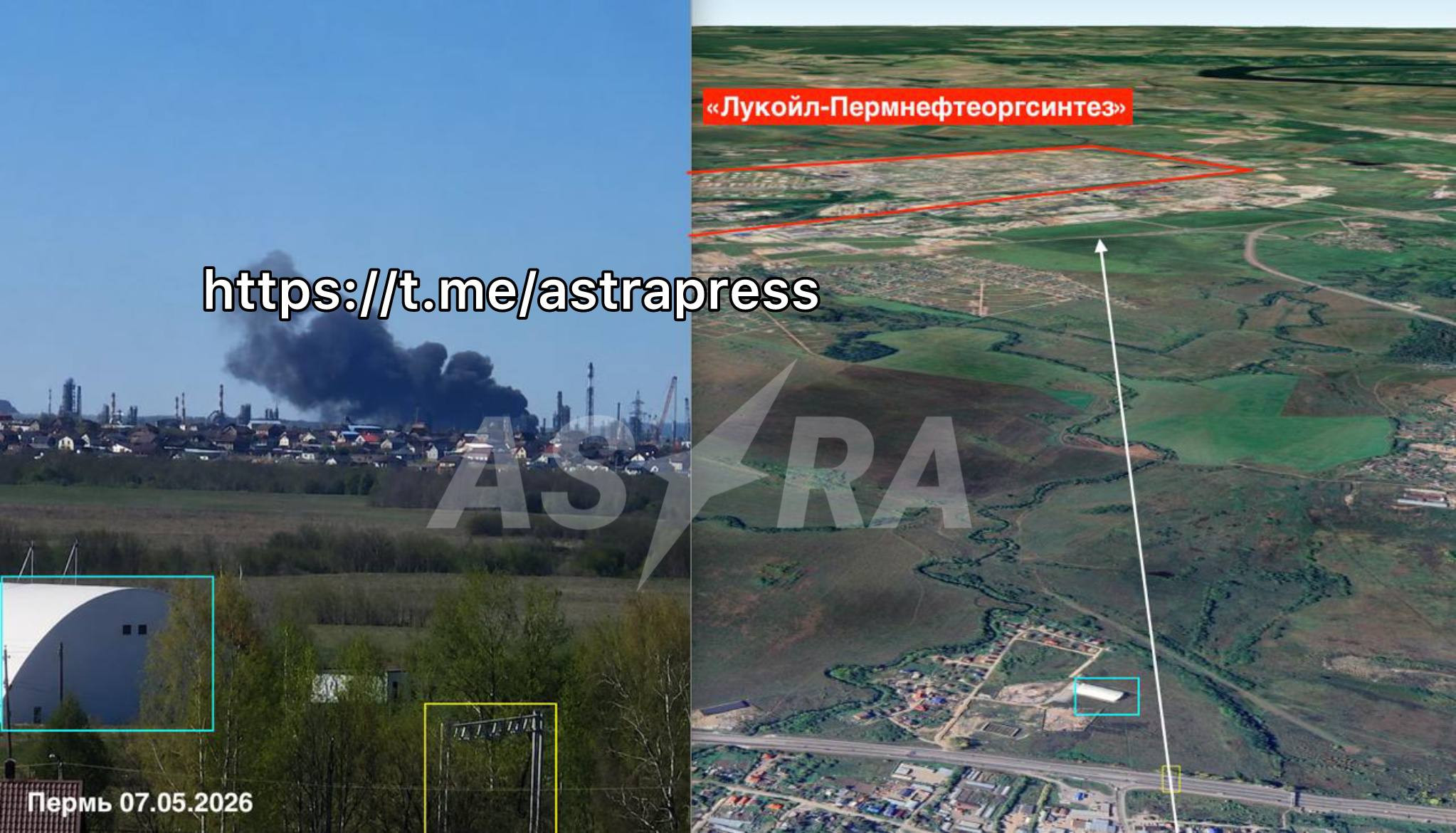
PERM – Ukrainian long-range drones struck a major Lukoil oil refinery in the Perm region on Thursday, marking one of Kyiv’s most ambitious aerial operations to date by penetrating deep into Russia’s industrial heartland.
The strike targeted facilities approximately 1,500 kilometers (932 miles) from the Ukrainian border, signaling a significant expansion of Kyiv’s reach into the Ural Mountains, the geographic divide between Europe and Asia. The operation underscores a calculated Ukrainian strategy to degrade Russia’s energy infrastructure and military-industrial capacity far behind the front lines.
Russian officials initially described the event as an attack on an “industrial facility,” but subsequent evidence and independent analysis confirmed the targeting of a critical petroleum hub. The strike coincides with a period of heightened tension over global energy prices and Russia’s reliance on oil exports to fund its ongoing military operations.
Precision Strikes in the Urals
The primary target was identified as the Lukoil-Permnefteorgsintez LLC (PNOS) refinery, one of the largest and most technologically advanced processing plants in the Russian Federation and part of Lukoil’s nationwide refining network. The facility is capable of processing over 13 million tons of oil annually, making it a cornerstone of the regional economy and a vital node in Russia’s domestic fuel supply chain.
Dmitry Makhonin, the governor of the Perm region, confirmed the breach of airspace via Telegram at approximately 11 a.m. Kyiv time.
“Today, an enemy drone struck an industrial facility in the Perm region. All emergency services are on scene. There were no casualties. Several other drones were shot down. Emergency services are working at the crash site,” Makhonin said.
Governor Makhonin later updated his report to include damage to an administrative building and an apartment complex, though he maintained that no casualties resulted from the blasts. Local authorities said emergency responders were working to secure hazardous materials and assess risks to nearby residential areas.
The operational scope of the attack extended beyond energy production. Analysis by the independent Russian outlet Astra indicated that a high-rise building struck during the raid was located only 600 meters (656 yards) from JSC UEC-STAR. This defense plant is a critical manufacturer of aircraft engine components for MiG-31 fighter jets, as well as Ka-52 and Mi-8 helicopters, suggesting the mission may have had dual economic and military objectives by pressing Moscow’s ability to sustain front-line aviation.
The incident comes as Russia’s energy sector operates under layered Western sanctions and U.S. Treasury oversight, including authorities exercised by the Office of Foreign Assets Control over Lukoil-related entities. Those measures shape how international buyers, insurers and shippers interact with Russian oil and complicate any emergency rerouting of products when a major refinery is taken offline.
Evolution of Ukrainian Drone Warfare
The strike was officially claimed by Robert “Magyar” Brovdi, the commander of Ukraine’s Unmanned Systems Forces (USF), who attributed the operation to the USF’s 1st unit – a formation Kyiv has increasingly positioned as a strategic tool for long-range precision attacks.
“Lukoil’s oil tanker in Perm was inspected on the night of May 6-7 by the Freedom-loving Ukrainian Birds of the 1st SBS unit for the remains of tanks, taps, and other units for pumping oil and its processing,” Brovdi wrote in a Facebook update, using characteristically sardonic language to describe battle damage assessment.
While official government reports remain vague regarding the specific hardware used, defense analysts and the outlet Militarnyi report that Ukraine deployed the Antonov An-196 “Liutyi” (fiery) long-range drone. The deployment of the Liutyi represents a tactical shift, allowing Kyiv to target high-value assets in the Russian interior without relying on missiles that are often subject to stricter international supply constraints, export controls and alliance-level political negotiations.
Ukrainian officials argue that such deep strikes conform to their right of self-defense under Article 51 of the U.N. Charter, while Moscow has repeatedly condemned cross-border attacks as terrorism and warned they could influence its calculus toward Western states supporting Kyiv.
The Strategy of Economic Attrition
The Perm operation is the latest escalation in a systematic campaign by Kyiv to cripple Russia’s oil refining capacity. This strategy aims to create a “bottleneck” effect: while Russia may continue to produce crude oil, its ability to refine that crude into gasoline and diesel for military and civilian use is diminished, raising domestic costs and straining logistics for units deployed in Ukraine.
The campaign has seen a rapid acceleration in scale and distance:
- April offensive: Ukraine reported striking 14 different refineries across Russia within a single month, stretching Russian air defenses across multiple regions.
- Deep penetration: Previous strikes have hit the Bashneft-Novoil refinery in Ufa (1,400 km from the border) and the Lukoil-Nizhegorodnefteorgsintez refinery in Kstovo (800 km from the border), each pushing the operational envelope further east.
- Financial impact: President Volodymyr Zelensky has stated that damage to Russian oil infrastructure has totaled approximately $7 billion in 2026, a figure that cannot be independently verified but aligns with the growing number of damaged facilities.
Ukrainian officials have suggested that these strikes serve a diplomatic purpose, providing Kyiv with increased leverage in potential future peace negotiations by demonstrating the vulnerability of Russia’s domestic economy and its dependence on a concentrated network of refineries.
The focus on energy infrastructure also interacts with Western sanctions policy, including price caps on seaborne Russian crude and refined products, by attacking not just export volumes but the physical backbone of Russia’s value-added oil industry.
Market Volatility and Revenue Offsets
The efficacy of the refinery campaign remains a subject of intense geopolitical and economic debate. While the physical damage to plants is evident, the financial impact is complicated by the global energy market and the Kremlin’s ability to re-route flows and tap budget reserves.
Russian officials claim that higher global fuel prices have actually bolstered the Kremlin’s coffers, asserting that Moscow received an additional 200 billion roubles (€2.27 billion) in oil revenues. Conversely, Ukrainian sanctions envoys argue that any price-driven gains are offset by the physical reduction in output caused by drone strikes and by the additional discounts Russia must offer to retain buyers wary of sanctions or supply disruptions.
Data from the Institute for the Study of War (ISW) provides a middle ground, noting that the Russian state has been forced to inject nearly 350 billion rubles (approximately $4.7 billion) in subsidies to oil companies to stabilize the sector. This suggests that while the Russian state is preventing a total collapse of its energy sector, it is doing so at a significant cost to its own treasury and under continuing pressure from measures such as the G7 price cap, which was designed to limit windfall gains from elevated global prices.
For policymakers in Washington, Brussels and other capitals, the Perm strike is likely to intensify discussions over how far Ukraine should be encouraged or equipped to hit targets inside Russia, and whether current export controls and financial sanctions are calibrated to take advantage of the operational shock inflicted by such attacks.
Russian emergency services remain on site in Perm to assess the full extent of the damage to the Lukoil facility and the surrounding industrial zone, while regional officials weigh longer-term disruptions to fuel supply, employment and tax revenues in one of Russia’s key industrial regions.
- Global Food Security Alliances: How Climate-Resilient Agricultural Corridors Are Stabilizing Wheat and Rice Supplies
- Cross-Border Renewable Energy Grids: North Sea and Mediterranean Subsea Cable Networks Enter Phase Two
- Trump says US will not strike Iran before midterm elections (globallypulse.com)
- Japan U18 Women Beat South Korea to Reach FIBA Asian Cup Final (archysport.com)
