
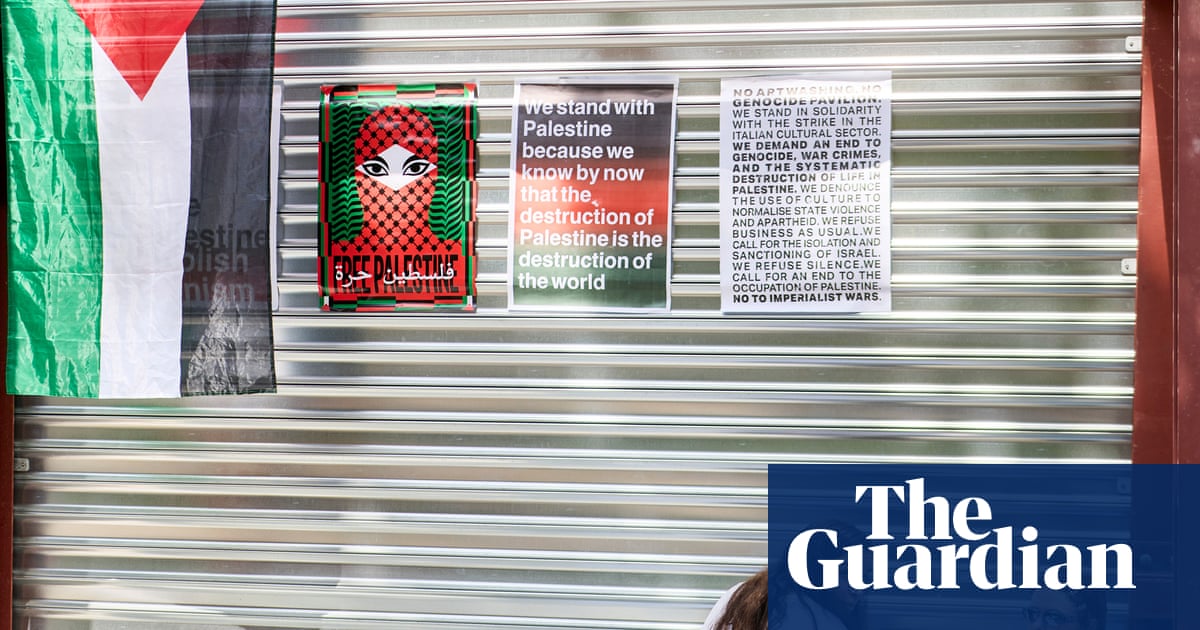
VENICE – A coordinated strike by cultural workers and artists disrupted the final day of the 2026 Venice Biennale press preview, with over a dozen national pavilions shutting their doors to protest the inclusion of Israel amidst the ongoing war in Gaza.
The unrest underscores a deepening crisis within the world’s most prestigious art institution as it struggles to navigate the intersection of cultural diplomacy and international law. The strike reflects a broader systemic tension where the perceived neutrality of the gallery space is being rejected in favor of geopolitical accountability.
The action was organized by the Art Not Genocide Alliance (Anga), which initially signaled that more than 20 pavilions would shutter to demand that Israel be barred from the event. On Friday, approximately a dozen pavilions participated in the strike, creating significant logistical confusion just 24 hours before the exhibition opens to the general public.
The impact varied by delegation:
- Full-day closures: Austria, Belgium, the Netherlands, Japan, North Macedonia, and South Korea.
- Partial or staggered closures: The United Kingdom, Spain, France, Egypt, Finland, and Luxembourg.
Visitors to the Giardini-the Biennale’s central park of national pavilions-encountered closed gates and makeshift notices. At the British pavilion, a sign informed visitors:
“Due to the Italian cultural workers’ strike today, it is not possible to open the British pavilion.”
The pavilion eventually reopened after additional staff were secured.
While some pavilions remained dark, other participating artists in the main exhibition, titled In Minor Keys, integrated political dissent into their displays. Tabita Rezaire and other artists added references to Palestine to their work, including the hanging of Palestinian flags. Posters displayed outside several pavilions read: “Palestine is the future of the world” and: “We stand with Palestine.”
The strike comes at a moment when the Biennale, founded in 1895 and governed by a publicly controlled foundation under Italian cultural law, is facing growing pressure to align its decisions with international humanitarian norms and the obligations set out in the Convention on the Prevention and Punishment of the Crime of Genocide. Protest organizers accuse the institution of ignoring those norms by maintaining Israel’s official presence while the war in Gaza continues.
Institutional Instability and Diplomatic Friction
The strike is the latest in a series of disruptions targeting the 2026 edition, highlighting the Biennale’s role as a lightning rod for global conflict and soft power. Earlier in the week, the Russian pavilion was forced to close temporarily following a protest staged by the activist group Pussy Riot, which challenged Russia’s presence at the event.
The turmoil extends beyond the pavilions to the event’s governance. The jury responsible for awarding the Golden Lion-the Biennale’s highest honor-resigned en masse prior to the opening. The jury members stated they could not consider entries from nations whose leaders were subject to international arrest warrants, a criterion that would have effectively excluded both Russia and Israel.
That stance placed the Biennale in direct tension with participating governments, which view the national pavilions as instruments of cultural diplomacy and, increasingly, as extensions of their foreign policy. With the jury gone and no immediate replacement structure announced, questions have been raised over how-or whether-the top prizes will be awarded this year, and who ultimately holds decision-making power when ethical objections collide with state participation.
This legal and ethical deadlock has trickled up to state-level diplomacy. The UK government confirmed it refused to send a minister to officially open the British pavilion, citing the organizers’ decision to allow Russia to participate in the exhibition. Diplomats from other delegations privately described hurried consultations over whether participation could be squared with their countries’ public positions on Israel, Gaza, and Russia’s invasion of Ukraine.
For the Biennale’s governing foundation, the crisis is not only reputational but structural: it must show it can manage disputes between national interests, artist coalitions, and international legal norms while preserving its mandate as a cultural institution rather than a de facto tribunal.
A History of Political Occupation
While the current protests are tied to contemporary conflicts in Gaza and Ukraine, the Venice Biennale has a long-standing history of becoming a site for political upheaval. The institution’s structure, which grants sovereign nations their own spaces within the Giardini and the Arsenale, frequently turns the exhibition into a microcosm of the United Nations, complete with walkouts, boycotts, and symbolic absences.
Past precedents of disruptive protest include:
- 1968: Student occupiers seized pavilions to demand structural reforms to the Biennale, leading to the total cancellation of the awards.
- 1970: Protests led by the Venice Communist party resulted in the suspension of the awards for a second time in three years.
Those earlier confrontations prompted the Biennale to revise its statutes and, over time, to redefine the balance between artistic autonomy and state representation. Today, national ministries of culture still underwrite most pavilions, but curatorial teams and artists have gained greater latitude to critique the very governments that fund them-a tension now visible in the decision by some national participants to strike against the inclusion of a fellow member state.
The Israeli pavilion remained closed on Friday morning, though organizers stated the closure was for a private event rather than a result of the strike. The pavilion’s status has become a focal point for activists who argue that, in the context of Gaza, official cultural representation cannot be separated from questions of state responsibility and potential violations of international law.
The Biennale opens to the general public on Saturday, with organizers insisting the show will proceed as planned. Behind the scenes, however, member states, curators, and the Biennale’s own leadership are already engaged in a broader reckoning over how one of the art world’s flagship institutions should respond when its mandate to present culture collides with the demands of international justice and the political use of national stages.
- Global Food Security Alliances: How Climate-Resilient Agricultural Corridors Are Stabilizing Wheat and Rice Supplies
- Cross-Border Renewable Energy Grids: North Sea and Mediterranean Subsea Cable Networks Enter Phase Two
- Yemen Crisis: Escalating Conflict Displaces Thousands and Disrupts Education for Children (archyde.com)
